Everything you need to know about non-qualified stock options

 

Everything you need to know about non-qualified stock options

What are Non-qualified Stock Options (NSOs)?

Non-qualified stock options (NSOs) allow employees to buy a company’s shares at a fixed price (known as the strike price), once the company releases it on the grant date (the date stock options are given to the employees). 

The stock options will be priced at a fair market value when the grant is issued at that time. This means that once the vesting period is over, the strike price will be the same as the fair market value when the NSO was granted. 

For instance, if the stock is priced for £50 on the grant date, the employee will be able to purchase the stock in the future (with expectations that the value of the stock has increased) at the same price of £50.

However, the rights over the stocks purchased can only be used after the vesting period is over, and therefore, employees would have to wait until you can exercise the options. They also have a deadline for exercising these options.

Here are some ways you can exercise your stock options:

1.     Exercise and Hold (Cash Exercise) – This is purchasing the stock options using cash at the strike price and regaining your cash once you sell your shares.

2.    Sell-to-Cover (Cashless) – The alternative method to using cash. This is immediately selling enough shares to cover the cost of exercising including commissions, applicable taxes, and any other fees. You can then either keep or sell the remaining stock. 

3.    Exercise and Sell (Same Day Sale/Cashless Exercise) - Immediately exercising and selling your shares. You can only receive net proceeds once the cost of exercising, commissions, applicable taxes, and fees have been covered.

Taxation on NSOs

Employees will still have to pay income tax on the difference with the fair market share price and the exercise price (profit made); subject to federal, state, and local income taxes as well as payroll taxes. After acquiring the options, the employee would have the freedom to either sell the shares or keep them.­­­­­

However, when proceeding with the ‘Exercise and Hold’ method, if you sell after holding the shares for one year or less; you will be taxed on the difference between the fair market price and exercise price, and the sale price will be taxed as a short-term capital gain (or loss) 

When you sell the stock options after holding for a year or more, you will be taxed on the difference between the fair market price and exercise price, and the sale price will be taxed as a long-term capital gain (or loss). This will also be applicable for the ‘Sell-to-Cover’ method.

 Glossary

Here’s a glossary to help you gain a better understanding of the keywords we’ve used throughout the article

Stock Option: The right to buy a specific number of shares of a company’s stock in the future, at a contractually specified price (Strike Price).

Strike Price: The price of your stock options that you can purchase, specified in your stock option grant.

Grant Date: Initial date that NSOs are given to you

Stock Option Grant: Specifies the maximum number of shares that you can purchase

Vesting Schedule: A waiting period until you obtain full rights of the asset and can exercise your stock options.

Expiration Date: If the stock options have not been exercised by the specified deadline, you lose all the stock options. (This is normally around 10 years)

Fair Market Price: The cost that an asset would put up for sale on the open market.

Calculating the prospective value of NSOs

You can also calculate the potential net value of your stock options by using the equation below.

Number of Shares x (Company Share Price – Exercise Price) = Net Value of Option

Advantages and disadvantages of NSOs

Advantages

  • Increased income - it allows you to buy stocks at a lower price than the fair market value and allow you to gain profit from it.

  • Flexibility - You have full control over how to exercise your stock options once the vesting period is over

  • Cashless - You may not need cash to purchase stocks as there are alternative cashless methods

  • Post-employment – The stock options can still be exercised even after you leave the company if you haven’t surpassed the expiration date

Disadvantages

  • High Tax - tax incurred from the profit made once exercised could be steep as it is considered as annual income. Also, you will be taxed as soon as you exercise and sell it

  • Risk – It is not guaranteed that the stock prices will increase and that you will gain profit from it

  • Limitations with exercise methods  Cashless exercise could also mean losing significant profits for lower-income employees; having to sell stock options immediately. With cash exercise, having cash upfront may not be affordable for some.

Summary

  • Non-qualified Stock Options (NSOs) is equity compensation method used by businesses

  • You have the freedom to exercise the stock options however they want

  • You will be taxed at exercise and sale

  • If stock options are held for a year or less, the NSOs will be taxed as short-term capital gain

  • If the stock options are held for a year or more, the NSOs will be taxed as long-term capital gain, with the rates ranging from 0 – 20%

  • There is a time frame on when you could start exercising your options, and once the vesting period is over, options must be exercised before the specified deadline.  


We hope that article has been informative, if you seek any further advice, please do not hesitate to contact us. To stay up-to-date and informed on the latest in UK tax advice, subscribe to our newsletter.


 
Daniel HeeryComment
Tax and Accounting Tips for Writers UK
 

Tax and Accounting Tips for Writers

A Guide for authors on handling their finances

1 ) Organising Your Paperwork

It seems self explanatory but finding a filing system that works for you is vital. If you don’t you will risk the chaos of sifting through all your incomings and receipts when it comes time to file your tax return.

Some steps you could take to keep organised include:

  • Keep your books up to date - Note down your incomings and their associated outgoings

  • Note down your expenses and organise their relevant receipts (there are mobile apps that can help you with this now)

  • Keep a folder of relevant documents such as claim forms if you are claiming benefits

This will not only save you time and energy but also a great deal of stress when it comes time to file your tax return!

If you have an accountant (or looking to hire one) organising your paperwork will also make the process more seamless enabling them to spend more time on finding ways to reduce your tax liability.


2) Keeping a Record of Your Expenses

We referred to this above but it is worth reiterating - organise your expenses!

The scene is set, you are the majority of the way through the filing process, the end is nigh! But wait, the HMRC are asking you to calculate and enter your expenses. You plant the palm of your hand firmly on your forehead; you have realised that the contents of that dust ridden bin bag positioned in a forgotten corner of the room contains all of your relevant receipts! Now you have to pour all of these receipts out of the bin bag and trawl through them, hoping you can make sense of when they were from and what they were for.

You may laugh (hopefully you have as it signals you are at least more organised than this), but believe me, as deadline day approaches situations like this are occurring throughout the country.

Whether or not writing is your main source of income or not – it is a great edition either way to create a record sheet or document for your expenses. It would help you to see how much you’re spending whether it’s weekly, monthly, or even annually. 

By being self-employed, you would arguably have to be careful with your expenses. A good way to do so would be by signing up to an accounting tool such as Quickbooks Online or Xero, this will help ensure that you’ve kept a record of all items purchased as well as how to run your self-employed job as a corporate would with their business. 


3) Separating Your Bank Accounts

It might seem like an obvious one – or maybe not, either way it’s a good idea to keep separate accounts, with one allocated account with a sole purpose of saving for your tax payment. This will allow you the peace of mind that you have a calculated amount set aside for your taxes, it’ll keep everything nice and clear for you. A bonus tip involves saving for your taxes from your first yearly payment, this will most likely make you over save for your taxes thus allowing you to give yourself a well deserved bonus once your tax return is done. All from your own pocket!


4) Learn About The Deductible Expenses You May Be Missing

Being aware of what you can and cannot claim on your expenses as a self-employed individual is vital when it comes time to file your tax return. Common claimable expenses include:

  • Stationery

  • Theatre and Cinema Tickets if for the purpose of research and are within the authors relevant genre

  • Courses and Conferences

  • Repairs and Maintenance relevant to the tools that a writer may use

  • Accountancy and Professional Fees

  • Reference books, CDs, journals and Newspapers if relevant

These are just a few of the expenses you may be able to claim.

It is worth noting that all expenses must be relevant to your profession. If you are unsure about a particular expense you are going to claim, our advice would be do not claim it. Instead seek the help of a professional tax advisor. You can receive very hefty fines if the HMRC find that you have claimed expenses that they deem as unacceptable.

5) Hiring an Accountant

As a self-employed individual taxes can be complex, and overwhelming. The easiest and most efficient way to file your taxes is to hire a tax professional. Not only will you save yourself a great deal of time and stress but a professional tax advisor will know every area that could be saving on your tax liability thus saving you money.


We offer affordable fees for authors, do not hesitate to Contact Us


The Budget UK 2021 Summary

What Self Employed Professionals Should Know About the 2021 Budget


What Self Employed Professionals Should Know About the 2021 Budget


Alistair Bambridge

Written by Alistair Bambridge
Partner & Founder
About Alistair


Chancellor Rishi Sunak has now announced the much-awaited 2021 Budget. Setting out the governments tax and spending plan for the year ahead.

This is without a doubt one of the most anticipated budgets yet due to the Covid-19 pandemic, resulting in higher demand than ever for government measures to help businesses and jobs recover.

This article will cover the main areas of the budget self-employed professionals need to be aware of. Below is a list of all the articles we have released to cover the 2021 Budget. Feel free to get in touch with any specific questions.


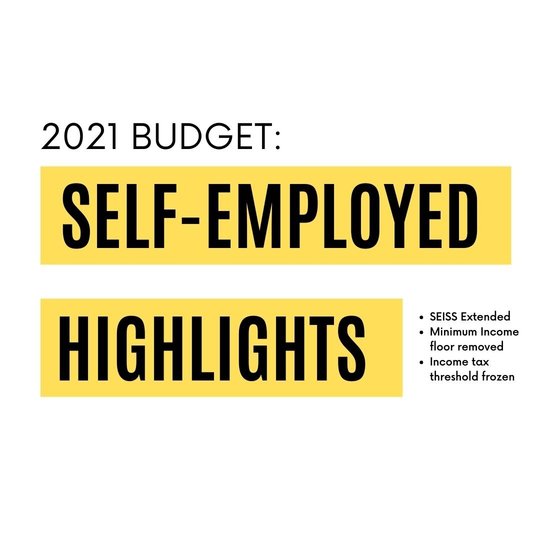
Highlights of the 2021 Budget for self-employed professionals

As expected, the Chancellor's 2021 Budget's core focus is on continued support as the UK moves towards what hopefully will be the end of the Covid-19 Pandemic this year. The Self-Employed were and are one of the worst-hit by the pandemic. As a result, the budget outlines several measures that will be of particular benefit for self-employed professionals, contractors and freelancers.


The self-employed furlough scheme (SEISS) extended to the new freelancers.

The self-employed furlough scheme (SEISS) has been extended to new freelancers and contractors who filed their first tax return for the 2019/20 tax year. Therefore over 600,000 people can now claim a SEISS grant. This is the 4th self-employment grant announced and will be followed by a 5th SEISS 5.

Although many are relieved to hear they will be receiving support, there is a lot of concern around the date to which the grant will be released: "Late April". One of our clients, a self-employed Yoga Teacher, has stated that the "delayed date is a massive blow and shock. It will be a real struggle financially making it to the end of April- hopefully, something changes".

Minimum Income Floor Removed for Self-Employed on Universal Credit

The minimum income floor for Self-Employed individuals on universal credit has been removed. This will be in place until late August.

The minimum income floor is a controversial system used to calculate Universal Credit Payments for Self-Employed Professionals.

Many will welcome the continued removal of the minimum income floor, as those who are not entitled to the Governments financial support scheme can instead receive Universal Credit.

Income tax thresholds frozen

The Income Tax Thresholds will be frozen until 2026. Over raising income tax, Sunak has favoured the method of "fiscal drag". This is a deflationary effect; as wages rise, a higher proportion of income is paid in tax.

Below is a great explanation of fiscal drag for those wanting to understand the topic further


The UK 2020/21 tax filing period will begin in April. Contact Us to receive our April filing discount. We are chartered UK tax advisers and accountants for self-employed professionals.

What does the 2021 Budget means for the creative industry?


What does the Budget 2021 Mean for the Creative Industry?


Alistair Bambridge

Written by Alistair Bambridge
Partner & Founder
About Alistair


Following on from our article "what self-employed professionals should know about the 2021 budget", we will be delving into what the budget means for the Creative Industry and Creative Freelancers. As an accountant specialising in creatives, how the 2021 Budget will support creative industry professionals back to the full prosperity of pre-covid years was highly anticipated.

This article will cover some of the main areas of the 2021 Budget announcement that creative industry professionals and businesses should know about.

We are also covering several other areas of the budget in the articles below:


How is the Budget going to help the creative industry?

The creative industry was one of the worst-hit by covid-19, with around £74billion and 2.7 jobs in 2020. Therefore many have been waiting for the 2021 Budget to lay out how it will pave the creative industry back to health.


£300million to be injected into the Cultural Recovery Fund

£300million is to be added to the £1.7billion Cultural Recovery Fund.

The Cultural Recovery Fund will provide financial support for music venues, museums, independent cinemas, galleries, theatres and heritage sites throughout the UK.

The Culture Secretary, Oliver Dowden, said

"It's a relief we can look ahead now, so this funding is not just about survival, but planning and preparing for reopening theatres, galleries and gigs."

Although many are happy with the creative industry cash injection- there is a large call out from the community for the fund to be extended to freelancers.


£90million injected into National Museums

An additional £90million to be invested into national museums to support them until their reopening in mid-late May.


£18.8 million to be injected into community projects

£18.8million to be invested in cultural community projects.

These projects include £5million to transform part of Wakefield High Street into a community library, museum and gallery space.

Scotland, Wales and Northern Ireland will receive an additional £77million to provide cultural groups with similar support.


Film and TV Production Restart Scheme extended.

The Film and TV Production Restart Scheme have been extended until December 2021. With a £500million fund, it has accepted 160 qualifying productions to date, and according to the government, saved 20,000 jobs.


"Elite Point-Based Visa" and Reform of the Global Talent Visa

Research has shown that the Creative Industries' gaps are more likely to be in higher-level occupations' such as architects and graphic designers. Part of the reason being is thought to be due to inadequacies in the current immigration system.

The 2021 Budget announced an elite points-based visa and a reform of the Global Talent Visa. These policies aim to attract and retain "the most highly skilled globally mobile talent". Depending on how these reforms are designed, they may support the creative industries demand for change.


Creative industry listed in Levelling-Up Fund

Creative Industry included in Levelling-Up Fund.

Maintaining and expanding the UK's world-leading portfolio of cultural and heritage assets included as a priority.

Details of plans:
  • Upgrading and creating new cultural and creative spaces such as sports or athletics facilities, museums, art venues, theatres, libraries, film facilities, prominent landmarks or historical buildings, parks or gardens.
  • New, upgraded or protected community hubs, spaces and assets (and associated green spaces)
  • Acquiring and refurbishing key cultural and heritage sites, including hotels and historic buildings

The Recovery loan scheme

The Recovery Loan Scheme will be available to creative industry businesses. The new loan scheme is designed to support UK business access to finance as they grow and recover from the disruption of Covid-19.


The Towns Fun extended to a further 45 Areas.

£1billion to be invested in 45 towns to help the country recover from Covid-19. The fund will be dedicated to cultural and infrastructure projects.

For further information on support available to freelancers, the 2021 Budget for Self Employed article


No Government-backed Insurance Scheme announced yet.

A Government-backed insurance scheme is yet to be announced.

Without which many creative companies will not be able to stage events due to the risk of losses from cancellations as a result of Covid-19


Contact Us for expert tax, accounting and business advice for creative industry businesses and professionals.

Prospective Homeowners Guide to the 2021 Budget


Prospective Homeowners Guide to the 2021 Budget


Alistair Bambridge

Written by Alistair Bambridge
Partner & Founder
About Alistair


The 2021 Budget is out, and we are covering all areas. This article will be covering the need-to-know facts for prospective homeowners and landlords.


WHAT THE 2021 BUDGET MEANS FOR THE PROPERTY MARKET

STAMP DUTY HOLIDAY EXTENDED.

The stamp duty holiday has been extended for housebuyers up until the end of June. The stamp duty holiday has saved homebuyers around £5billion collectively in stamp duty so far. This tax break helped drive a boom in property prices last year, and clients' comments lead us to believe the incentive will lead to continued interest.

One of our clients, a self-employed musician, commented:

"I wanted to buy last year, but I couldn't find the right property. Because I knew stamp duty holiday was coming to an end, I was going to renew my rental agreement- however, now I have more time, I will be getting back to looking for a property."

This will be welcomed by many who are currently on the hunt for a property.

The Stamp Duty crystallises- therefore, home sales must go through before the end of June to be eligible for the tax holiday.

Is it all good?

One of the key concerns with the Stamp Duty Holiday and corresponding stamp duty holiday extension is that although it has boosted the property market and the economy generally, it has also created an artificial bubble that has seen house prices rise 8.5%. This means that first time buyers have to save more to come up with the deposit.

There is also a risk that prices have been artificially inflated and will go down when the holiday ends. This means that those who brought during the stamp duty holiday period may find they have overpaid, potentially negating any savings made from not paying stamp duty.


GOVERNMENT-BACKED 5% DEPOSIT MORTGAGES

Government-backed mortgages with deposits of just 5% have been announced. This is a huge win for many first time buyers who previously have been required to save between 10- 25% of a properties value to acquire a mortgage.

This will help counteract the effect of increasing property prices.

The government is set to guarantee loans, enabling lenders to offer mortgages worth up to 95% of a properties value work up to £600,000. This means that 86% of properties currently listed on Rightmove should be eligible for the mortgages.

Is it all good?

One thing to look out for with these new mortgages is the interest-rates. We don't know yet what terms banks will be offering; however, higher interest rates than typical can be expected. Although the government is offering a shoulder to hold the majority of risk associated with low-deposit mortgages, banks will still be liable for some of it. Therefore banks are likely to offset the risk by making borrowers pay higher interest rates.


UNIVERSAL CREDIT UPLIFT

An extension to the temporary £20 per week increase to Universal Credit standard allowance for a further six months. This applies to all new and existing claimants and will maintain the higher surplus earnings threshold of £2,500 for Universal Credit Claimants for a further year until the end of the 2021-22 tax year (April 2022).

Landlords argue that this does not tackle the fundamental issues that make Universal Credit inadequate for both tenants and landlords in the Private Rental Sector (PRS). One of our landlord's clients has argued it would be better if tenants had a choice to elect whether the housing element of their Universal Credit is paid directly to their landlords.

Another argument is that all claimants should choose how regularly the Universal Credit is paid to help with budgeting.


Contact Us for expert property tax, accounting and business advice for landlords and prospective buyers.

FILE YOUR 2020-21 PERSONAL TAX RETURN WITH US IN EARLY APRIL TO RECEIVE OUR "EARLY UK TAX FILERS" DISCOUNT. WE SPECIALISE IN BOTH UK AND US TAX AND ACCOUNTING MATTERS.

What Does the 2021 Budget Mean for High Net Worth Individual's: The 5 Year Freeze


What Does the 2021 Budget Mean for High Net Worth Individual's: The 5 Year Freeze


Alistair Bambridge

Written by Alistair Bambridge
Partner & Founder
About Alistair


This article will cover some of the main areas of the 2021 Budget that may affect High-Net-Worth individuals, resident in the UK.

Other areas we are covering:

What Self-Employed Professionals Need to Know About the Budget

Prospective Buyers Guide to the 2021 Budget 

What the 2021 Budget means for Corporates 

Areas of the 2021 Budget that are aimed at supporting minorities  

How the Budget will affect mutual funds and the stock market

What the 2021 Budget means for the creative industry

In the Chancellor’s speech, Sunak confirmed that there will be freezes in income tax thresholds, as well as freezes in the pension lifetime allowance, capital gains tax (CGT) and inheritance tax (IHT), utilising the ‘fiscal drag’ method. This is a deflationary effect; as wages rise, a higher proportion of income is paid in tax.

While the majority of HNW individuals have a gross income in excess of £125,000, therefore unaffected by the five-year freeze in the personal allowance, the freeze in tax thresholds will see their income tax liability rise over the period. As HNW individual’s income rise with inflation, a higher proportion of their income will be taxed at the upper and additional rate band, increasing their tax burden on the 31st of January.

A simple way for HNW individuals to reduce their tax is through pension contributions (extending basic rate and upper rate tax thresholds). However, on Wednesday the Chancellor confirmed that the lifetime allowance for pensions would be frozen at £1,073,100 until April 2026 (reversing the original plan to increase the allowance with inflation). Where HNW’s have to pension savings above this, extra tax penalties are incurred, either 55% or 25%.

Although the majority of HNW individuals have their personal allowance reduced to zero, the freeze in the CGT allowance will have an impact on High-Net-Worth investors. As individuals are limited to £20,000 annual Individual Savings Account (ISA) allowance per year, many HNW’s have investments outside of tax shelters. As share and property prices rise in the next five years (with inflation), High-Net-Worth’s will therefore be exposed to a further 20% / 28% tax on their gains, increasing their tax liability in ‘real terms’.

Finally, the Inheritance tax threshold will also stay frozen at £325,000 per person. This has not changed since 2009. Each individual has a tax-free allowance – ‘nil-rate band’ – of £325,000. If they are giving away their private residence to a direct descendant, there is an additional allowance for ‘the residence nil-rate band’ of £175,000. However, for HNW individuals with an estate over £2m, this is tapered by £1 for every £2 over. With yet another 5-year freeze (taking us to 2026), HNW individuals estate’s will be subject to a further 40% tax, as house prices and wealth levels rise. Legal inheritance rax planning is one of the easiest and most beneficial ways to lessen the tax bill caused by the new stealth tax (taxation levied in a covert or indirect manner) which has been introduced.

Contact us for more expert tax, accounting and business advice for high net worth individuals. We are a chartered, personal tax accountants specialist in private wealth and HNW matters

How the 2021 Budget Will Affect Investments and the Stock Market


How the 2021 Budget Will Affect Investments and the Stock Market


Alistair Bambridge

Written by Alistair Bambridge
Partner & Founder
About Alistair


Chancellor Rishi Sunak’s new 2021 Budget’s main aim is to restart the UK’s economy after lockdown. The new Budget has a lot more detail relating to personal finance and investing than last year’s budget. This article outlines how some of the key measures will affect your investments and the stock market.

Tax Changes For Investments

The chancellor has set out a plan to raise corporation tax to 25% from 1 April 2023, which will only apply to company profits above £250,000. Multiple reports suggest that the rate will be gradually lifted across the course of the parliamentary term, which is therefore somewhat higher than investors might have been expecting.

Companies who have profits below £50,000 will remain at the current 19% rate, with a taper introduced up to £250,000. According to the Chancellor, this means that 70% of companies will remain ‘completely unaffected.’

These tax increases will have clear consequences for investors in domestic UK stocks since corporate earnings are declared after the deduction of tax. Therefore, the rise in taxes will reduce profit expectations from 2023 onwards, reducing companies’ capacity for buybacks, dividends, and debt repayments.

The revision in tax forecasts can also hurt the net present value of assets as a higher discount is placed on the future value of cash flows. The Chancellor’s most interesting announcements, especially for corporate boards, is what he has called the ‘super deduction tax. This will enable finance officers to offset the total cost of capital investments plus an additional 30%, against their tax bills.

This tax which will be in place for the next two years is a huge incentive for companies to spend their way out of the crisis and it seems to be designed to cushion the blow for companies’ future spending plans and cash flow management, brought on by the corporation tax increase.

Furthermore, it is not immediately clear whether investments will extend to intangible or other hard-to-value assets. But overall, this can be a large incentive for growth-focused UK stocks, with the OBR suggesting that these measures can lead to a 10% boost in investments, which is equivalent to more than £20 billion a year.


ISAS and Pensions

As well as holding basic and higher tax thresholds until April 2026, the Capital Gains tax allowance was forecasted to be cut as a part of a wider wealth tax’ on investors, but like the other allowances, it has been frozen at £12,300 until April 2026. ISA allowances have also been frozen at £20,000 for adult ISAs and at £9,000 for junior ISAs.

The Pension Lifetime Allowance (LTA) will also be frozen at £1.07 million, for the same period. There is some criticism on the move being a ‘tax on good investment decisions’ and the head of pensions products at Fidelity International, James Carter, says there needs to be a full review on pensions and tax. According to Carter, there are already significant savings gap and uncertainty in the pension’s taxation regime can damage people’s engagement in planning for retirement.

According to the chief executive of Wealth Club, Alex Davies, the LTA freeze is a huge blow to more wealthy pension savers which means that people will need to look beyond pensions in order to build large retirement pots. He also states that this is likely to motivate more sophisticated investors towards Venture Capital Trusts and Enterprise Investment Schemes, which have not been affected by the latest Budget changes.


UK Stock and Green Bonds

The Budget also demonstrates how the UK government is hoping to cash in on the demand for sustainable savings with the launch of a green savings bond through NS&I. The green bonds offer a winning combination of helping investors support green projects and at the same time protecting them with the strength of the NS&I name.

The green bonds come with 100% government backing, which should help the UK hit the target of being net-zero for carbon emissions by 2050 and creating green jobs. Although at the current moment it is unknown what the green bonds will run for or what rate they will pay, there is hope that the NS&I will take this opportunity to offer something very lucrative to investors. The government expects to issue £15 billion in green bonds this financial year, further details to follow in June.

The Chancellor also mentioned a review on UK share listings that will have an impact on retail investors. This is known as the ‘Hill Review’ and the changes within it are designed “to make the UK the best place for high-growth, innovative businesses to publicly list”. It could make changes to how many shares in a company are available to the public and lead to smaller companies to list. The chief executive of Stanhope capital, Daniel Pinto, says that the current listing rules are stuck in the past and leave London on the back foot against other financial centres. He said the “City should no longer be synonymous with big banks and FTSE 100 companies. It should become the financial centre of choice for SMEs and fast-growing businesses”.

Contact Us For expert tax, accounting and business advice for Investors

How the 2021 Budget Will Help Equality and Diversity


How the 2021 Budget Will Help Equality and Diversity


Alistair Bambridge

Written by Alistail Bambridge
Partner & Founder
About Alistair


The economy has taken a huge hit as a result of the Coronavirus pandemic, with very few jobs being offered to those job hunting and others losing the jobs that they had. Nevertheless, the new 2021 budget that has recently been introduced by the government plans to pave people’s ways back into the working world. 

There’s still the question of how it might help minorities, such as people from BAME backgrounds, or anyone a part of the LGBTQA+ community, and women in general. They actually stated that they make recommendations for investments and policies to promote gender equality for women in all their diversity in the recovery from Covid-19. 

This article will cover some of the different government legislations that could benefit equality and diversity. We have also covered the following 2021 Budget topics:

What Self-Employed Professionals Need to Know About the Budget

Prospective Buyers Guide to the 2021 Budget 

How will the 2021 Buget affect High-Net Worth Individuals?

What the 2021 Budget means for Corporates 

How the 2021 Budget Will Affect Investments and the Stock Market  

What the 2021 Budget means for the creative industry

Although there is no substantial legislation for those with disabilities, BAME or LGBTQA+ communities, there are several budget changes that could improve equality and diversity. Most prominently, there are many ways that businesses may be able to employ Budget to work towards improved equality and diversity standards. For example, 35 of the UK's major environmental organisations collaborate on an employment scheme to diversify the sector further. The increased funding for apprenticeships announced could be used to support these efforts further.


Stamp duty holiday extended and 5% mortgages

Evidence has shown that Black families struggle more to get on the property market, this is due to a number of issues that extend far beyond getting a deposit together. However, the Stamp Duty Holiday and 5% mortgages could indeed assist those who already have savings or who are on income that will allow them to afford a 5% deposit before the end of June.

The extent to which this will really help can be disputed, the stamp duty holiday has sent property prices through the roof meaning that an above-average income and larger deposit is still required.

For more on the 2021 budget and what it means for those buying a property in our "Prospective Homeowners Guide to the 2021 Budget"


Helping BAME businesses recover from Covid-19

Evidence shows BAME businesses have been incredibly hard by the coronavirus pandemic. This is thought to be due to the higher sickness and mortality rates Covid-19 has had on the BAME communities. There is a demand for increased grants to help such businesses get back on their feet and grow. 

Again, although there is no legislation specific to BAME businesses there have been a number of grants and exemptions made available to businesses in the 2021 Budget.

Some of the opportunities include the Kickstart Scheme, which allows corporates to hire people that they would only have the pay minimum wage, but is a beneficial factor for both them and the employee, as they’re able to give those struggling to find a job because of the pandemic, a chance to put get the foot into the career path they’re looking to get into. BAME business will also be giving those from a BAME background more equal opportunities.

Chancellor Rishi Sunak also confirmed the Government’s decision to boost incentive payments for businesses to hire apprentices of any age. He also said the Government would invest £126 million “to triple the number of traineeships.” Meaning that BAME businesses will be able to hire more people.


Equal opportunities for employment in 16-24

There has also been a kick-starter scheme that has been introduced that aims to help those ages 16-24 to avoid long-term unemployment. It works by offering a person between the ages of 16-24 to work as an employee and be paid minimum wage, allowing them to work during the pandemic. This scheme is probably the one that has been a great advantage for people between that age gap across the UK as unemployment has been a huge problem for the country, especially for those trying to find their way into the working world. 

It creates an equal opportunity for those between 16-24 because when you're competing with new graduates, people with a few years' experience who lost their jobs during the pandemic and even people with 10+ years' experience, it can be extremely overwhelming and difficult to find a job. The scheme introduces a new way of giving people a chance to learn without needing a certain amount of experience but gives them a chance to land a permanent position at the end of the scheme. Many companies have hopped on board to open positions for those who are actively looking to be employed to avoid long-term unemployment. 

Although it’s an amazing opportunity for those between 16-24, training providers are concerned that the new scheme will replace apprenticeships for young people – stating that those who take part in the Kickstart Scheme will not be able to be apprentices, claiming that “those furthest from the jobs market, are at risk of never entering it”.


Equality for women and the 2021 budget

In a speech by the Minister for Women and Equalities, Liz Truss, set out the Government's latest approach to tackling the inequality between men and women across the UK, held on the 17th of December. The speech, which was called the 'New Fight for Fairness,' explained the current problem with the debates around equality in the UK. She went on to explain why "now is the time to root the equality debate in the real concerns people face."  For women, one of the briefings includes a budget for women and employment. Research shows that women are the majority of employees’ industries with some of the highest Covid-19 job losses, including retail, accommodation and food services. Therefore, women have outweighed men by being furloughed all across the UK; it's taken a huge impact on young females, especially, who are new graduates or even just finished secondary school. 

Rishi Sunak has extended the self-employment income support scheme (SEISS) to the end of September, benefiting self-employed females. As well the extension of the self-employment income, he announced the furlough scheme would also be extended until September.


Support for those with Disabilities

The Departments for Work and Pensions (DWP) confirmed that the State Pension will rise by 2.5% this year, and benefits by 0.5% starting from April. This includes Disability Living Allowance (DLA) – the highest being £89.60 (from £89.15) and the lowest being £23.70 (from £23.60).

As for work grants, people with disabilities are able to get a grant. A work grant helps to motivate and help a disabled person to stay at work, or to start working. They also have the option of talking to their employers about changes they must make in the workplace that could make it easier for them if they have a physical disability for example. They can then apply for a work grant via gov.uk

To apply for one, the person applying needs to be a resident in the UK, have a disability or long-term health condition, or mental health condition and are aged 16 and over.

Contact us for bespoke business, tax and accounting advice for self-employed professionals

Daniel HeeryComment
Mutual Funds and how they are taxed in the UK

Mutual Funds and how they are taxed in the UK


Mutual Funds


Alistair Bambridge

Written by Alistair Bambridge
Partner & Founder
About Alistair


Mutual funds are a very popular choice for investors. There are around 12,000 mutuals funds in the UK alone, as a result making decisions as a prospective investor can be extremely overwhelming. This article will break down the basics of what a mutual fund is, how they work and the different types. At the end of the article, we will also be covering the UK tax implications of holding mutual funds.


What are mutual funds?

Mutual funds are pools of money collected from various investors, usually for the purpose of investing in stocks, bonds, and other securities. They are typically managed by professionals and owned by a group of investors. That is to say, a mutual fund is a collection of securities owned by a group of investors which are managed by a fund manager.


How they work

When you purchase a mutual fund, you are ultimately pooling your money with that of other investors. Therefore, the money that is pooled together by you and the other investors is managed by the fund manager who invests in different financial assets and manages it on a daily basis.

Different types

  1. Equity Funds
    Equity funds invest in stocks and the different types specialise in different areas, such as, value stocks, growth stocks, small-cap stocks, mid-cap stocks, and large-cap stocks, or a combination of all these.
  2. Money Market Funds Money market funds invest in short-term fixed-income securities. Such as, Treasury bills, government bonds, commercial paper, and certificates of deposits. These types of investment have lower risk, but also a lower potential return than other mutual funds.
  3. Fixed Income Funds
    Fixed income funds buy investments which pay a fixed rate of return by focusing on getting returns coming into the fund primarily through interest.
  4. Index Funds
    Index funds aim to track the performance of a specific index. For example, the S&P, or the FTSE 100 index. Therefore, the movements of index funds move as the index moves, when the index goes up the index funds go up and vice versa. These funds tend to be popular as they require lower management fees compared to some of the other funds, due to the managers not needing to do as much research.
  5. Balanced Funds
    Balanced funds invest in a mix of equities and fixed-income securities- usually a 40% equity 60% fixed income ratio. These funds aim to generate higher returns while mitigating risk through fixed-income securities.

Benefits

Mutual funds are managed by a professional who is constantly monitoring the fund’s portfolio. As well as, the manager of the fund can devote more time to selecting investments than a retail investor would. They also allow for investment diversification by the funds investing in various asset classes and not just a single stock or bond. Furthermore, mutual funds possess high liquidity. In other words, you are able to sell your mutual funds within a short period of time if needed.


Disadvantages

Mutual funds usually charge high management fees and operating expenses (MER), which can lower your overall return. In other words, if the fund posted a 1-year return of 10%, the MER would lower this return. Due to mutual funds being managed by a manager, there can be said to be a loss of control. When you invest in a mutual fund you are ultimately giving someone else your money and they are managing it for you. Furthermore, mutual funds do not guarantee returns. In fact, a vast majority of mutual funds fail to beat major market indexes like the FTSE 100 or S&P 500. Lastly, mutual funds are not insured against losses.

Largest Mutual Funds – Globally

  1. Black Rock Funds
  2. Vanguard
  3. Charles Schwab
  4. Barclays
  5. Fidelity Investments
  6. State Street Global Advisors
  7. JP Morgan
  8. Capital Group
  9. Amundi Asset Management
  10. PIMCO

Source: Mutual Fund Directory

Mutual Funds and Tax in the UK?

Everyone, including children, have an annual capital gains tax (CGT) exemption, which amounts to £12,300 (in the 2020-2021 tax year. This means that any gains realized within this amount incur no tax. Gains over the annual exemption are charged at 10%-20%, depending on all your income.

You can offset any losses against gains. That is, losses and gains that are realized in the same tax year have to be offset with each other, and this will reduce the amount of gain that is subject to tax. Furthermore, if you incur more losses than gains, these can be carried forward to offset against gains in the future, provided you register those losses with HMRC.

Since your rate of CGT is dependent on your income tax band, reducing your income tax rate can have a knock-on benefit on your CGT. Some simple ways to reduce your taxable income are through pension contributions or charitable donations.

The current ISA yearly allowance is £20,000 and all those personal capital gains are tax-free on ISA investments. Using this as a form to relieve some of the tax on capital gains from your investments in a Mutual Fund.

When you invest your money in a multi-asset fund, you are not personally liable for any gains made when the fund itself sells holdings, since this is the fund trading rather than you. However, you may be liable to CGT on any gains when you sell your shares, after taking annual allowances into account.

Something else to think about is that it is possible that over time you to build up capital gains that are in excess of your annual CGT exemption. In order to reduce this risk, you may use your annual allowance to sell at least part of the holding at the end of the tax year and then buy it back. By doing so, you basically reset the cost of your holding at a higher level and therefore reduce the potential profit against which your future CGT liabilities will be calculated.

However, tax rules mean that you have to wait 30 days before you are able to buy the same holding back. Therefore, if you are not comfortable with this ‘out-of-market risk, you could also consider investing in an exchange-traded fund (ETF) that offers similar exposure in the interim.

Contact us for expert tax advice for Social Security Benefits

Daniel HeeryComment
RSUs and other Stock options - How Do They Compare?

RSUs and Stock Options - How Do They Compare?

Author: Uk Tax Associate Molly Smith

Many companies offer stock-based incentives and compensation to their employees, in the form of Restricted Stock Units (RSUs). It is a simple way to increase morale, while also incentivizing employees to put maximum effort into their work, and see the stocks they have accrued, appreciate in-value. Simply put, these workers own a small part of the business, thus giving them a vested interest in the business’ success. But what are the pros and cons of this kind of incentive? Not to worry, keep reading and you are sure to find out.

Restricted Stock Units

RSUs are company shares given to employees by their employer as a form of compensation or incentive. RSUs come at no initial cost to yourself, they do, however, need to be left to vest over a certain period. For example, if your company offers you 500 Shares on an RSU basis over 5 years, once that 5-year period is over, you will acquire the shares at no cost.

Problems may arise if you wish to leave the company before the designated 5 year period has ended. If you did decide to do this you could lose your entitlement completely to the RSUs. This is not the only condition placed on the shares fully vesting and you may have to also meet other conditions. They could be locked-behind performance-based targets and any other perceivable parameter that said company decides.

Another common misconception is the wrongful understanding of no Initial cost. While it is correct, you are not paying for these shares, you will not receive all the proceeds from these shares. For example, if your company is giving you 100 shares after 2 years and they are valued at £20, the misconception is that you will receive £2,000. This is incorrect as RSUs, once vested, are subject to income tax and must be declared, so a portion of your shares will have been sold before you have seen the proceeds at all.

Stock Options

Stock Options, much like their counterpart, are also a form of compensation or incentive to employees. A stock option is a window of time that employers will grant to employees, to purchase stocks at a reduced price. The goal being, the company to grow so that the market price is greater than the employee accessible price agreed upon. For example, an employee may have the option to purchase shares at £20 per share for 6 months, in that time, if the market price of these shares rises to £25, the employee can take advantage of this. However, if the price remains the same, or falls below the employee accessible price, the stock option is rendered useless. The employee could also wait too long, letting the stock option expire, leaving them unable to purchase at the given price.

Summary

You have two incentivizing strategies, both with benefits and drawbacks. Both are used to drive productivity and work toward a higher share price. Your choice between the two may be determined by your future plans and your financial position. Either way, both options give an opportunity for returns and should be considered, given that they are offered.

Any Questions

You have two incentivizing strategies, both with benefits and drawbacks. Both are used to drive productivity and work toward a higher share price. Your choice between the two may be determined by your future plans and your financial position. Either way, both options give an opportunity for returns and should be considered, given that they are offered. Contact Us

Daniel HeeryComment
Everything You Need To Know About Abridged Accounts

EVERYTHING YOU NEED TO KNOW ABOUT ABRIDGED ACCOUNTS WHAT ARE ABRIDGED ACCOUNTS?

Author: Uk Tax Associate Molly Smith

WHAT ARE ABRIDGED ACCOUNTS?

Abridged accounts were introduced in 2008 and are a simplified record of a small company’s accounts. Some financial specifics that are included in full accounts can be excluded from the financial statements, balance sheet, and profit and loss statement, when finalizing abridged accounts. Abridged accounts help small businesses make it more difficult for the public to gain a perception of the company's performance from Companies House.

Abridged accounts are slightly more detailed than the abolished abbreviated accounts.

WHAT ABRIDGED ACCOUNTANTS INCLUDE

Abridged accounts do not include a breakdown of items on the balance sheet; it is not essential to include a breakdown of debtors, creditors, and fixed assets. Due to this, the account’s corporation tax figure is not displayed.

Abridged accounts must include the simplified balance sheet and profit and loss statement, along with any notes the company wishes to disclose. Without this breakdown, it is not possible to approximate a company’s net profit or loss.

If you have abridged accounts, they will have to be identified, therefore a statement needs to be included mentioning that the accounts enclosed are abridged. It has to mention that shareholders have consented to the abridged accounts.

The balance sheet must include the name of the director of the company, alongside their signature. The company can decide to append a simple profit and loss account, in addition to a copy of the company director’s report.

Even though abridged accounts are much simpler than filing full accounts, companies still are obliged to present a fair and true depiction of their accounts.

Unless a company decides to claim exemption, the abridged accounts must include an auditor’s report.

    WHEN CAN ABRIDGED ACCOUNTS BE FILED

    You will need to file abridged accounts if you do not publish the net profit of your company

    You will be able to file an abridged account when all shareholders of your company have agreed to the abridgment of accounts. This consent from shareholders must be given every year, meaning it can not be left to a majority vote, all shareholders have to approve the use of abridged accounts. To file abridged accounts you must meet two of the three requirements:

    • The average number of employees is less than 50, therefore must be a small-sized business
    • Company turnover is less than £10.2 million

    Balance sheet totals to less than £5.1 million.[1]

    Therefore, if you are a small business and believe that your company profits should be a private matter, you must file abridged accounts.

    ABBREVIATED ACCOUNTS

    Abbreviated accounts, due to changes in UK Company Law, were abolished and could no longer be filed after January 1, 2016[4].

    These types of accounts were commonly used amongst small businesses as they required far less information than full accounts, as the public and competitors could not gain a detailed insight into the business performance of your small company – similar to the abridged accounts.

    Therefore, from January 1 2016 small companies would have to file full accounts, or the alternative option – file abridged accounts. These differ from the previous abbreviated accounts as the criteria for what Companies House considered a small business changed.

    • The number of employees required to be considered as a ‘small company’ stayed the same with a threshold of 50.
    • The turnover to qualify as a ‘small company’ was previously £6.5 million[5], compared to the current £10.2 million with abridged accounts
    • The balance sheet limit to be identified as a ‘small company’ was capped at £3.6 million, whereas now with abridged accounts, the balance sheet threshold stands at £5.1 million.

    Need any More Help?

    Tax can be a complex subject, especially to those lacking experience in filing their tax return. At Bambridge, we have a team of charted accountants available to offer you sound tax advice. Do not hesitiate to contact us for help with any of your tax needs.

Daniel HeeryComment
Accounting for non-profit organisations
 

Accounting for non-profit organisations

A non-profit organisation has aims other than profit, such as social, cultural, philanthropic welfare. They do not possess external shareholders who provide capital, they source finance through charitable donations. If you are a member of a non-profit organisation, then you must be aware that it will be eligible for tax exemptions.

Accounting

Accounting for non-profit organisations must take place when there are any monetary transactions. This needs to be recorded as non-profit organisations are answerable to society for such money collected and spent by them.

Why should non-profit organisations maintain accounts?

  • To avoid malpractice and misappropriation

  • Have control over monetary transactions

  • To comply with provisions of laws applicable

  • To know the net worth of the organisation

  • To know the source of incomes and heads of expenditure

  • To know the surplus or deficit of the organisation during a particular period

Financial statements for non-profit organisations

Income and Expenditure:

This account records any income and expenditure, whether it is received or not. The result of the Income and Expenditure account will be a surplus (if income is greater than expenses) or deficit (if expenditures exceed income) rather than profit or loss.

If surplus, this will be carried forward as capital into the organisation, used for the welfare of the society.

Balance Sheet:

Similarly, to a for-profit organisation, a non-profit organisation will require a balance sheet, displaying the assets and liabilities of the organisation.

However, as there are no owners of the organisation, there will be no owner’s equity, and therefore the accounting equation for a non-profit organisation is as follows:

Net Assets= Assets-Liabilities 

A non-profit organisation balance sheet has capital fund (amount contributed by its members) rather than the owner’s capital. Other funds may be found on the balance sheet, such as charity fund, prize fund etc.

Receipts and Payments Account:

This is a summary of all cash and bank transactions. It records all receipt revenue and capital receipts.

Capital Receipts and Expenditure

Capital Receipts and Expenditures are non-recurring and do not form part of the regular flow of the organisation. These are expenses and revenues which occur rarely and are long-term. For non-profit organisations, these may include

  • Life membership fees

  • Donations

  • Sale of fixed assets

  • Purchase of assets

  • Investments made

Revenue Receipts and Expenditure

Revenue receipts and expenditures are recurring and are part of the regular flow of the organisation. These occur regularly and are usually short term. For a non-profit organisation, these may include:

  • Subscriptions received

  • Rent received

  • Interest on investment received

  • Wages and salaries

  • Electricity expenses etc.

Trustees' Annual Report

As a non-profit organisation, you must file a trustees’ annual report. This contains information about the charity, how it is run, its achievements and activities and helps to explain the numbers in the corresponding accounts.

The sole purpose of the trustees’ annual report is to ensure that the charity is accountable to stakeholders for any funds received and spent.

The trustees’ annual report explains its outputs, outcomes and its impacts and benefits.

You will need to complete a trustees’ annual report if the charity’s income is below £500,000[3]. The report should include:

  • Charity name, registration, address, and names of trustees

  • Structure of the organisation and how it is managed

  • Activities and objectives in the year

  • Achievements and performance in the year (including reporting on its public benefit)

  • Financial review including any debts, details of reserves policy (if necessary)

  • Details of any fund held as a custodian trustee

For a large charity, income above £500,000, a full report needs to be prepared, following the Statement of Recommended Practice (SORP).

Tax for non-profit organisations

Your non-profit organisation may have to pay tax if you have received income that does not qualify for tax relief and/or income has been spent on non-charitable purposes. Therefore, non-profit organisations pay tax on:

  • Dividends received from UK companies

  • Profits from developing property

  • Purchases (VAT rules for non-profit organisations apply)

  • Business rates in non-domestic buildings (80% discount applies)

Tax exemptions for non-profit organisations

As a non-profit organisation, you do not need to pay tax on your charitable expenditure – the income and gains you utilise for charitable purposes. This includes:

  • Donations (Gift Aid)

  • Profits from trading (if applicable)

  • Rental or investment income (bank interest)

  • Profits when you sell an asset (property)

  • When you buy property

VAT for non-profit organisations

As a non-profit organisation, registering for VAT is the same as a for-profit organisation; you must register for VAT if your taxable turnover is above the threshold (£85,000).

To claim VAT relief as a non-profit organisation, you must give your supplier evidence that you are not for profit, for example, your Charity Commission Registration Number

If you are VAT registered, you are required to send a return every three months.

As a non-profit organisation, you will pay VAT on goods and services bought from a VAT registered business. VAT registered businesses can sell particular goods and services at reduced or the zero VAT rate.

 
Daniel HeeryComment
An Employers Guide To UK Pensions
 

An Employers Guide To UK Pensions

Socio-economic experts have said that financial planning and pensions are becoming increasingly important for future generations as life expectancy consistently rises every year.

A pension is a long-term savings plan which you contribute to over your working life that you can them live off later in life. Responding to the increasing importance of pensions, The Government and The Pension Regulators have introduced a number of incentives that can help individuals increase their pension savings.

This article will focus on informing employers about all of the need to know facts about pension tax relief schemes for employees

Who are the pension regulators?

The Pension Regulators (TPR) is the UK regulator of workplace pension schemes. They therefore are a focused pension organisation that ensures employed individuals pensions are protected. 

The pensions regulators are responsible for:

  • Ensuring employers enrol their staff into a pension scheme (automatic enrolment)

  • Protecting employee savings in workplace pensions

  • Improving workplace pension schemes

  • Reduce the risk of pension schemes ending up in the Pension Protection Fund

  • Helping employers balance the needs of their pension schemes with business growth.


Choosing the pension scheme for your staff

 There are a number of different pension schemes you can choose from as an employer for your staff. When choosing a pension scheme employers must consider which scheme is most beneficial to the employees. 

Below is further information about what employers need to consider when choosing a pension scheme.


DOES THE PENSION SCHEME INCLUDE AUTOMATIC ENROLMENT?

 Automatic enrolment means that staff will not be required to do anything to join the scheme, nor choose their own investments. Some schemes only accept employers with a minimum number of staff, or employees who earn a certain amount. 

It is important to check if the scheme is regulated by the Financial  Conduct Authority.

HOW MUCH THE SCHEME WILL COST THE BUSINESS AND EMPLOYEES?

 Different pension scheme providers have different fees. Some providers will charge monthly and others will charge a one-off up-front charge for the life of the pension scheme. There can also be exit fees for employers who decide to change pension schemes.

As pension scheme members, employee’s contributions should pay the charges to cover the cost of managing their savings. Some schemes may have different charges for different members, depending on income. It is important to weigh up the cost and charges against the level of service that the scheme will provide.


WHAT TAX RELIEFS WILL MOST BENEFIT EMPLOYEES? 

There are two methods that can be used to allow employees to have access to tax relief on what they pay into their pensions:

  • Relief at source

  • Net pay arrangements

A pension scheme can only use one method for all staff. Which method is used can affect lower and higher paid staff differently. Neither method is usually judged as superior to the other, but it can be good to be aware of what the implication of each method is.

Tax relief will only be available to employees who do not pay income tax if there is a scheme that uses relief at the source. Such schemes may have lower member charges. 

The staff that pays income tax will have access to tax relief through either the relief at source or net pay arrangement methods. However, if the relief is at source, higher rate taxpayers and additional rate taxpayers will have to claim the tax relief by completing a self-assessment.

RELIEF AT SOURCE TAX RELIEF SCHEME MODELS

Below we have summarised the different tax relief schemes that us relief at source:

National employment Savings Trust (NEST)

The Peoples Pension

True Potential Investments

Standard Life Workplace Pension


NET PAY ARRANGEMENT TAX RELIEF SCHEME MODELS


The Bluesky Pension Scheme

Creative Pension Trust

NOW: Pensions

Smarter Pension Master Trust

The Lewis Workplace Pension Trust

Workers Pension Trust

 
Daniel HeeryComment
How to increase your pension pot and retire early
 

How to increase your pension pot and retire early


In recent years there have been a number of government pension schemes and incentives introduced to help people save towards retirement. Experts have said that financial planning for retirement is becoming increasingly important as the UK population lives longer and longer. 

The benefits to saving into a pension run long and wide. Pension schemes allow savings to grow much faster than through other means. This not only allows people to retire earlier, but also can enable cash injections when required later on in life. 

Below is the the questions answered in this article surrounding retirement income and pension tax relief

The different types of pensions

How pension tax relief can increase pension savings

The lifetime allowance

How to find out your pension balance

The Maximum Pension Contributions

How much to save into your pension plan

Can you pay into a spouse's pension?

The benefits to making maximum contributions

If you have further questions contact us

The different types of pensions

There are three main types of pension: 

The State Pension

The State Pension is a retirement fund paid out by the government when individuals reach the state pension age. You can find out what your state retirement age is via the Gov.uk checker. You build up your entitlement to the State Pension by making National Insurance Contributions throughout your working life. If you are employed this is usually done automatically through PAYE.

How much is the state pension?

The state pension is currently set at £175.20 per week. However it can be higher depending on your National Insurance records and if you choose to delay taking your state pension. 

Defined benefit pension

If you have ever worked for the public sector or large company, it is likely you have a defined benefit pension. 

How much is the defined benefit pension?

The total amount you receive is based off of your income and how long you have been part of the scheme. 

Defined Contribution Pension 

Defined contribution pensions can be a combination of personal and workplace pension schemes, as well as stakeholder pension schemes. The Defined Contribution Pension built up through contributions by yourself and your employer. The final balance of your DC pension will depend on the below: 

  • How much money you paid into your pension

  • How much money your employer paid into your pension

  • How much tax relief you received 

  • How your investments have performed over time. 

You can access your defined contribution pension fund from the age of 55. Many use this pension savings to tide them by until they have access to their other pension funds later in life. 

How pension tax relief can increase pension savings

When money is paid into your pension some of the money that would have gone to the government as tax goes into your pension also. 

Claiming pension tax relief on workplace pensions

There are two ways you can receive tax relief on your workplace pension: Relief at the Source or Net pay arrangements. Which pension scheme your work uses is generally decided by the business owner. 

Claiming pension tax relief on Relief at the Source arrangements

Under the Relief at the source arrangement, your employer deducts tax from you taxable earnings as normal. They can then deduct 80% of your pension contributions from your net pay and send this to your pension provider. Your pension provider will then claim the other 20% in tax relief directly from the government. 

Higher and additional rate taxpayers do not automatically receive the tax relief under the relief at the source arrangement. They must claim the extra 20% in a self assessment tax return.

Claiming pension tax relief on Net pay arrangements

Under the Net pay arrangement, your employer deducts the full amount of your pension contribution from your gross pay. You will pay tax on your earnings minus your pension contributions. As a result your tax bill will be lower. 

All taxpayers will receive the tax relief automatically under this arrangement. However, no tax relief is available to people who do not pay tax under the arrangement. 

The Lifetime allowance

Lifetime Allowances (LTA) are a cap on the amount of tax-free savings that can be made within a pension fund. For the 2020-21 tax year, the lifetime allowance is set at £1,073,100. This means that the maximum amount someone can save into their pension tax-free is £1,073,100.

If you exceed the lifetime allowance there could be a tax charge, the excess can be paid as a lump sum, subject to a 55% tax charge. You can also opt to keep the money in you pension pot and be charged a 25% tax on the excess. 

How to find out your pension balance

Checking Personal, workplace and self employment pensions

Your pension provider will typically send you a breakdown of your total retirement savings in an annual pension statement. If you have a defined contribution pension, which most workplace and personal pensions are, your annual pension statement will include a calculation of the level of income you can expect to receive in retirement. 

What is the maximum contribution that can be made to your pension?

After establishing the major tax perk of putting long-term savings into your pension, many clients follow up with questions regarding the minimum contributions and maximum contributions that can be made each year. For the 2020/21 tax year, the annual limit is 100% of your salary or £40,000 (Whichever is lower). This included both contributions paid by you and employer contributions. 

Tapered annual allowance 

How much to saving into your pension savings

The tapered annual allowance is lower than the standard annual allowance and mainly affects those with income over £240,000. For every £2 of adjusted income over £240,000, the individuals allowance will be reduced by £1. 

Exceeding the pension contribution limit

If you exceed the pension contribution limit, there will be a tax charge on any amount over the contribution limit. This is called an ‘annual allowance charge’.

Figures released by the government show that around 10.4 million people contributed to their personal pension during the 2017-18 tax year. The average gross annual contribution for the 2017-18 tax year was £226 per month. This figure considers both the employer and personal contributions.

The average annual contributions tend to differ considerably depending on salary bracket. It is generally advised that people make the maximum contribution that they can each year, without impairing their regular cash flow.

Can you pay into a spouses pension?

If you have met maximum contributions to your own pension for the tax year, you may be considering contributing your spouses. It is possible to make pension contributions to your spouses pension. In this case your spouse will receive the benefits of the pension tax relief. 

The Benefits to maximum contributions

Unlike the majority of other saving schemes and products, pension plans can by boosted by contributions and money from the government in the form of tax relief. 

Below are some of the key benefits to pension savings

Employer contributions

When you make a contribution to your workplace pension, your employer will also contribute to your pension plan. This means that your will receive extra money that does not come from your salary.

Tax relief

For every £100 paid into a pension by a basic rate taxpayer, the government will contrite £25. If you are a higher rate taxpayer you can claim a further 25% top up through your annual tax return.

No inheritance tax

If you were to die before the age of 75, your pension can usually be passed on as one lump sum without inheritance tax.

Contact us to for support claiming pension tax relief

 
Daniel HeeryComment
Tax advice for creatives moving to America
 

Tax advice for creatives moving to America

Every year thousands of individuals and families leave the UK to further their career in America. The increased opportunity is very attractive for a wide range of different careers; however, the differences in tax regulation can be tedious and difficult to navigate for those who have taken the step to move abroad.

We aim to aid expats in their exciting new journey and alleviate some of the stress and pressure that comes with moving to America by providing free tax advice.

We are a team of American and British Accountants who are expert in all areas surrounding cross border taxation.

How Different is the American Tax System? 

The American tax system, when compared to the United Kingdoms tax system, is widely considered to be much more complicated and difficult to understand. According to the BBC a ‘typical company’ will spend around 110 hours to comply to the UK tax code, this is substantially less than the 175 hours that American companies spend with the US tax code. Below are some key differences


What British Expats need to know about the IRS

 It is important to know the regulatory body for the American tax system is the IRS. Like the HMRC (UK’s regulatory body) they are responsible for the collection of tax and enforcement of tax laws. This includes, auditing households and individuals, providing the yearly tax brackets, providing tax aid, collecting tax, etc.

The Taxation of Households rather than individuals

The US tax code allows couples to file under one household, this doubles the tax bracket and is generally favored over opting to file separately. This is because it provides a tax break to households with one high-income earner, as the tax bracket will essentially double.


State Taxes

 Different states have different State Taxes. For example, Alaska, Florida, Nevada, South Dakota, Texas, Washington, and Wyoming have no state income tax at all; whereas, a state such as Utah has a flat income tax rate of 4.95%.

Better Rates for High Income Earners

Despite the more complicated nature of the American tax system there can be substantial benefits in regards to the money you come away with for the wealthier portion of the population. This is because of the lower tax percentage for higher earners. Where in UK the income tax brackets can go as high as 45% in the US federal income tax is capped at 37%.


How to know if I need to submit a US Tax Return?

According to the IRS any individual can be considered a “United States resident for tax purposes if you meet the substantial presence test for the calendar year”.

The Substantial Presence Test is a means of measuring the amount of time an individual has spent in the USA for work purposes. To fit the requirements you must either be “physically present” for 31 days of the current year and 183 days over a 3 year period (this period being the current year and the 2 years prior).

For queries regarding your tax the IRS has an interactive tax assistant. This online database contains answers to frequently asked questions to help individuals and households with tax problems.

The income tax due date is normally the 15th of April; However, due to the current coronavirus pandemic, the due date for income tax return 2018/19 has been deferred 3 months to July 15th.


Tax Advice for Actor Expats in America

The USA has one of the biggest entertainment industries on the planet. Every year thousands of budding actors from all across the globe make the move to America to further their career. We have compiled brief tax advice for an actor who has moved to America.


The Forms 

British expats who are employed by a US employer must fill out form W-4, which lets their employer know how much tax to withhold from their pay check, based on their circumstances.

The US tax return form is called form 1040, and it can be e-filed online. The American tax year is the same as the calendar year, and the filing deadline is 15th April following the end of the tax year. It’s important not to miss this deadline, as fines for late filing are much higher than those in the UK.

There is a vast array of forms all with different uses. For a comprehensive list of each form and what each one is for, visit irs.gov/forms-instructions. Failing that you should contact a tax professional to assist you with your tax return.

More information on tax forms

Deductions

 Tax-deductible expenses function to reduce an individual/ household’s taxable liability. For example, if a household’s net income is $40,000, and they have $5,000 in tax-deductible expenses, said household will only have to pay tax on $35,000 of their income.


Some common deductible expenses include:

·     Travel - Any transportation, accommodation, Airfare that occur as a direct result of your work. You can also include 50% of Meals within this category

·     Agent Fees

·     Manager Fees

·     Equipment - Film Camera, Lights, etc.

·     Headshots

·     Office Expenses

·     Education

·     Promotional Expenses - Photos, Videos, Websites, Advertisements in trade publications, Business cards and other promotional expense

·     Makeup and Wardrobe - Deductible only when incurred through business use directly, i.e. not for a pair of Jeans you have used on stage but also wear day-to-day outside of Acting

·     Subscriptions: Magazines, Newsletters and other Subscriptions relevant to your business

·     Legal and Professional Fees


Receipts 

It is very important that you keep your receipts organized and filed. If the IRS were to conduct an audit on your account, and were to query a deduction claimed, it would be your responsibility to provide the receipt for said deduction. Failure to do so would lead to a re-evaluation in tax owed and, depending on the severity of the circumstance, could lead to fines and maybe even legal action.


Tax Legislation for Expats

Specific legislation has been formed to provide financial aids for expats. It is important to be aware of the various legislations as they can allow for maximum savings on your tax bill.


Double Tax Treaty

Double tax treaties (also known as double tax agreements) are created between two countries, which define the tax rules when it comes to a tax resident of both countries. These agreements often aid in the reduction of overall tax liability for individuals who have to submit tax returns in two countries. Double tax treaties are complex and often require a tax professional’s assistance to make sure you are claiming correctly and taking full advantage of the legislation. 

The Totalisation Agreement

The Totalisation Agreement is designed to ensure that UK expats living in America (and Americans living in the UK) only pay social security tax (i.e. National Insurance tax) contributions in one of the two countries rather than both, with the contributions counting towards state pension entitlement in both.

Aid for Expats

Navigating the murky waters of US tax legislation is the last thing you will want to do when making the exciting move to further your career. We understand this and want to help. Please do not hesitate to contact us for expert advice on any and all of your tax needs.

Bambridge Accountants London and New York aims makes tax simpler for self-employed professionals worldwide.

Our team of highly trained US and UK accountants are expert in tax for all sectors within the creative industry. We have worked with self employed actors, photographer, graphic designers, architects, directors, creative directors and so much more. We have prepared thousands of UK tax returns and US tax returns for self employed professionals and learn't so much along the way.

Contact us for expert entertainment industry tax support

 
Returning To The UK - What Are The Taxes For UK Expats?
 

Returning To The UK - What Are The Taxes For UK Expats?

The current crisis has many UK expats returning home to be with family and loved ones. For others, they may just have been planning a short trip to their home country and have been unable to fly out due to flight restrictions.

Expat taxes when you leave the UK

When you leave the UK to move abroad, the UK tax year is split into 2 - you will be UK tax resident up to the date you leave and then non-resident for UK tax for the remainder of the tax year.

You will complete a UK self-assessment tax return, claiming split-year treatment.

You will also need to be out of the UK for a full tax year to claim the split year treatment.

UK residence and taxes

Your UK residence status impacts how you pay tax in the UK.

UK tax residents report worldwide income in the UK and are liable for UK tax. There are exclusions if your permanent tax home (tax domicile) is overseas.

Non-residents only pay UK tax on their UK source income, foreign income is excluded.

Tax issues for UK expats returning home

For British expats returning home early, you may now be deemed UK tax resident and will be liable for UK tax on your worldwide income.

If you were planning to be outside the UK to claim split-year treatment and you have come back early, you may not qualify for that tax status.

Now you are living in the UK, your UK tax return may need to be adjusted to report worldwide income for the entire time you were away.

The UK will give relief for double taxation, by recognizing foreign tax credits on foreign-sourced income. If the UK has a tax treaty with the other country, there may be further tax relief.

Returning to the UK within 5 years

While you are overseas, if you sell or otherwise dispose of assets you held before you left the UK, you may be liable for UK capital gains tax if you return within 5 years of leaving the United Kingdom.

The UK tax will be charged in the year you return to the UK, the tax due date being 31 January following the end of the tax year.

UK tax returns once you move back

Once you arrive back in the UK, if you have foreign taxable income, were outside the UK for less than a whole UK tax year, or you are working for yourself you may need to register with HMRC for self-assessment.

Exceptional circumstances

If you have been unable to leave the UK due to the current travel restrictions, and based on the number of days you have spent in the UK you would deem to be non-tax resident, HMRC will grant 60 additional days in the UK to keep your non-residency tax status.

As an expat explore the number of days you have spent in the UK so far this year - HMRC are trying to assist expats meaning you may still be able to claim non-residency for tax.

Summary

As an expat accountant, we specialize in expat tax UK reporting and also US expat taxes. If you need assistance, feel free to contact us here.

 
Daniel HeeryComment
Business Tax Reliefs in the UK
 

Business Tax Reliefs in the UK

The government and HMRC have introduced a number of tax reliefs to work as an incentive to entrepreneurs to keep their business’s growing and thriving. As a business owner or self-employed professional, you can experience huge benefits from understanding the different reliefs and credits you are entitled to. 

Understanding how the tax system can work in your favour could not be more important, especially as we move towards a post-Brexit economy.


What is the difference between tax credits and tax deductions?

Tax credits are often regarded as superior, in terms of tax savings, to deductions. Credits are deducted from income before gross before-tax income is determined. Deductions are taken in the next step of the tax process, reducing the net taxable income.


Business Tax Credit and Deductions for ‘Going Green’

The government have introduced many incentives to encourage energy efficiency and being environmentally friendly. In addition to tax credits, you may also be eligible for tax deductions for changes made to your business facilities.

 Examples of some ‘Going Green’ credits: Business Energy Tax Investment Credit


Research and Development Tax Credits

Research and Development tax credits have been introduced to encourage businesses to build and discover in their field. The PATH Act of 2015 includes some increased incentives- in the form of tax credits- for small businesses who use the R&D tax credit.


Alternative/Hybrid Vehicle Tax Credit

Individuals and businesses who buy and use a new hybrid or electric vehicle can take advantage of the Alternative Vehicle Tax Credit.  


Contact us for more advice and tips on the different tax credits that can be claimed

 
Daniel HeeryComment
How to get a mortgage as a self-employed first-time buyer
 

How to get a mortgage as a self-employed first-time buyer

Nationwide, it is becoming more and more difficult be granted an appropriate-sized mortgage. The number of people going self-employed within the UK is increasing every year, with self-employed workers now accounting for 15% of the working population (Jones, 2018).

There are a number of problems currently associated with being self-employed, i.e. the pension crisis and getting a mortgage. This article focuses on how to get a mortgage as a self-employed individual.  Research has shown that 30% of self-employed homeowners feel that the mortgage process is biased (McDowell, 2018).

 There is no such mass-market thing as a mortgage especially designed for the self-employed (currently), self-employed individuals are able to get the same- if not a higher- income than employed professionals and so are in the same pool as everyone else for mortgage brokers. However, the problem associated with self-employed individuals getting a mortgage is often the issue of proving their income.  

Proving you income to mortgage brokers

Generally speaking, the longer that you have been self-employed the better; this way you can show a steady ability to pay towards a mortgage. The majority of lenders insist that chartered accountants do the accounts. Feel free to contact us to see about getting your accounts done with the goal of getting a mortgage in the future. 

 You will also be expects to present the income you’ve reported to the HMRC and the tax paid, a SA302 is used to show this.

Planning towards getting a mortgage 

One thing that is overlooked by so many self-employed professional, when they go to enquire about getting a mortgage is the amount they are claiming in expenses. Yes, on the most part it is great to save money against tax. However, when it comes to getting a mortgage- not so great. In the spirit of being granted mortgage, you should consider not claiming the maximum and paying a little extra tax for a few years. If you are seeking to get a mortgage as soon as possible, but have previously claimed the maximum, feel free to contact us about backdating your tax returns.


Just gone self-employed

If you have just gone self-employed and want to get a mortgage, don’t lose hope. There are specialist lenders such as Precise Mortgages and Kensington that may consider applicants with only one year worth of accounts. It should be noted that this is likely to come at a higher rate.


Your self-employed status 

The status of your self-employment, whether it is sole trader, company director etc., is an important factor to your eligibility for a mortgage. Sole traders are assessed differently depending on whether their income has increased or decreased over recent years. While contracts who earn a day rate can have their rate multiplied by the number of working days in the year, as well as looking at their past income.


Contact us for expert tax support for self-employed professionals


Daniel HeeryComment
Expenses to claim as a self-employed consultant
 

Expenses to claim as a self-employed consultant

As a self-employed consultant you are likely to have several running costs and expenses. Theses costs and expenses should be taken away from your business income to work out your profits. Not all expenses are allowable for tax purposes, it is therefore important to be aware of you what you are and aren’t allowed in order to save money against tax and avoid a HMRC enquiry.

What are allowable expenses? 

Allowable expenses include costs that you pay with the sole purpose of earning business profits. You’re not able to deduct costs:

·      For non-business or personal purposes

·      For buying or improving fixed assets or capital items which last for several years

·      Which are recoverable under an insurance policy

Below are some allowable expenses that you may be able to claim as a consultant:

Accountancy fees

Accountancy fees, like many other professional fees, are allowable expenses. This means that you can claim the cost of your tax returns against your taxable income.

Advertising

As a consultant it is likely that you have to market yourself to gain work. The money you spend on ad campaigns and creation is claimable against tax. This includes the costs of running a website.

Car Insurance

If you have brought a car for the purpose of work, traveling from one client to another, you can claim a portion of your car insurance against tax.

 Contact us for expert tax advice for consultants

 
Daniel HeeryComment
What are statutory accounts?
 

What are statutory accounts?

Statutory accounts (commonly known as annual accounts) are financial reports that must be prepared and filed at the end of each financial year. For UK private limited companies statutory accounts are a compulsory part of the tax year.  

Statutory accounts are used to report financial activity and the performance of limited companies; as well as being used to calculate corporation tax.

Once your Statutory accounts have been prepared they should be sent to shareholders, Companies House and the HMRC.  

Limited companies must produce their annual accounts in line with either IFRS Standards or the New UK GAAP. Therefore they must include a balance sheet, a profit and loss statement and notes about the accounts.


Depending on the size of your company, you may also need to include a directors’ report and/or an auditors report.


I’m a small business owner. Do I need to file statutory accounts?

If you are the owner of a small business you may not be required to file full statutory accounts or supply chain reports.

Dormant companies, micro-entities and small companies are subject to different rules when it comes to statutory accounts.


Dormant companies and statutory accounts

If you are the owner of a dormant company you are not required to audit your company nor submit an audit report.


Micro-entities and statutory accounts

If you are the owner of a micro-entity, Companies House will accept simpler statutory accounts and balance sheets.


Small Companies and statutory accounts  

If you are the owner of a small company Companies House will accept ‘abridged’ accounts.  These contain much simpler balance sheets and make less information about your company publicly.


Contact us for support on your statutory accounts

 
Daniel HeeryComment
The Basics of Tax for Business Owners
 

The Basics of Tax for Business Owners

As a business owner it is important to be aware of your companies tax obligations and liabilities. There are a number of taxes that small businesses are required to pay. Below is our breakdown of the taxes you should know about as a business owner:

Corporation tax 

If you are the owner of a limited company and your profit is above a set threshold it is likely that you are required to pay corporation tax.  Corporation tax is self assessed- meaning that the company is required to calculate how much Corporation tax they owe. This should be paid nine months after the businesses tax year-end. 


VAT  

If your business sells products and services, then- depending on your company’s income- you may be required to start charging clients Value Added Tax (VAT). VAT is chargeable on the majority of products and services sold in the UK. VAT is usually charged at a rate of 20% of the price of the product or service. 


National Insurance 

If you employ staff then you are required to pay National Insurance Contributions (NIC). These payments should  be made directly to the HMRC when you run payroll. 


Income tax 

If you are a sole trader, you are required to pay income tax based off of the income of your company. You must start paying income tax once your income exceeds the personal tax allowance.


Business rates

The business rates you are required to pay depend on the location of you company and the type of company you run. There work the same as council tax.


Contact us for expert tax advice for business owners

 
Daniel HeeryComment
How cryptocurrency is taxed in the UK and how UK tax on cryptocurrency can be reduced
 

Updated 21st September 2022

As accountants specialists in UK and US investments,  we have experienced increased demand from both clients and our article readers for more information on UK tax on cryptocurrency. 

This article will break down how cryptocurrency is taxed in the U.K and tax planning considerations for cryptocurrency in the future. 

We will update this article as the UK tax treatment of cryptocurrency develops. 

For an explanation of how cryptocurrency is taxed in the US and  how to reduce US tax on cryptocurrency- go to this article 

Disclaimer:

Please note: Recommendations and obligations for crypto investors will vary depending on the circumstance. This article offers a general overview of the topic.

We recommend always consulting a certified UK tax adviser for cryptocurrency to ensure your investments are treated in line with UK tax law and for maximum savings against tax.

Skip to different questions in the articly by selecting from the list below

How is cryptocurrency taxed in the UK?

How Capital Gains Tax is applied to Cryptocurrency 

What can I deduct when calculating my crypto gain/ losses?

Do you pay tax on all crypto gains?

How to pay capital gains tax on cryptocurrency in the UK?

UK Income Tax on cryptocurrency 

What should you know about Paying Employees in crypto-assets

What you should know about Trading (buying and selling) Cryptocurrency?

UK Inheritance Tax on cryptocurrency 

Are gifts of cryptocurrency taxable in the UK?

Tailored advice for UK tax on cryptocurrency


What is Cryptrocurrency?

'Cryptocurrency' is a term often used when referring to ‘virtual currencies. 

Bitcoin is by far the most popular and well-known cryptocurrency. However, there is a wide range of cryptocurrencies available both to invest in and purchase. Some examples of cryptocurrency include

The value of some types of cryptocurrency has risen at such a rate that ‘bitcoin millionaires’ are becoming a norm. The surge in cryptocurrency income has been followed by an increased interest in how virtual income is taxed in the UK

How is Cryptocurrency Taxed in the United Kingdom?

As with any other currency, there is no specific crypto tax in the UK. Instead, your crypto will be subject to either income tax or capital gains tax.

 Whether you pay income tax or capital gains tax will depend on how you're using crypto and the particular transactions you’re making.

The treatment of cryptocurrency in the UK tax system is an evolving area, we will keep this article up to date with all the latest UK cryptocurrency tax changes.

Save this article to your bookmarks so you always have it to hand when handling UK taxes on your cryptocurrency

How Capital Gains Tax is Applied to Cryptocurrency

In the majority of cases, you will hold crypto assets as a personal investment, usually for capital appreciation or to make particular purchases. In these instances, you will be liable to pay Capital Gains Tax when you dispose of the crypto

A ‘disposal’ is a broad concept and includes: 

·      Selling crypto for money

·      Exchanging crypto for a different type of crypto

·      Using crypto to pay for goods or services

·      Giving away crypto to another person (unless it’s a gift to your spouse or civil partner)

View the capital gains thresholds

What Can I deduct When Calculating my Crypto Gain/ Losses?

There are certain allowable expenses/deductions that can be claimed when claiming a loss on your cryptocurrency against tax. These include, but are not limited to: 

·      Transaction fees paid

·      Advertising costs for a purchaser

·      Professional costs eg. to draw up a contract for acquisition or disposal

·      Costs of making a valuation or apportionment to be able to calculate gains or losses

·      Exchange fees

Speak to one of our chartered crypto tax accountants for more information on what you can claim

Help on calculating your crypto gain/loss:

This can be complex, however, with a want for providing you with as much information about UK tax on crypto as possible we have included. If any questions come up just drop us an email. 

Feel free to skip to Do you pay tax on all crypto gains?” if you would like to avoid technical jargon.

The gain/loss is equal to the disposal proceeds less the base cost of the cryptocurrency.

The base cost is determined by applying specific ordering rules on a cryptocurrency by cryptocurrency basis to acquisitions:

  1. On the same day.

  2. Within the following 30 days.

  3. From the ‘pool’, which effectively means that gains on disposal are calculated using the average cost of the cryptocurrency.

Do You Pay Tax On ALl Crypto Gains?

No, HMRC gives every UK taxpayer a Capital Gains Tax Allowance of £12,300 in the 2021-22 tax year. This means you'll only pay Capital Gains Tax on any capital gains over your £12,300 allowance. 

However, this allowance is not just for cryptocurrency, it includes all capital gains within a tax year eg. gains on shares, securities, property etc.

The rate of tax you will pay for any gain over the allowance will depend on your level of income (10% for basic rate taxpayers and 20% for everyone else).

How to Pay Captial Gains Tax On cryptocurrency in the UK?

You report cryptocurrency gains on the Capital Gains Summary (SA108) pages in your annual Self-Assessment tax return.

As cryptocurrency is neither a listed nor unlisted share, information on any capital gains or losses should be detailed in the section ‘Other property, assets and gains’ in boxes 14 to 22.

In some instances, you may want to declare your ‘buying and selling’ crypto transactions even if you didn’t make a taxable gain. Why? If you made a loss by 'buying and selling cryptocurrency, you have two options. 

1) Your crypto loss can be offset against capital gains of the same tax year. 

2) Your crypto loss can be carried forward indefinitely against gains of future years. 

All UK residents are required to declare taxable cryptocurrency gains on their UK tax return. If you’re a US expatriate living in the UK and have declared crypto gains on your US return, you will still be required to report the gain on a UK tax return. 

For US expatriated holding cryptocurrency the article “us crypto article*title” may also be helpful

For more information on how to report cryptocurrency gains, book an initial consultation with a member of our team today.

How does the UK handle Income Tax On Cryptocurrency?

If you fall into any of circumstances below, you are eligible to pay income tax on your crypto assets: 

If you receive cryptocurrency as a form of payment then it will be regarded as taxable income, thus you should pay income tax on your crypto assets.

There are circumstances where the rules and regulations around the taxation of cryptocurrency/ crypto assets remain unclear in the U.K. as the HMRC has little guidance on the matter. These include engage-to-earn or play-to-earn platforms and include: 

  • Referral Rewards like Binance Referral

  • Learn to earn campaigns, like Coinbase Learning Center 

  • Watch to Earn platforms like Odysee

  • Browse to Earn platforms like Premission.io browser extension

  • Play to Earn games like Axie Infinity

  • Shop to Earn through browser extensions like Lolli

  • Share Public addresses to earn on platforms like Moon Faucet

However, it can be inferred that earning tokens and coins in this manner can be classed in the same bracket as Mining crypto and Staking Rewards which leaves them eligible for taxation. 

If you do have to pay income tax on your crypto-assets the earnings will fall into the U.K. income tax brackets for the year that you are filing based on the economic worth at the time. 

For complete clarity on whether you owe income tax on any of these earnings, we advise that you speak to a tax professional who is familiar with the taxation of cryptocurrency

What Should you know about paying employees in crypto-assets?

Where you are seen to be making an income from crypto, you will pay income tax. 

Cryptocurrency received as employment income count as ‘money’s worth’ and are subject to Income Tax and National Insurance contributions on the value of the asset.

Cryptocurrencies are readily convertible assets if trading arrangements exist or are likely to come into existence.

Accordingly, employer and employee, NICs will be payable when employees are paid in exchange tokens. The employer must collect the income tax and NICs due and pay it to HMRC through Pay As You Earn (PAYE). This applies even if an employee does not have a cash salary, in which case the employee must “make good” the tax the employer has paid on their behalf within 90 days of the end of the tax year in which the asset was received, otherwise additional income tax and NICs will apply.

If you retain crypto assets that were subject to income tax on the acquisition, CGT may apply on a future disposal.

What Should You know about trading (buying and selling) Cryptocurrency?

Trade in cryptocurrency is very similar in nature to trade in shares, securities and other financial products.

 If your crypto activity is considered to be trading then Income tax will take priority over Capital Gains Tax and will apply to profits (or losses). 

However, it is only in exceptional circumstances would HMRC expect you to buy and sell crypto with such frequency, level of organisation and sophistication that the activity would constitute a financial trade in itself. It’s often the case that you would describe buying and selling crypto as ‘trades’, however, the use of the term ‘trade’ is not sufficient to be regarded as a financial trade for tax purposes.

For most, the activity will not amount to trading but will be regarded as an investment where Capital Gains Tax will apply.

UK Inheritance Tax on cryptocurrency

The HMRC considers cryptocurrency property of the deceased for the purposes of inheritance tax and their value will be calculated at the date of death.

As part of the estate, crypto-assets are treated according to the normal rules on inheritance tax. 

For example:

A total estate of less than £325,000 is currently tax free and over that amount the tax rate will be 40 per cent. 

Estates left wholly to spouses are normally exempt from tax regardless of their value, and donations to charity are always tax-free.

Cryptocurrency can fluctuate in value and a sudden drop could result in beneficiaries paying disproportionate taxes. 

For example:

 Assets could be valued at a certain amount for inheritance tax purposes but could be worth half of that a week later if the market crashes. 

Unlike with other assets, at present, there is no tax relief for this situation.

This means the amount of tax payable would not be updated to reflect a fall in value of crypto-assets after death.

Are gifts of cryptocurrency taxable in the UK?

Gifting crypto in the UK is taxed. 

A gift of cryptocurrency is seen as disposal and is therefore subject to Capital Gains Tax.

The proceeds are considered to be the value of the crypto on the date of the transfer. 

For inheritance tax purposes, the gift will be considered as a ‘potentially exempt transfer’ (PET) and no IHT will apply unless the ‘transferor’ dies within 7 years of the transfer. 

How the UK treats cryptocurrency compared to how cryptocurrency is taxed in the EU?

When comparing the UK’s tax treatment of cryptocurrency to how some countries in the EU we can see major variations. 

There is not currently one set rule for tax on cryptocurrency between EU countries.

In general, members of the EU "charge capital gains tax on cryptocurrency-derived profits at rates of 0-50%", which is very similar to the UK.

However, in the UK, taxation on crypto assets and future developments are seen as less defined than in some European countries. 

“Some countries like Malta and Portugal have gone as far as creating crypto havens.

Tailiored Advice for UK tax on Cryptocurrency

Recommendations and obligations for crypto investors will vary depending on circumstance. This article offers a general overview of the topic.

We recommend always consulting a certified UK tax adviser for cryptocurrency to ensure your investments are treated in line with UK tax law and for maximum savings against tax.
To speak to one of our certified UK tax advisors drop us a message or book an appointment

 
Daniel HeeryComment
What goes on a confirmation statement?
 

What goes on a confirmation statement?

A confirmation statement is a form that was introduced to replace the annual return (AR01) in June 2016. The purpose of an annual confirmation statement is to verify important company data registered on Companies House to ensure it is correct and up to date.

Compared to the statements predecessor, the Companies House form AR01, a confirmation statement (CS01) is more straightforward as it is not necessary to enter previously filed information if there have been no changes in the past 12 months.  A confirmation statement gives you simple ‘check and confirms’ option that allows you to move last year’s details forward.


What is included on an annual confirmation statement?

Below we have put together some of the information that is included on a confirmation statement:

·       Company name and registration number

·       Registered office address

·       Single alternative inspection location (SAIL address)

·       Location of the company’s statutory registers (i.e. registered office or SAIL address)

·       Information about each director

·       Full name

·       Former names used for business purposes within the past 20 years

·       Usual residential address

·       Service address

·       Date of birth

·       Nationality

·       Occupation

·       Information about each company secretary (if applicable)

·       Name

·       Former names

·       Service address

·       Principal business activities (Standard Industrial Classification (SIC) codes)

·       Name of each shareholder

·       Shares held by each shareholder – class, quantity, and details of any transfers

·       Statement of capital

·       total number of shares of the company

·       aggregate nominal value of those shares

·       aggregate amount (if any) unpaid on those shares (whether on account of their nominal value or by way of premium)

·       For each class of shares, you’ll also need to provide the:

·       prescribed particulars of the rights attached to the shares

·       total number of shares of that class

·       aggregate nominal value of shares of that class

·       Trading status of shares

·       Information about people with significant control (PSCs)

·       Name

·       Month and year of birth

·       Nationality

·       Country, state or part of the UK where the PSC usually lives

·       Service address

·       Usual residential address (this must not be disclosed when making your register available for inspection or providing copies of the PSC register)

·       Date he or she became a PSC in relation to the company (for existing companies the 6 April 2016 should be used)

·       Which conditions for being a PSC are met


Confirmation statement deadline

Your confirmation statement deadline, otherwise known as a confirmation date, is due on the anniversary of your company’s formation. You can find out this date by accessing public records.

 
Daniel HeeryComment
Can I withdraw from my pension early? Advice from a UK tax accountant.
 

Can I withdraw from my pension early? Advice from a UK tax accountant.

Updated: 24/08/2022

If you are considering withdrawing from your pension early it is important to understand the different components of your pension that may lead to hefty fines. 

A rise in 'Early Pension Release' offerings from companies have been found in recent years. Anybody considering taking advantage of this offering should do so with caution and seek the appropriate advise. Early Release Pensions, some times called 'Pension Unlocking' involves withdrawing money from your pension before the minimum age of 55 (57 from 2028). 

Although not illegal, Early Release Pensions, have often been employed by scammers and sadly many innocent people have lost their savings as a result. Unless you meet specific conditions, you’ll be charged a substantial amount of tax on your early pension withdrawal.

Pension providers may charge you up to 30% on the total sum you withdraw which is a considerable chunk of money to miss out on. Further to this, the pension provider is then required (by law) to notify HMRC that you have withdrawn money from your account. This will be followed by a hefty 55% tax on the remaining amount you're left with after the previous 30% cost was incurred. Whether you felt you were aware of the potential costs or not, HMRC will require you to pay up. You can offer to pay the money back into your pension fund if you are yet to spend it but under certain circumstances, you will not be allowed to do so. 

EXCEPTIONS WHERE YOU MAY AVOID FINES:

There are some early pension tax exceptions that the HMRC allows where you may be able to access your pension pot early. It is important that this be done through certified professionals to ensure that you are eligible and avoid unnecessary expenses. 

1) You are severely ill and need to retire early for health reasons. 

2) Your life expectancy is less than a year

3) you had previously declared a 'protected retirement date' which brought the date of withdrawal forward. This had to have been created before 06/04/2006. This pension privilege is reserved for those in professions that are unrealistic to be in until the standard retirement age. 

In both these cases, your money would be released to your directly from your pension provider. 

Pension release at 55 

Once you have reached the age of 55 you can release money from your personal or work pension. 

Up to 25% can be withdrawn from your pension pot tax-free. This can be done as a lump sum or in smaller instalments.  

For more information on pension tax planning contact us 

 
Are you saving enough for retirement?


Are you saving enough for retirement?

Retirement planning doesn't have to be complicated but can often be neglected because we like to prioritise our current spending. Failing to pay into a pension or disregarding retirement saving might make your bank account a little fuller in the short-term, but when you reach an age where generating an income isn't as easy as it once was, you'll find yourself high and dry if you don't plan ahead. According to a study by Which? the average household needs £18,000 a year to cover household essentials and this doesn't include costs of any bucket-list items you might have been saving for your wonder years - keep reading to find out if you're doing enough to save for your retirement.

You might want to start by finding out how much you already have saved. While household essentials came in under £20,000, the figure rises to an average of £26,000 when you take into consideration 'luxury' additions like leisure activities (what retirements are made for!). If you check up on your funds and they're underperforming, having a reshuffle and seeing what other plans are available will help maximise your assets.

According to the Bureau of Labor Statistics, the average worker will hold 10 different jobs before the age of 40 and this can make keeping up with your work pension schemes difficult. You may have funds saved you've forgotten about entirely and you wouldn't be alone - at the last count, there was £3 billion of unclaimed savings. Workplace pensions can be traced using 'Pension Tracing Service' and for Personal plans give 'The Pensions Advisory Service' a call. This will make sure you are getting all the funds you're entitled to. You may then wish to place all your funds under the same scheme to make keeping track of your savings easier. While this might not be possible with some savings due to penalties or complex clauses, modern schemes can often be cheaper and more tax-savvy, so explore all your options.

Pensions are tax-friendly so if you can afford to pay more each month into a retirement fund it can really pay off. You will tend to find increasing the amount you pay into a Workplace pension scheme will prompt your employer to match your contributions. With Personal pension plans, savings are from untaxed earnings resulting in a 25% increase on savings where you would have normally paid 20% income tax on any earnings. If you're a higher rate taxpayer, filing your annual tax return will enable you to claim back additional tax you paid on your contributions. 

If you haven't yet started paying into a pension plan, whether it be through work or a personal alternative, it's never too late to start. When taking into consideration tax breaks, even if you haven't accumulated much you'll have dropped into a lower tax band at retirement age and therefore pay less in taxes when you choose to cash out. By law, 25% of the money you take out upon retiring is tax free regardless.