Posts in US Expat
Eligibility for Renouncing U.S. Citizenship: A Focused Guide
 

Eligibility for Renouncing U.S. Citizenship: A Focused Guide

Recent Updates

17th March 2026:
The U.S. government has announced that the fee for renouncing citizenship will be reduced to $450. This reverses the 2015 increase and acknowledges the challenges faced by Americans abroad. Increased interest may, however, extend processing timelines.

Renouncing U.S. citizenship is a significant legal step. Understanding eligibility is critical for those contemplating this decision. This guide focuses exclusively on the criteria and considerations for determining eligibility for renouncing U.S. citizenship.

Legal Age and Mental Competence

  • Age Requirement: You must be 18 years old to renounce U.S. citizenship. This ensures they are of legal age to make such a significant decision independently.

  • Mental Competence: You must be mentally competent, meaning you fully understand the legal and personal implications of renouncing citizenship.

Voluntariness and Intention

  • Voluntary Action: The decision to renounce must be made without coercion, pressure, or undue influence. The decision must reflect your genuine desire to relinquish citizenship.

  • Intention to Relinquish: There must be a clear intent to renounce all rights and privileges associated with U.S. citizenship. This is typically expressed through a formal oath of renunciation.

Statelessness and Dual Citizenship

  • Avoiding Statelessness: While U.S. law does not prevent stateless renunciations, individuals are strongly advised against it. Being stateless can lead to severe legal and practical challenges. Ideally, one should have citizenship in another country before renunciation.

  • Dual Citizenship: If you already hold dual citizenship or will immediately acquire another citizenship upon renouncing U.S. citizenship, you will face fewer complications. This status helps avoid statelessness and ensures continued national identity and legal rights in another country.

Tax Compliance and Obligations

  • Tax Considerations: Eligibility for renunciation does not hinge on tax status. However, post-renunciation tax obligations vary depending on your compliance with U.S. tax laws up to the point of renunciation. Read more in our Form 8854 article.

  • Fully Compliant Individuals: If you are compliant with all U.S. tax obligations for the five years preceding renunciation you may renounce without future U.S. tax filing requirements, aside from completing Form 8854 to certify compliance in the year of renunciation.

  • Individuals with Tax Obligations: If you have not met your U.S. tax obligations you may still renounce but must settle your tax status to avoid being classified as “covered expatriates.” This status could lead to ongoing U.S. tax obligations and implications for any U.S.-sourced income or assets. Read more in our Covered Expatriate article.

Renunciation and Future Obligations

  • No Future Citizenship Rights: Renouncing U.S. citizenship is irreversible. You lose the right to live in the U.S. without immigration controls, vote in U.S. elections, and receive U.S. consular protection abroad.

  • Possible Visa Requirements: Former citizens may require visas to visit the U.S. Their travel to the U.S. is subject to the same requirements and scrutiny as other foreigners.


This quick online assessment is designed to help you identify whether you are eligible to renounce your U.S. citizenship. Answer the following questions based on your current situation

!Important The survey above only offers a general overview of your eligibility. There are more factors that may be taken into account when the IRS dertermine your eligibility.


Need More help?

Determining eligibility to renounce U.S. citizenship requires a thorough understanding of legal age, mental competence, voluntariness, intention, the potential for statelessness, and tax compliance. Individuals considering renunciation must assess these factors carefully, ideally with professional advice, to ensure they meet all criteria and fully understand the consequences of their decision.


If you need more help do not hesitate to contact us.

 
Minimising Exit Tax for US Covered Expatriates: A Step-by-Step Guide
 

Minimising Exit Tax for US Covered Expatriates: A Step-by-Step Guide

Recent Updates

17th March 2026
From April 13, 2026, the cost of renouncing U.S. citizenship will drop dramatically to $450. This follows the Department of State’s final rule and years of advocacy from expatriate groups. While the new fee reduces financial barriers, applicants should expect continued delays due to rising demand.

Last update: 17th March 2026
Author:
Alistair Bambridge,  a Chartered Accountant with over 20 years of experience specializing in US expatriate tax and Covered Expatriate status. Recognised for his expertise, Alistair has been awarded “The Best for High Net Worth Clients” by Spears and “The Best for Expatriate Tax.” He is a trusted figure in tax advisory, regularly contributing insights to renowned platforms such as CNN and BBC. Leading Bambridge Accountants, he has assisted thousands in successfully navigating the complexities of renouncing US citizenship, establishing him as a leading authority in the field.

If you find yourself classified as a US "Covered Expatriate," it means you've either renounced your US citizenship or ended your long-term residency. Here's what you need to know and how you can manage your situation effectively.

We are experts in the worldwide treatment of US Expatriates who hold the Covered Expat status. Contact us with any questions you have.

What is "Covered Expatriate" Status?

A "Covered Expatriate" refers to someone who has renounced US citizenship or ended long-term residency, with specific tax conditions: net worth over $2 million, high average annual net income tax, or failure to certify tax compliance for the last five years.

Tax Implications for US Covered Expatriates:

  • Exit Tax: Assets are deemed sold for their fair market value the day before expatriation, leading to possible capital gains tax.

  • Deferred Compensation: Items like pensions or stock options are taxed as if received on the day before expatriation.

  • Non-Grantor Trusts: If a covered expatriate is a beneficiary, distributions received post-expatriation are subject to immediate taxation.

  • Gift and Estate Tax: Covered expatriates may be subject to US gift and estate taxes on transfers of U.S. property to US persons.

  • Compliance Requirements: Filing Form 8854 to certify compliance with all federal tax obligations for the five years prior to expatriation.

  • Future US Income: US-sourced income post-expatriation can still be subject to US tax.

Minimizing Exit Tax

With strategic planning and expert guidance, it's possible to minimise the financial impact of holding the Covered Expatriate Status. Below, we break down essential strategies to effectively reduce the Exit Tax for US Covered Expatriates.

Valuation

Gifts

  • Utilise the annual tax-free gift allowance to reduce your net worth.

  • Gifts can be given to family members or trusts, lowering your taxable estate.

  • Keep within the legal limits to avoid additional taxes.

Timing

  • Plan your income recognition strategically.

  • Deferring income until after expatriation can reduce taxable income in the US.

  • Accelerating deductions before expatriation can lower tax liability.

Retirement Accounts:

  • Understand the tax implications for different types of retirement accounts.

  • Withdrawals from certain accounts may be taxed differently if taken before or after expatriation.

  • Consider the timing and amount of withdrawals to optimise tax efficiency.

By carefully considering these factors, US-covered expatriates can effectively minimise their Exit Tax and manage their financial transition more smoothly.

Required Documentation for "Covered Expatriates"

Filing Form 8854 is a critical step in finalising your expatriation from the U.S. Ensuring you have all the necessary documentation and information will help make the process smoother and help you comply with U.S. tax laws as a covered expatriate.

Personal Details

What’s Needed?

Your full name, Social Security Number (SSN) or Individual Taxpayer Identification Number (ITIN), mailing address, and date of birth.

Purpose

To identify you in the IRS system and ensure your expatriation status is correctly recorded.

How to Prepare

Ensure all personal information is current and accurate. If you don’t have an SSN or ITIN, you may need to apply for one before filing.

Tax Compliance Status

What’s Needed

Certification that you have complied with all U.S. federal tax obligations for the five years preceding the year of expatriation. This includes filing all necessary tax returns and paying all due taxes.

Purpose

To verify that you are not expatriating to avoid U.S. tax responsibilities.

How to Prepare

Gather your tax records for the past five years, including copies of filed returns and records of tax payments. If there are any unfiled returns or unpaid taxes, address these before expatriating.

Assets and Liabilities Balance Sheet

What’s Needed

A detailed listing of all your global assets and liabilities as of the day before your expatriation date.

Purpose

To determine your net worth and assess if you meet the net worth test for covered expatriate status.

How to Prepare

List all assets (e.g., real estate, stocks, bonds, and other investments) and all liabilities (e.g., mortgages, loans, and other debts). Use fair market values for assets. If necessary, get professional appraisals.

Income Statement for the Expatriation Year:

What’s Needed

An overview of your income for the year you expatriate, including the total income up to the day before your expatriation.

Purpose

To calculate any exit tax owed based on income and gains up to your expatriation date.

How to Prepare

Compile information on all sources of income, including employment, investments, and any other income. Ensure you have accurate records and statements to support the figures provided.

Ensure you have detailed records and valuations for all assets and liabilities.

Overview of the Process of Filing as a "Covered Expatriate"

Below is a quick overview of the process of filing as a Covered Expatriate. This includes many of the steps we will take to ensure you are both compliant and liable to minimal tax. Ideally, we start the process with planning a few years before you plan to renounce so that we can ensure the most tax-efficient outcome.

Initial Assessment and Data Collection

  1. Client Consultation: Once you have booked in your formal consultation with us, we will arrange a video or phone call to discuss your current tax situation, expatriation intentions, and financial status. This is to determine whether you meet the criteria for being a "Covered Expatriate.

  2. Document Gathering: We will now request all necessary documents, these include previous tax returns, details of all global assets and liabilities, income statements, and proof of compliance with U.S. tax laws for the last five years.

  3. Preliminary Assessment: An evaluation of your net worth and tax compliance status will now be conducted to confirm your "Covered Expatriate" status. You will then be provided with a detailed overview of potential tax liabilities, including the Exit Tax.

Preparation and Filing

  1. Form 8854 Preparation: Form 8854, including your income statement, will now be filled out, ensuring accuracy in reporting personal details, tax compliance status, and a balance sheet of assets and liabilities

  2. Review and Submission: Once you have reviewed and approved Form 8854 and accompanying documentation. We will file the form alongside your final tax return, if applicable, or submit it independently if a tax return is not required.

  3. Confirmation of Filing: We will then send confirmation from the IRS that Form 8854 has been successfully filed. Keep copies of all filed documents for future reference.

Post-Filing Follow-up and Compliance

  1. IRS Communication: We will monitor communications from the IRS regarding your expatriation filing. Responding to any requests for additional information and clarify or correct any issues as necessary.

  2. Exit Tax Calculation and Payment: If applicable, you will now have to pay Exit Tax based on deemed asset sales. We will discuss arranging payment to the IRS or discuss options for deferral if applicable.

  3. Ongoing Compliance: We can now conduct a debrief call to discuss any continuing U.S. tax obligations, such as reporting and paying tax on U.S.-sourced income or fulfilling any deferred tax agreements.

Waiting Times and IRS Interactions

Processing Time

IRS processing times can vary, especially for complex cases. Typically, the review process can take several months.

IRS Notices

You may receive notices or requests for additional information from the IRS. Prompt and accurate responses are crucial.

Finalization

Once the IRS has processed the expatriation filing and any due taxes have been paid, the expatriation process is considered complete. However, the IRS may audit the filings, so maintaining documentation is critical.

Conclusion

Understanding and navigating the US "Covered Expatriate" status requires a detailed approach and awareness of the associated tax implications. At Bambridge Accountants, our goal is to provide clarity and guidance throughout this complex process. Our expertise is rooted in a deep understanding of the unique challenges faced by those renouncing US citizenship or ending long-term residency.

Our process begins with a thorough assessment of your financial situation and tax history to determine your Covered Expatriate status accurately. This includes a comprehensive review of your global assets, liabilities, and past tax compliance. By identifying key areas of concern and opportunity, we aim to ensure a complete and accurate filing, minimizing the risk of future complications.

Once we've gathered all the necessary information, we meticulously prepare and review Form 8854, focusing on every detail required by the IRS. This form is critical in finalizing your expatriation from the U.S. and must be completed with precision. Our team ensures that your personal details, tax compliance status, and financial information are reported accurately, reflecting your situation correctly and favorably

Following the submission of Form 8854 and any related documents, our service extends to monitoring communications from the IRS, addressing any queries, and ensuring that any additional requests are fulfilled promptly and accurately. We understand the importance of maintaining open lines of communication with the IRS and strive to facilitate a smooth, uninterrupted process.

In terms of Exit Tax calculation, our team provides comprehensive support in evaluating your assets and determining the applicable taxes, exploring opportunities for minimization where possible. Should there be any tax obligations arising from the expatriation, we guide you through the payment process, discussing options such as installment payments or deferrals, based on your circumstances.

Our commitment extends beyond the filing process. We provide ongoing advice and support to ensure that you understand and can manage any continuing US tax obligations. This may include advice on how to handle U.S.-sourced income or guidance on complying with deferred tax agreements.

In conclusion, the journey through expatriation and its tax implications can be intricate. By leveraging our expertise at Bambridge Accountants, you can navigate this path with greater ease and confidence. Our approach is tailored to provide clear, comprehensive support, ensuring that you are informed and prepared every step of the way.

For more detailed information or specific queries, feel free to reach out. We're here to assist you through each stage of your expatriation journey.

We are committed to providing you with the support and expertise necessary to navigate the complexities of expatriation smoothly and effectively.

 
US Pensions Explained: The Traditional IRA and Roth IRA compared


US Pensions Explained: The Traditional IRA and Roth IRA compared

This article will outline some of the major differences between ad Roth and Traditional IRA. For expert tax and accounting support for US pensions contact us.

What is an IRA

An Individual Retirement Account (IRA) is a monetary investment account that is optimised against-tax to support individuals saving towards retirement. The IRS also uses the acronym “IRA” in placement for “Individual Retirement Arrangements”. Individual Retirement Arrangements broadly refer to individual retirement accounts, retirement annuities and other trusts or custodial accounts that act as personal saving plans with tax advantages for saving money towards retirement.

Traditional and Roth IRA

Traditional and Roth IRS’s are two retirement saving arrangements that the IRS offers to tax payers. Below we will be explaining how the two IRA’s work and offering a comparison to help individuals decide which is the best type of IRA for them.

Click the button below to see our Roth IRA vs Traditional IRA calculator to get a more accurate idea of the return on investment off each of the IRA’s

How Traditional IRAs Work

A Traditional IRA allows individuals to save pre-tax income and use it for investments that can grow tax-deferred. Under this savings account the IRS does not assess capital gains or dividend income tax until withdrawals are made. This means that tax will not be paid on savings until the point of money is taken out of the account.

Investments for the traditional IRA for a given tax year must be made before the US tax filing deadline (typically April 15th ).

Maximum contributions - 100% of earned compensations

Taxpayers can contribute 100% of any earned compensation up to a specific maximum dollar amount. This amount changes yearly- see out Traditional IRA Threshold chart to identify how much can be contributed for a specific year.

Contributions may be tax-deductible depending on IRA holders income, tax-filing status and other factors.

If an individual has both a Traditional IRA and an employer-sponsored retirement plan, the IRS may limit the amount of contributions that can be deducted from taxes.

For example:

  • In 2021, if a taxpayer has a 401k or pension program the individual would only be able to take full deductions if their MAGI was $66,000 or less for singles and $105,000 or less if married couple file jointly.

  • With MAGIs of $76,000 for singles and £125,000 for married couples to IRS allows no deductions.

Age of distribution: 59 ½

Account holders can begin taking money out of the account at the of age 59 ½. Once the account holder turns 72 years minimum distributions (RMDs) must be taken each year. The minimum and maximum distributions allowed at different account holder ages is listed in the Traditional IRA Age Distributions chart.

Funds removed before full retirement eligibility incur 10% penalty on the amount withdrawn and taxes at standard rates. There are some exceptions for penalties:

  • Money is use for purchase or rebuilding of first home (limited to $10,000)

  • You become disable before distributions

  • Your beneficiary receives the asset after your death 

  • You use the assets for reimbursed medical expenses

  • Used for medical insurance cost after losing job

  • Your distribution is part of the SEPP

  • Asset is used for higher-education expenses 

  • Expenses incurred from adoption of a child

  • The asset is distributed as a result of IRS levy

  • The amount is a return on non-deductible contributions

  • You are in the military and called to active duty for more than 179 days

How Roth IRAs work

A Roth IRA is a retirement arrangement that allows money to be invested after the point of tax. However, unlike with a traditional IRA, account holders do not have to pay tax on their investments at the point of withdrawal.

Roth IRAs only allow the holder the contribute earned income, ineligible funds which include:

  • Rental income

  • Interest income

  • Pension or annuity income

  • Stock dividends and capital gains

Regular contributions must be made in cash, i.e., they cannot be securities or assets.

Not everyone can have a Roth IRA

Roth IRAs are limited by your income; you cannot contribute to a Roth IRA if your income is too high. To find out who can have a Roth IRA in a given tax year based on income see this chart.

Maximum contribution limit changes yearly

The contribution limit changes yearly, for example, in 2021 the limit is $6,000 a year unless you’re 50 or over, then the limit is $7,000. To find out the contribution limits on Roth IRA’s and deduction limits for Traditional IRAs for a given tax year visit our page on the topic: Roth IRA and Traditional IRA Thresholds.

No requirement to withdraw

The IRA can be maintained indefinitely, there is no requirement to withdraw as there is with a 401k and Traditional IRA.

Roth IRA or Traditional IRA?

Which IRA suits you is entirely dependant on your individual situation, and a judgement call on what you feel your tax situation come retirement age.

For those who feel their marginal tax rate will be higher during their retirement age a Traditional IRA would be a better option. This is because of the tax-deferred nature of a Traditional IRA, allowing any investments to be taxed at a lower rate than if they were to be taxed in a traditional savings account or alternatively a Roth IRA .

A Roth IRA suits those who feel their tax rate will be higher in retirement. The Roth IRA allows individuals to pay tax on their contributions now which means upon distribution they receive the payments tax free. In contrast to the Traditional IRA, any growth from investments are allowed to grow tax-free.

Either IRA is a sound investment for your future, for any help regarding your Roth IRA or traditional IRA do not hesitate to contact us

 
Form 1099 - External Income

Understanding Form 1099

Information Reporting for Non-Wage Income
Our founder alistair bambridge
Author: Alistair Bambridge CTA, AAT, EA, CPA Bio: Alistair is a chartered accountant with over 20 years of experience dealing in US & UK Taxation
 

Understanding IRS Form 1099: Information Reporting for Non-Wage Income

The IRS Form 1099 series plays a critical role in ensuring taxpayers report income that does not come from regular employment. These forms serve as official documentation of various types of payments made throughout the tax year that may be subject to taxation. Whether the income stems from freelance work, investment returns, or rent, the 1099 forms help the Internal Revenue Service (IRS) confirm that all reportable income has been disclosed.

This guide provides an in-depth look at the purpose of the 1099 forms, when they are required, common errors to avoid, and the key differences between employees and independent contractors.

Purpose and Scope of the 1099 Series

Form 1099 encompasses multiple form types, each tailored to a different category of income. While many taxpayers may associate tax reporting with W-2 wages, a growing number of Americans earn income through side businesses, freelance work, investments, or other non-employment channels. This is where the 1099 series becomes essential.

The IRS uses these forms to match reported income to tax returns. If income is not reported by the taxpayer but is reported on a 1099, the discrepancy may trigger an audit or a notice of underreported income.

Filing Responsibilities for Businesses and Payers

Any business, nonprofit, or self-employed individual operating in a trade or business capacity must issue 1099 forms when they pay qualifying vendors, service providers, or independent contractors. The general threshold for reporting is $600 or more in a calendar year. This reporting applies to payments for services, rents, prizes, medical services, and more.

The IRS requires that these forms be provided to recipients by January 31, and copies must also be sent to the IRS by that same deadline. If a payer needs to submit more than 100 forms, electronic filing is mandatory. Noncompliance, including late filings or paper submissions when electronic filing is required, may result in penalties.

When a 1099 Form Is Not Required

There are specific scenarios where a 1099 is not necessary:

  • Payments under $600 within the tax year.

  • Payments made to incorporated businesses, unless for legal or medical services.

  • Personal, non-business payments (such as paying a friend to babysit for personal reasons).

  • Transactions that fall under employee wages, which are reported on Form W-2, not 1099.

Understanding these exceptions can help businesses streamline their compliance efforts and avoid over-reporting.

Employees vs. Independent Contractors

Proper classification of workers is a common challenge—and a critical one. Misclassification can lead to serious legal and financial consequences.

How to Distinguish Between the Two

The distinction between an employee and an independent contractor depends largely on the degree of control and independence in the working relationship. The IRS examines three categories of evidence:

  1. Behavioral control: Does the company control how the worker does their job?

  2. Financial control: Does the business control the financial aspects of the worker's job, such as payment terms or reimbursement for expenses?

  3. Type of relationship: Are there benefits such as insurance or a contract indicating permanent employment?

If a business directs the method, schedule, and tools used to perform the work, the individual is likely an employee. Conversely, a contractor typically works independently, provides their own tools, and determines how to achieve results.

The Consequences of Misclassification

Misclassifying employees as contractors is a costly error. If the IRS determines that a business has incorrectly classified a worker, the business may be liable for:

  • Back taxes

  • Unpaid Social Security and Medicare taxes

  • Federal unemployment tax (FUTA)

  • Penalties for failure to withhold income taxes

Additionally, state labor departments may impose their own penalties, especially if wage or benefits violations are involved. Correct classification not only ensures IRS compliance but also fosters trust and clarity in your workforce.

Common Types of 1099 Forms

The IRS 1099 series consists of several specialized forms tailored to different types of income. Knowing which form applies to your situation ensures accurate reporting and minimizes the risk of penalties or processing delays.

Form 1099-NEC – Nonemployee Compensation

Reinstated in 2020, Form 1099-NEC is used exclusively to report payments to independent contractors, freelancers, and other non-employees. If you pay a contractor $600 or more in a calendar year for services rendered, you must file this form. This includes payments made via cash, check, or bank transfer—excluding payments made through third-party platforms like PayPal or credit card processors, which may fall under Form 1099-K.

Form 1099-MISC – Miscellaneous Income

This form is used to report income not covered by other 1099 forms, including:

  • Rent payments

  • Royalties over $10

  • Prizes and awards

  • Payments to attorneys

  • Healthcare payments

  • Certain types of cash payments to individuals or partnerships

It’s important to distinguish between Form 1099-MISC and Form 1099-NEC, especially since some income types—such as attorney fees—may require both.

Form 1099-DIV – Dividends and Distributions

Issued by corporations, brokerage firms, and mutual funds, Form 1099-DIV reports dividends and capital gains distributed to shareholders, typically when the amount exceeds $10. It may also include exempt-interest dividends from municipal bond funds.

Form 1099-INT – Interest Income

Financial institutions are required to report interest income totaling more than $10 per recipient per year. Form 1099-INT includes taxable interest, tax-exempt interest, and any federal income tax withheld due to backup withholding.

Form 1099-R – Retirement and Pension Distributions

If you receive a distribution of more than $10 from an IRA, pension plan, annuity, or similar account, the plan provider is required to issue a Form 1099-R. This form helps track taxable distributions, early withdrawal penalties, and rollover amounts.

Additional Tips for Accurate Filing

To ensure compliance and avoid penalties, consider the following:

  • Verify the recipient’s Taxpayer Identification Number (TIN) before issuing the form.

  • Track payments accurately throughout the year; don’t rely solely on year-end calculations.

  • Avoid filing 1099 forms for personal transactions or for employees (which should be reported on a W-2).

  • File early to allow time to correct any rejected forms or missing data.

  • Consult IRS Form 1099 instructions or a tax professional for edge cases or industry-specific rules.

Final Considerations

The IRS Form 1099 series ensures transparency and accountability in income reporting for individuals and businesses engaged in non-traditional earnings. With the growing gig economy and the increasing number of freelancers and small business contractors, Form 1099 has become more relevant than ever.

Whether you are issuing the forms as a business owner or receiving them as a taxpayer, understanding your responsibilities is key to ensuring accurate tax filing and avoiding penalties. If in doubt, seek guidance from a qualified tax advisor or CPA to navigate complex reporting situations with confidence.

 
Tax advice for creatives moving to America
 

Tax advice for creatives moving to America

Every year thousands of individuals and families leave the UK to further their career in America. The increased opportunity is very attractive for a wide range of different careers; however, the differences in tax regulation can be tedious and difficult to navigate for those who have taken the step to move abroad.

We aim to aid expats in their exciting new journey and alleviate some of the stress and pressure that comes with moving to America by providing free tax advice.

We are a team of American and British Accountants who are expert in all areas surrounding cross border taxation.

How Different is the American Tax System? 

The American tax system, when compared to the United Kingdoms tax system, is widely considered to be much more complicated and difficult to understand. According to the BBC a ‘typical company’ will spend around 110 hours to comply to the UK tax code, this is substantially less than the 175 hours that American companies spend with the US tax code. Below are some key differences


What British Expats need to know about the IRS

 It is important to know the regulatory body for the American tax system is the IRS. Like the HMRC (UK’s regulatory body) they are responsible for the collection of tax and enforcement of tax laws. This includes, auditing households and individuals, providing the yearly tax brackets, providing tax aid, collecting tax, etc.

The Taxation of Households rather than individuals

The US tax code allows couples to file under one household, this doubles the tax bracket and is generally favored over opting to file separately. This is because it provides a tax break to households with one high-income earner, as the tax bracket will essentially double.


State Taxes

 Different states have different State Taxes. For example, Alaska, Florida, Nevada, South Dakota, Texas, Washington, and Wyoming have no state income tax at all; whereas, a state such as Utah has a flat income tax rate of 4.95%.

Better Rates for High Income Earners

Despite the more complicated nature of the American tax system there can be substantial benefits in regards to the money you come away with for the wealthier portion of the population. This is because of the lower tax percentage for higher earners. Where in UK the income tax brackets can go as high as 45% in the US federal income tax is capped at 37%.


How to know if I need to submit a US Tax Return?

According to the IRS any individual can be considered a “United States resident for tax purposes if you meet the substantial presence test for the calendar year”.

The Substantial Presence Test is a means of measuring the amount of time an individual has spent in the USA for work purposes. To fit the requirements you must either be “physically present” for 31 days of the current year and 183 days over a 3 year period (this period being the current year and the 2 years prior).

For queries regarding your tax the IRS has an interactive tax assistant. This online database contains answers to frequently asked questions to help individuals and households with tax problems.

The income tax due date is normally the 15th of April; However, due to the current coronavirus pandemic, the due date for income tax return 2018/19 has been deferred 3 months to July 15th.


Tax Advice for Actor Expats in America

The USA has one of the biggest entertainment industries on the planet. Every year thousands of budding actors from all across the globe make the move to America to further their career. We have compiled brief tax advice for an actor who has moved to America.


The Forms 

British expats who are employed by a US employer must fill out form W-4, which lets their employer know how much tax to withhold from their pay check, based on their circumstances.

The US tax return form is called form 1040, and it can be e-filed online. The American tax year is the same as the calendar year, and the filing deadline is 15th April following the end of the tax year. It’s important not to miss this deadline, as fines for late filing are much higher than those in the UK.

There is a vast array of forms all with different uses. For a comprehensive list of each form and what each one is for, visit irs.gov/forms-instructions. Failing that you should contact a tax professional to assist you with your tax return.

More information on tax forms

Deductions

 Tax-deductible expenses function to reduce an individual/ household’s taxable liability. For example, if a household’s net income is $40,000, and they have $5,000 in tax-deductible expenses, said household will only have to pay tax on $35,000 of their income.


Some common deductible expenses include:

·     Travel - Any transportation, accommodation, Airfare that occur as a direct result of your work. You can also include 50% of Meals within this category

·     Agent Fees

·     Manager Fees

·     Equipment - Film Camera, Lights, etc.

·     Headshots

·     Office Expenses

·     Education

·     Promotional Expenses - Photos, Videos, Websites, Advertisements in trade publications, Business cards and other promotional expense

·     Makeup and Wardrobe - Deductible only when incurred through business use directly, i.e. not for a pair of Jeans you have used on stage but also wear day-to-day outside of Acting

·     Subscriptions: Magazines, Newsletters and other Subscriptions relevant to your business

·     Legal and Professional Fees


Receipts 

It is very important that you keep your receipts organized and filed. If the IRS were to conduct an audit on your account, and were to query a deduction claimed, it would be your responsibility to provide the receipt for said deduction. Failure to do so would lead to a re-evaluation in tax owed and, depending on the severity of the circumstance, could lead to fines and maybe even legal action.


Tax Legislation for Expats

Specific legislation has been formed to provide financial aids for expats. It is important to be aware of the various legislations as they can allow for maximum savings on your tax bill.


Double Tax Treaty

Double tax treaties (also known as double tax agreements) are created between two countries, which define the tax rules when it comes to a tax resident of both countries. These agreements often aid in the reduction of overall tax liability for individuals who have to submit tax returns in two countries. Double tax treaties are complex and often require a tax professional’s assistance to make sure you are claiming correctly and taking full advantage of the legislation. 

The Totalisation Agreement

The Totalisation Agreement is designed to ensure that UK expats living in America (and Americans living in the UK) only pay social security tax (i.e. National Insurance tax) contributions in one of the two countries rather than both, with the contributions counting towards state pension entitlement in both.

Aid for Expats

Navigating the murky waters of US tax legislation is the last thing you will want to do when making the exciting move to further your career. We understand this and want to help. Please do not hesitate to contact us for expert advice on any and all of your tax needs.

Bambridge Accountants London and New York aims makes tax simpler for self-employed professionals worldwide.

Our team of highly trained US and UK accountants are expert in tax for all sectors within the creative industry. We have worked with self employed actors, photographer, graphic designers, architects, directors, creative directors and so much more. We have prepared thousands of UK tax returns and US tax returns for self employed professionals and learn't so much along the way.

Contact us for expert entertainment industry tax support

 
Tax advice to a UK business expanding to the US
 

Tax advice to a UK business expanding to the US

As a UK business considering expanding to the US it is essential that you understand that tax obligations and implications you will incur as a foreign business in the US. 

EIN and Form 8832

Before any forms are completed, the firm must obtain an Employee Identification Number (EIN) from the IRS.  When this happens, the IRS will automatically designate the company as either a corporation, partnership, or disregarded entity with one owner.  From there, the foreign company should fill out form 8832 to either confirm this classification or elect a different one. 

W-8 Forms

The most important step in this process is filling out one of the W-8 forms.  This type of form acknowledges that the foreign company intends to take advantage of the tax treaty they have with the US, and therefore will see the 30% withholding tax reduced.  For UK businesses, this rate is reduced to 0%, so they should not have to pay any withholding taxes on payments received from US businesses.  This applies to a wide variety of income types, including interest, dividends, rents, royalties, premiums, annuities, and compensation for services.  In most cases, the company making the payment or the IRS will tell the firm which form to fill out.   Usually, foreign entities will fill out W-8BEN-E while partnerships will use W-8IMY. 

Setting a business up in a physical location of the US

If the UK company decides to set up a physical location in the US, they will be subject to US corporate tax.  The firm should file form 1120 and pay the tax to the IRS.  This income should also be reported on the UK tax return.  However, they may file for double tax relief under the UK/US tax treaty and reduce their UK tax liability by the amount of US tax paid.  If the company does not have a physical location in the US, they do not have to pay US Corporate Tax. 

Form 1065

Additionally, the IRS may request that a company entering the US provide records of their income and expenses for past years.  This is commonly done using Form 1065, and is strictly for reporting, not tax, purposes. 

By following these steps, any UK business can efficiently begin operating in the US while minimizing their tax burden and remain in accordance with all US tax laws.    

Contact us for expert US Corporation tax advice

 
Expenses and Deductions for Musicians
 

Expenses and Deductions for Musicians

One of the first steps that we will take when looking at your accounts is ensuring that you are claiming absolutely every expense you are eligible to as a musician. 

MUSICIANS HAVE A NUMBER OF TAX DEDUCTIONS THAT ARE UNIQUE TO ANY OTHER INDUSTRY.

Below we have put together a list of some of the expense you are entitled to as a musician. 

CLOTHING

Clothing can be an extremely useful expense to claim on your tax return. As a musician you almost definitely spend some of your income on work-related clothing, whether it be clothing for auditions, shoots or rehearsals.

Clothing is definitely one of the more obvious expenses to claim. However for a smooth and painless tax-filing season every year, it is vital that you are aware of your entitlements when claiming this expense. Many musicians are subject to penalties and hold-backs due to over claiming. 

USE OF HOME AS AN OFFICE

Use of home as an office is an expense that all too often missed out by musicians. If you use your home to apply for auditions, rehearse or any other work-related uses you are entitled to claim this expense.

You are able to claim a percentage of your household bills for your use of home as an office.

TRAVEL TICKETS

Part of the nature of being a musician is constantly performing and practicing at different locations. All travel that is work-related is claimable against tax. Therefore flights, train-tickets and bus-rides to photography shoots are claimable. 

It is important to note that if your travel was partly personal-related, i.e. 5 days of your travel were taken as holiday, you must apportion the expense.

Work-related petrol and other motor costs are also claimable.

EQUIPMENT 

Perhaps on of the most obvious expenses to claim for a musician is work-related equipment i.e. your instrument or microphone! This expense can, however, be stretched much further. For example, the equipment need to maintain your instrument. 

Make sure you are identifying all work-related expenses on equipment. Equipment is defined as items that you intend to use for a prolonged period. Your do not include this in your business expenses but instead in an AIA (Annual Investment Allowance), which works to reduce the tax you pay. 

Find out more expenses and deductions you are entitled to as a musician. Contact us now.

 
Bookeeping For E-Commerce Businesses
 

Bookeeping For E-Commerce Businesses

Bookkeeping is the recording of all financial transactions of a business. It is recommended that you keep a record of all expenses and revenues of your online business.

It is also recommended that you use accounting software, specifically one that tailors to e-commerce businesses. The best option will depend on your business and preferences; it will track sales, costs, and inventory. Xero and QuickBooks are popular accounting software.

Cash Flow

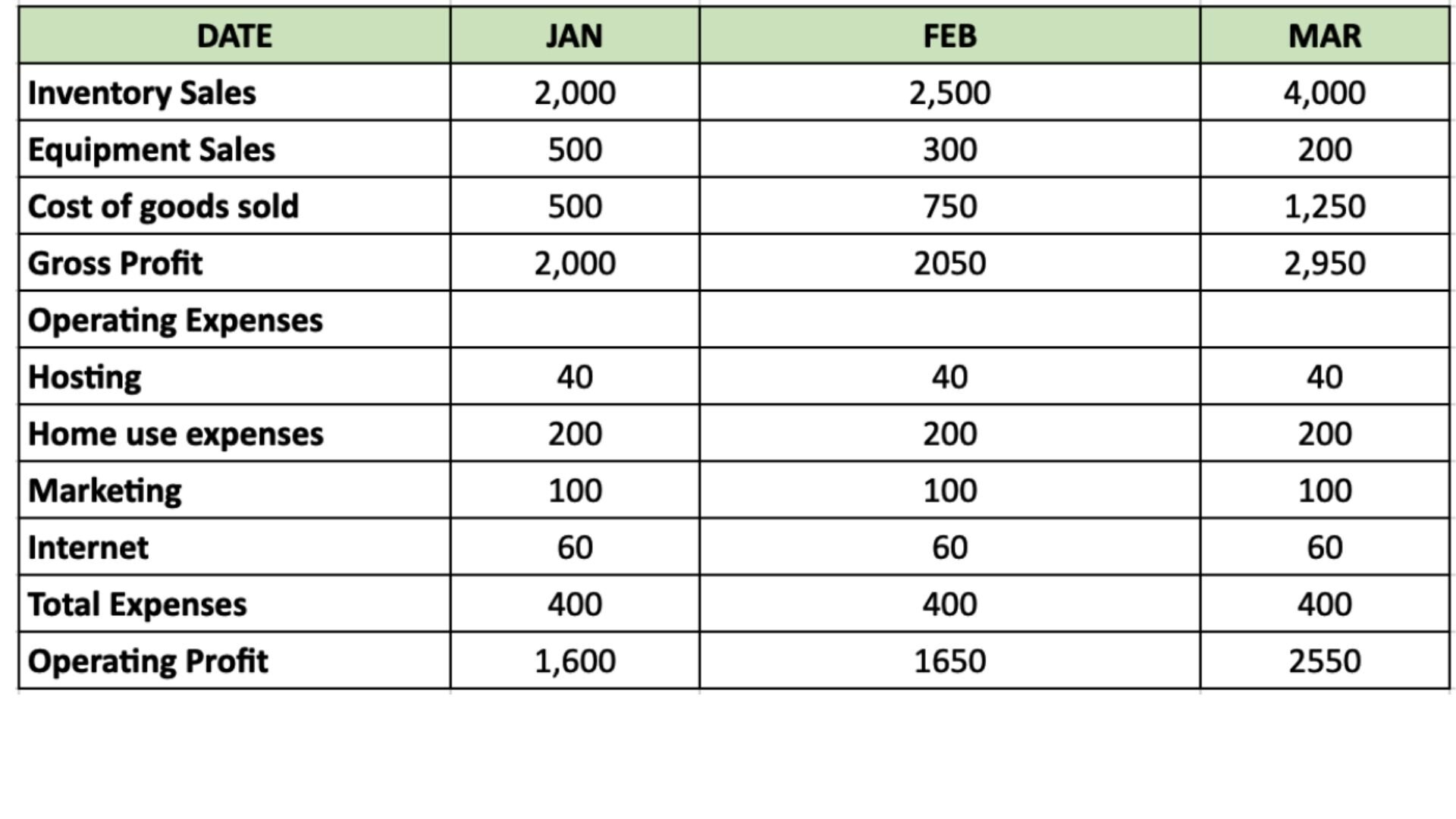
You should watch your cash flow, which is the money coming in and coming out of your business. Here is a basic example of a cash flow statement for an eCommerce business for the first quarter:

A cash flow statement is considered the most important document you can have as an eCommerce entrepreneur. When you know how much cash is flowing in and out of your online business, you can sustain a positive profit margin. On the other hand, if you experience a loss, your cash flow reflects where you need to budget or where you are overspending.

Balance Sheet

A balance sheet consists of assets and liabilities of the business. Both columns should be balanced. The purpose of a balance sheet is to measure the overall position of your business.

The balances must follow the accounting equation:

Assets = Liabilities + Owner’s Equity

(Owner’s equity is the money invested in the business by the owner.)

Income statement

The income statement includes all money brought in over a period. In the basic example above, this shows over a quarter. It shows operating and non-operating income, for example, your inventory sales, and equipment sales, therefore your primary income is your inventory sales.

VAT Threshold for E-commerce

The threshold for eCommerce businesses and selling from a physical store is the same. If you reach the turnover threshold of £85,000 per annum, you will need to register for VAT and charge tax on your goods sold to customers (20%). Therefore, you may need to increase your prices by 20% in order to maintain profit margins, but this may have the effect of customers being sensitive to the price change.

Potential E-commerce sales and delivery tax

The UK HM Treasury is considering applying a 2% sales tax for eCommerce businesses, as well as the 20% standard VAT rate. This is to level out the competition between high street businesses, who face higher operating costs, and online sales.

In addition to this, there could possibly be a delivery tax implemented in order to reduce pollution. This has the aim of influencing consumer behaviour and encouraging customers to environmentally friendly businesses.

Claimable expenses for E-commerce business

Allowable or claimable expenses are costs that are wholly and exclusively involved with the day to day running a business. This, therefore, excludes any costs incurred that are involved with your personal use.  As an eCommerce business, you can take advantage of multiple tax deductions on multiple claimable expenses.

Claimable expenses for eCommerce businesses may include:

·      Advertising and promotion - costs of promotion of your e-commerce business: Marketing (social media advertisements, sponsored advertisements, sponsored content fees by influencers, email marketing software) and Website related content (hosting, domain names, website subscriptions)

·      Banks fees

·      Cost of Goods Sold – the expense you pay as an online seller for manufacturing or selling a product: Materials, Labour (people involved in the production, not those hired for sales), Inventory (goods purchased for resale)

·      Use of home office expenses – must not include personal use, therefore you must proportion your business use and personal use of your home.

Capital Expenses

A capital expense is usually a large cost incurred in order to purchase an asset that you are expecting to have long use of life and benefit your e-commerce business. In this case, your capital expenses would be computers purchased and the website, as most websites provide customers with a system where they can purchase goods or services and contact your business. These are functions and qualify for capital allowances, as they fall into the ‘plant and machinery’ category:

·      Domain name

·      Hardware relating to the website

·      Operating software relating to the website

(You can also claim these as start-up costs for your e-commerce business)

This differs from a revenue expense as this is an amount that is expensed immediately and are used more in the day to day life of the business and is replaced more regularly, such as office stationery.

How to claim expenses for E-commerce businesses

If you are self-employed or a sole trader, employed or a partner at an e-commerce business, you can claim your allowable expenses through the HMRC Self-Assessment Tax Return. You can either file your tax return online or send a paper form, before the tax deadline.

You must have registered for the Self-Assessment Tax Return by the 5 October 2020, and pay the tax you owe by 31 January 2021

If you are filing your tax return online, you must send this by the 31 January 2021.

If you are filing a paper return, you must send this by 31 October 2020.

Contact us for support on your taxes


UK Tax Rules on U.S. VA Benefits

UK Tax Rules on U.S. VA Benefits

A complete guide for U.S. veterans and their families living in the UK — understand how VA benefits are treated for UK tax purposes and avoid costly mistakes.

U.S. Veterans Affairs benefits support
Guide to UK Tax Rules on U.S. Veterans Affairs (VA) Benefits

U.S. Veterans Affairs (VA) benefits are payments and programs provided by the U.S. Department of Veterans Affairs to support former members of the U.S. Armed Forces, as well as many dependents and survivors. These benefits are designed to recognise military service and provide assistance with healthcare, financial stability, and overall quality of life.

For U.S. veterans living in the UK, understanding how these benefits interact with UK tax law is crucial. While many VA benefits may be tax-free in the United States, their treatment under UK Income Tax rules can vary, and double taxation considerations may also arise.

Types of U.S. Veterans Affairs Benefits

Disability Compensation

Tax-free monthly payments made to veterans who have disabilities directly connected to their military service. The amount is based on the severity of the disability and can increase if the veteran has dependents. These payments provide critical financial support and are usually the most significant benefit received by former service members.

Pension Benefits

A financial safety net for wartime veterans with limited income and resources. This pension helps ensure basic living standards for those who may not have sufficient retirement savings. It often comes into consideration for older veterans or those facing financial hardship in retirement years.

Education and Training (GI Bill)

Provides funding for tuition, housing, books, and other costs associated with higher education or vocational training. The GI Bill has historically enabled veterans to gain new skills, pursue university degrees, or retrain for civilian careers, making it one of the most impactful long-term support programs.

Health Care

Access to a nationwide network of VA medical facilities and services. This includes preventative care, hospital treatment, mental health services, and specialist care tailored to the unique needs of veterans. The healthcare benefit remains one of the most relied-upon forms of support from the VA system.

Home Loan Guaranty

Helps veterans, service members, and certain surviving spouses secure favorable terms on home loans. The guaranty reduces lender risk, enabling borrowers to access better interest rates, avoid large down payments, and achieve home ownership more easily. This program has assisted millions of veterans in establishing stable housing.

Survivor Benefits

Payments and services provided to the eligible family members of deceased veterans. These may include Dependency and Indemnity Compensation (DIC), education support, and healthcare coverage. Survivor benefits aim to ease financial burdens and provide stability for families who have lost a loved one through service.

In the context of taxation, the most relevant benefits are usually disability compensation and pension benefits, as they involve direct payments that may be subject to the tax rules of the country where the recipient resides.

U.S. veterans benefits overview
UK and US tax treaty guidance

What UK Residents Need to Know About Receiving VA Benefits

VA Disability Compensation and the VA Pension benefit (a needs-based payment for wartime veterans with limited income and assets) are exempt from tax in the U.S., and therefore also exempt in the UK under the U.S.–UK Double Taxation Convention. This makes them tax-free in both countries.

It’s important to distinguish these from regular U.S. military retirement pay, which is taxable in the U.S. and may also be taxable in the UK, depending on your residency and citizenship status. VA disability and VA pension benefits are not taxable in the UK, while military retirement pensions are treated differently and must be declared to HMRC when applicable.

Double taxation treaty legal text and flag overlay

Why VA Benefits Are Not Taxable in the UK

VA benefits such as disability compensation and the needs-based VA pension are exempt from UK tax because they are not taxable in the United States and are protected under the U.S.–UK Double Taxation Convention.

Article 17 (Pensions, Social Security, Annuities, Alimony, and Child Support) governs pensions and similar payments. Since VA disability compensation and VA pension payments are already exempt from U.S. federal income tax, this article prevents the UK from taxing them.

Article 24 (Relief from Double Taxation) sets out the broader framework for eliminating double taxation. It ensures that when the treaty grants an exemption (as it does for VA disability and pension payments), the exemption is respected by both tax authorities.

Together, Articles 17 and 24 ensure that VA benefits remain tax-free for UK residents, while also clarifying how double taxation is avoided across the treaty as a whole.

Do You Need to Report VA Benefits to HMRC?

UK residents receiving U.S. VA disability compensation or VA pension benefits do not need to report these to HMRC, as they are exempt from tax in both the U.S. and the UK under Articles 17 and 24 of the U.S.–UK Double Taxation Convention.

That said, it is important to keep documentation such as VA award letters and treaty references in case HMRC requests evidence. Only regular U.S. military retirement pensions (non-VA), which are taxable, must be reported to HMRC.

Do You Need to Claim Treaty Relief for VA Benefits?

You do not need to claim treaty relief for U.S. VA disability compensation or VA pension benefits in the UK. Since these payments are not taxable in the U.S. and are already exempt under the U.S.–UK Double Taxation Convention, they simply do not need to be declared on a UK tax return.

The exemption applies automatically, though it is advisable to keep your VA award letters and a copy of the treaty reference in case HMRC requests clarification.

Are Survivor Benefits Taxable in the UK?

Survivor benefits from the U.S. Department of Veterans Affairs, most commonly Dependency and Indemnity Compensation (DIC), provide ongoing financial support to eligible surviving spouses, children, or dependents of veterans who died in service or from service-connected conditions.

These payments are tax-free under U.S. law, and because they are not subject to U.S. income tax, they are also exempt from UK taxation under Articles 17 and 24 of the U.S.–UK Double Taxation Convention.

This means that if you are a UK resident receiving DIC or other VA survivor benefits, you do not need to include them on a Self Assessment tax return, nor claim treaty relief—the exemption applies automatically. However, it is good practice to keep your VA award letter and supporting documentation in case HMRC requests clarification.

veteran reviewing VA benefit documents

Need More Help?

Most U.S. Veterans Affairs benefits — including disability compensation, pensions, and survivor payments — are tax-free in both the U.S. and the UK under the U.S.–UK tax treaty. However, regular U.S. military retirement pay is treated differently, and understanding how the rules apply to your situation is important.

You generally don’t need to report VA benefits to HMRC, but keeping award letters and documentation is always advisable. If you’d like tailored advice or support with U.S.–UK tax matters, feel free to Get in Touch. Our team has extensive experience assisting veterans and their families with cross-border tax issues.

Closing your Limited Company

Closing your Limited Company

Whether you’re winding down a small business or managing significant assets, understanding your options for closing a UK company can help you choose the most efficient and cost-effective route

Leaves in autumn

How to Close a Limited Company - At a Glance

Closing a limited company is a significant decision that requires careful planning and adherence to legal requirements. Whether the company has reached the end of its natural life cycle, is no longer trading, or has become financially unsustainable, directors and shareholders must follow the correct procedure to ensure the business is wound up properly. Taking the right steps not only ensures compliance with Companies House and HMRC but also helps to protect directors and shareholders from potential liabilities.

The process can vary depending on the company’s financial position and circumstances. A solvent company can often be closed through a voluntary process, while an insolvent business may need to go through formal liquidation overseen by an insolvency practitioner. In either case, understanding the legal obligations, the role of directors and shareholders, and the potential implications for outstanding debts or assets is essential. With the right guidance, closing a company can be managed smoothly, allowing all parties involved to move forward with confidence.

Directors and Shareholders when Closing a Company

Below is a summary of everything covered in this section

Do all Directors and Shareholders Need to Agree?

When it comes to closing a limited company, the process requires the agreement of all directors and shareholders. This safeguard ensures that the decision reflects the interests of everyone with a stake in the business. If a sole director has passed away, a new director must be appointed before the company can be formally closed, as the process cannot move forward without someone in that role.

How to Appoint a New Director to Close a Company

If your company has lost its only director the shareholders can vote to appoint a new director.

If there are no shareholders, the executor of the deceased director’s estate may appoint a new director—but only if the company’s articles of association allow it.

Without a director, Companies House may eventually strike the company off automatically. However, this can make handling assets and accounts more complicated.

What if Shareholders are not in Agreement?

Disagreements among shareholders can also complicate the closure process. If not everyone is in agreement, the company’s articles of association will usually outline how disputes should be resolved, often through a formal vote. In more difficult cases, mediation or negotiation may be required, and in the most intractable disputes, legal action could be necessary to move things forward.

When do Articles of Association Allow Executors to Appoint a New Director?

The role of a company’s articles of association is particularly important in these circumstances. Some companies include clauses that grant executors of a deceased director’s estate the authority to appoint a new director, allowing the business to continue or close smoothly. If such provisions are not present, however, the responsibility usually lies with the remaining shareholders to make the appointment.

Chef cooking in a wok, looks tasty
Live classical concert with a full audience

Solvent vs Insolvent: Which Closure Route to Take

When deciding how to close a limited company, one of the most important factors to consider is whether the business is solvent or insolvent. The company’s financial position will determine the options available and the formal process that must be followed.

A solvent company, which can pay its debts in full, may be closed through a relatively straightforward voluntary route. An insolvent company, on the other hand, requires a more formal procedure to protect creditors and ensure the process is handled lawfully. Understanding the difference between these two scenarios is the first step in choosing the most appropriate and compliant way to bring your company to an end.

Closing a Solvent Company

A company is solvent if it can pay its bills. In this case, you can:

Apply to strike off the company from the Companies House register.

Enter a Members’ Voluntary Liquidation (MVL): A formal process managed by a licensed insolvency practitioner.

Closing an Insolvent Company

If your company cannot pay its debts, you can:

  • Enter Administration: Protection from creditors while an insolvency practitioner restructures or closes the company.
  • Apply for Creditors’ Voluntary Liquidation (CVL): Directors voluntarily wind up the company with creditor involvement.
  • Propose a Company Voluntary Arrangement (CVA): An agreement with creditors to pay debts over time, avoiding liquidation.

If debts are ignored, creditors can force the company into compulsory liquidation through the courts.

open barn door

Reasons you May Want to Close a Company

There are various reasons you may want to close a company including:

  • The business is no longer profitable.
  • Retirement of the owners.
  • Disputes between directors or shareholders.
  • Restructuring or moving to a different business model.
  • Death of a director or shareholder.
  • Insolvency and inability to continue trading.

However, there are some circumstances where you should consider whether closing your company is the preffered option.

An Alternative to Closing: Making the Company Dormant

You don’t have to close your company if it’s not trading. Instead, you can let it become dormant for tax purposes.

A dormant company must not:

  • Trade or carry out business activity.
  • Receive income.
  • Engage in transactions other than filing requirements.

The Company will still remain registered at Companies house, and you must:

  • File annual accounts.
  • File Confirmation Statements
New York City
Live classical concert with a full audience

A Guide to Closing your Solvent Company

When a company is solvent, meaning it can pay all its debts and liabilities, there are two main routes to bring it to a formal close. The first is a Members’ Voluntary Liquidation (MVL), a structured process overseen by an insolvency practitioner, often chosen for its tax efficiency and suitability where significant assets are involved. The second is a strike off (dissolution), a simpler and more cost-effective option, best suited to smaller businesses with straightforward affairs.

Choosing the right route depends on the size of the business, the complexity of its assets, and the tax implications for shareholders. While both options achieve the same end result of closing the company, the process, costs, and potential benefits can differ significantly.

Directors and Shareholders when Closing a Company

The right route depends on your company’s size, assets, and goals:

Members’ Voluntary Liquidation (MVL):

Best for companies with significant assets (typically £25,000 or more).

Distributions to shareholders can often be treated as capital gains rather than income, which may reduce tax liability (especially if Business Asset Disposal Relief applies).

Provides a clear and formal process for winding down.

Requires a licensed insolvency practitioner, so costs are higher. A Members’ Voluntary Liquidation (MVL) always requires a licensed insolvency practitioner (IP), even if the company is solvent. That’s actually what defines it as an MVL: directors swear the declaration of solvency, but then a licensed IP must be appointed to carry out the liquidation process on behalf of the company.

Strike Off (Dissolution):

Suitable for companies with minimal assets, few shareholders, and no outstanding debts.

Directors complete and submit a DS01 form to Companies House.

Must ensure all debts are cleared and accounts/taxes settled before applying.

Chef cooking in a wok, looks tasty

How to Close a Company Through a Members’ Voluntary Liquidation (MVL)

Step 1: Declaration of Solvency:

Directors swear a formal statement that the company can pay all its debts within 12 months.

Step 2: Pass a Resolution:

Shareholders vote to wind up the company voluntarily.

Step 3: Appoint a Licensed Insolvency Practitioner:

They take control of the winding-up process.

Step 4: Distribute Assets:

Remaining company assets are realised and distributed to shareholders.

Often more tax-efficient than strike-off distributions.

Step 5: Remove Company from the Register

Once liquidation is complete, the insolvency practitioner arranges for the company to be struck off.

old couple walking in new york with the empire state building and statue of liberty in the background

How to Close Your Company by Getting Struck Off the Companies House Register

Step 1: Settle All Debts and Liabilities:

Make sure the company has paid all creditors, taxes, and outstanding obligations.

Step 2: Dispose of Assets:

Transfer or distribute any remaining company assets to shareholders.

Assets left in the company after strike off become property of the Crown.

Step 3: Complete the DS01 Form:

Signed by a majority of directors.

Submit to Companies House with the required fee.

Step 4: Notify Stakeholders:

Within 7 days of submitting the form, send copies to Shareholders, Creditors, Employees, HMRC and other relevant authorities

Step 5: Companies House Review:

A notice is placed in the Gazette.

If no objections are raised, the company will be struck off the register after 2 months.

A Guide to Closing Your Insolvent Company

An insolvent company is a compnay that cannot pay any debts due, be that bills or other third party debts. There are three main voluntary routes of closing an insolvent company:

  • Administration: Protection from creditors while an insolvency practitioner tries to rescue or restructure the company.
  • Creditors’ Voluntary Liquidation (CVL): Directors voluntarily place the company into liquidation and an insolvency practitioner realises assets to repay creditors.
  • Strike Off (dissolution): A low-cost way to close a company with no assets or debts, but only suitable if creditors will not object.

If you ignore debts: Creditors may petition the court for compulsory liquidation.

Live classical concert with a full audience

How to Choose: Administration, Strike Off, or CVL

Administration is often chosen if:

The business has a chance of survival.

You want protection from legal action by creditors while a restructuring plan is explored.

A sale of the business or assets as a going concern might be possible.

Creditors’ Voluntary Liquidation (CVL) is often chosen if:

The company cannot be rescued.

Directors want to take responsibility and avoid compulsory liquidation.

You want to formally deal with debts and close the business in an orderly way.

Strike Off may be attempted if:K

The company has no assets and very small or informal debts.

You are confident creditors will not object.

You want the simplest closure route.

Creditors can block strike-off if money is owed, so this route is risky for insolvent businesses.

Chef cooking in a wok, looks tasty

How to Close an Insolvent Company Through Administration

Step 1: Appoint an Insolvency Practitioner (IP):

Only a licensed IP can act as an administrator.

Distance selling (B2C goods into the EU)

Directors (or a qualifying charge holder, such as a secured lender) file with the court to appoint an administrator.

Step 3: Moratorium Begins:

Legal protection from creditor action is granted.

Step 4: Administrator Takes Control:

They will:

  • Assess whether the company can be rescued.
  • Propose a restructuring or voluntary arrangement.
  • Sell the business as a going concern, if viable.
  • If no rescue is possible, move to liquidation.
old couple walking in new york with the empire state building and statue of liberty in the background

How to Close an Insolvent Company Through a Creditors’ Voluntary Liquidation (CVL)

Step 1: Board Decision:

Directors acknowledge the company is insolvent and pass a resolution to wind up voluntarily.

Step 2: Appoint an Insolvency Practitioner:

They become the liquidator and take control.

Step 3: Notify Creditors:

Creditors are informed and asked to approve the liquidator.

Step 4: Liquidation Process:

They will:

  • Company assets are valued and sold.
  • Proceeds are distributed to creditors (in legal order of priority).
  • Employees’ claims are handled.

Step 5: Company Removed from Register:

Once liquidation is complete, Companies House strikes the company off.

A CVL demonstrates directors acted responsibly, which may help reduce the risk of being held personally liable for wrongful trading.

old couple walking in new york with the empire state building and statue of liberty in the background
Live classical concert with a full audience

A Guide to Compulsory Liquidation

Compulsory liquidation happens when creditors force the closure of a company through the courts. It is usually triggered by debts of £750 or more that remain unpaid. In this situation, directors have little control, and the process can carry serious consequences for their record and future business activities.

How Compulsory Liquidation Works

The process begins when a creditor who is owed £750 or more issues a winding-up petition through the court. If the court agrees, it grants a winding-up order. At this point, an Official Receiver is appointed as liquidator and assumes control of the company. The liquidator’s role is to sell the company’s assets and distribute the proceeds to creditors. Once the process is complete, the company is dissolved and removed from the register.

Consequences for Directors

Directors lose all control of the company once compulsory liquidation begins. Their conduct will be investigated by the liquidator, and any evidence of misconduct could result in disqualification from acting as a director in the future. There is also a risk of personal liability if wrongful trading is proven, making this route one of the most serious forms of company closure.

Company Voluntary Arrangement (CVA)

A Company Voluntary Arrangement, or CVA, is an alternative to liquidation. It allows a business to enter into a binding agreement with its creditors to repay debts over a set period. The arrangement enables the company to continue trading while restructuring its debt, provided at least 75% (by value) of the creditors who vote approve the proposal.

The process starts with the directors working alongside an insolvency practitioner to prepare a repayment proposal. The insolvency practitioner, acting as nominee, presents this plan to creditors. A meeting is held where creditors vote on the proposal, and approval requires at least 75% support based on the value of debt. If the plan is accepted, the insolvency practitioner becomes the supervisor, ensuring that agreed payments are made on time.

The company is then able to continue trading, provided it keeps up with its repayment obligations. This option can preserve jobs, maintain customer relationships, and protect the company’s reputation while addressing its financial difficulties.

Chef cooking in a wok, looks tasty

Need More Help?

If you need more help or haven't found exactly what you were looking for, feel free to Get in Touch. We have over 20 years of experience helping our clients with their tax for their companies.

Understanding VAT in the UK

Understanding VAT in the UK

Value Added Tax (VAT) can be confusing to those subjected to the tax. This guide will help self-employed individuals and small business owners navigate the accounting process needed for VAT.

VAT at a Glance

  • VAT (Value Added Tax) is a consumption tax charged on most goods and services in the UK.
  • Threshold: Registration is compulsory once taxable turnover exceeds £90,000 in any rolling 12 months (HMRC, VAT thresholds)
  • Rates: 20% (standard), 5% (reduced), 0% (zero-rated), with some activities exempt.
  • Cash Flow: VAT is not a business cost, but how you manage it can make or break your finances.
  • Compliance: Errors bring penalties; voluntary registration can bring advantages.
Bike shed in europe

What is VAT?

VAT is a tax on consumption, levied at each stage of the supply chain. Businesses collect VAT on sales (output VAT) and can reclaim VAT paid on expenses (input VAT). In practice, you are a tax collector for HMRC.

  • VAT is not a direct business cost — customers bear it.
  • Correctly managing VAT improves cash flow.
  • Mishandling VAT can trigger penalties, interest, or fines (HMRC VAT penalties)

VAT Tax Rates

The UK has several VAT rates, depending on the type of goods or services. Below is a table outlining the different rates and what they apply to:

Rate Name Tax Rate Income Type Applied To Example
Standard Rate 20% Applies to most goods and services. Professional Services, Retail Products, Softwares
Reduced Rate 5% Applies to certain goods like home energy and mobility aids Children’s car seats, some domestic energy supplies.
Zero Rate 0% Goods/services are taxable but charged at 0%. Importantly, zero-rated sales count toward VAT registration thresholds. Most food items, books, children’s clothing, public transport
Exempt Supplies N/A Some services are outside the scope of VAT. Insurance, most financial services, education. But businesses cannot reclaim VAT on purchases related to exempt supplies.
New York City

VAT Registration Threshold

From1 April 2024, the VAT registration threshold rose to £90,000. You must register if Your taxable turnover exceeds £90,000 in a rolling 12 month period or You expect your turnover to exceed £90,000 in the next 30 days.

For U.S. citizens working overseas, particularly those employed by foreign companies, eligibility to participate in a 401(k) may be limited or unavailable. However, if you are on a U.S. payroll or working for a multinational with U.S. benefit plans, contributions might still be possible. Coordination with both HR and a cross-border tax advisor is recommended to ensure contributions are handled correctly and tax-efficiently.

Example: A freelance designer earns £7,500 per month. After 12 months, turnover = £90,000. They must register before the next invoice is issued.

Businesses below the threshold may register voluntarily — to reclaim VAT on expenses, improve B2B credibility, or prepare for growth (HMRC voluntary registration)

How VAT Works in Practice

Suppose you invoice a client £2,000 for services:

Output VAT: 20% = £400 → Total invoice = £2,400.
Input VAT: You buy a laptop £1,200 + £200 VAT.
VAT due to HMRC: £400 collected – £200 reclaimed = £200 payable.

Keep VAT funds in a separate account. It prevents “accidental” spending and nasty surprises.

VAT Calculator (UK)

Add or remove VAT using standard (20%), reduced (5%), zero (0%), or a custom rate.

Net
£0.00
VAT
£0.00
Gross
£0.00

Tip: switch modes to either add VAT to a net amount or remove VAT from a gross amount. Results are rounded to 2dp.

Threshold Implications and Tracking

Tracking turnover is essential to ensure timely registration. You should include the below in your tracking:

How to Itemise and Track your VAT

Below is an example of what you should include when tracking your VAT reciepts.

Columns to Include Description How to document
Date The date of the transaction or invoice. Enter the exact invoice or transaction date.
Invoice # Unique invoice or receipt number. Use the official invoice or receipt number to keep records organised.
Customer / Supplier Who you sold to (customer) or bought from (supplier). Include full company or individual name.
Description Short description of goods or services. Write a short, clear description of the goods or services.
Net Amount Amount before VAT is applied. Enter the amount before VAT; do not include VAT here.
VAT Rate (%) The VAT rate applicable to this transaction (e.g., 20%). Enter the applicable VAT rate for the transaction.
VAT Amount VAT calculated on the net amount (Net × VAT Rate). Let the formula calculate automatically, or enter manually if needed.
Total Amount Total including VAT (Net + VAT Amount). Let the formula calculate automatically, or enter manually if needed.
Type (Sale/Purchase) Specify if this is a sale or a purchase. Label as “Sale” for sales invoices or “Purchase” for expenses.
Notes Any extra information (e.g., exemptions, partial VAT, payment method). Optional, add anything relevant like “VAT exempt” or “partial payment.”

You can also use our premaid template to get your started when tracking your VAT. You can also see our complete example template to understand how the calculations happend.

Pricing Considerations

When VAT applies, you need to consider whether your prices are VAT-inclusive or exclusive:

VAT-Exclusive Pricing

Displayed Price does not include VAT. VAT is added at checkout

Example: Service £1,000 + VAT 20% = £1,200

VAT-Inclusive Pricing

Price Includes VAT. You must calculate the VAT component and Remit it to the HMRC

Example: Service £1,200 = VAT Portion £200 + Net Revenue £1,000

Careful pricing ensures your profit margins and cashflow remain intact.

VAT: Sector Variations you can’t Ignore

Not all industries play by the same VAT rules. Three areas, construction, hospitality, and digital services, have quirks that catch many small firms out.

Construction: the Domestic Reverse Charge

Since 1 March 2021, many services under the Construction Industry Scheme (CIS) use the Domestic Reverse Charge (DRC).

Mechanism: suppliers invoice without VAT; the customer (if VAT-registered) records both output VAT and input VAT on their return.

Impact: subcontractors lose the short-term cash-flow boost from collecting VAT; contractors take on the compliance duty.

Scope: applies only where both parties are VAT-registered and services fall within CIS. Excludes end-user clients (e.g. homeowners) and zero-rated new builds.

Hospitality: dine-in vs takeaway

VAT here depends less on what is sold than on where and how it is consumed.

  • Standard-rated (20%): dine-in meals, hot takeaway food, alcoholic drinks, hot drinks.
  • Zero-rated: many cold takeaway foods (e.g. sandwiches, fruit, milk).
  • Always standard-rated (even if cold): crisps, confectionery, savoury snacks, soft drinks.

Getting it wrong at the till adds up fast; modern POS systems can automate rates.

Digital services: post-Brexit rules

Supplying digital services (software, SaaS, e-books, streaming, online courses) to EU consumers now triggers the EU’s Non-Union OSS system.

Rule: VAT is charged at the customer’s local rate, not the UK rate.

Process: UK businesses must register for OSS in one EU member state (HMRC does not run OSS for services post-Brexit).

Benefit: one OSS return covers all EU sales, avoiding multiple registrations

Example: a UK consultant selling a €100 subscription to a customer in Spain must add 21% Spanish VAT and declare via OSS.

old couple walking in new york with the empire state building and statue of liberty in the background

Pricing Considerations

When VAT applies, you need to consider whether your prices are VAT-inclusive or exclusive:

VAT-Exclusive Pricing

Displayed Price does not include VAT. VAT is added at checkout

Example: Service £1,000 + VAT 20% = £1,200

VAT-Inclusive Pricing

Price Includes VAT. You must calculate the VAT component and Remit it to the HMRC

Example: Service £1,200 = VAT Portion £200 + Net Revenue £1,000

Careful pricing ensures your profit margins and cashflow remain intact.

VAT Registration Rules

Below is a summary of everything covered in this section

Mandatory Registration - At a Glance

VAT registration is required if your business turnover exceeds £90,000 over a rolling 12-month period. It also applies if you expect turnover to cross that threshold within the next 30 days. This ensures compliance with HMRC rules and allows your business to charge VAT correctly.

Voluntary Registration - At a Glance

Even if your turnover is below the mandatory threshold, you can choose to register voluntarily. Doing so allows you to reclaim input VAT on purchases, which can reduce costs. It can also enhance your credibility with suppliers and customers while preparing your business for future growth.

De-Registration

If your business turnover falls below £88,000, or if you stop trading, you can apply for deregistration. This step can simplify your tax obligations and reduce the administrative burden of VAT reporting.

Application

Most businesses register online through HMRC using a Government Gateway account. The process is relatively straightforward and involves submitting details about your business and expected turnover.

Processing Time

Once your application is submitted, HMRC typically issues a VAT registration number within two to four weeks. You will then be required to display this number on invoices and other business documents.

falcon sitting on perch
New York City

Mandatory vs Voluntary Registration

Mandatory registration: required if taxable turnover exceeds £90,000 in any rolling 12 months, or if you expect to pass that figure in the next 30 days.

Voluntary Registration: possible below the threshold; often used to reclaim input VAT, boost credibility, or prepare for growth.

Mandatory Registration

A business must register for VAT if:

Taxable turnover (standard, reduced, zero-rated) exceeds £90,000 in a rolling 12-month period. Exempt sales are excluded.

Projected turnover will exceed £90,000 in the next 30 days — registration is required immediately, even if your trailing 12 months are lower.

Example:

A freelance designer bills £8,000 per month. After 11 months, turnover = £85,000. Next month’s forecast = £9,000, pushing the 12-month total to £94,000. The designer must register before issuing the next invoice.

Voluntary registration

Businesses below the threshold can opt in. Why bother?

Reclaim input VAT: cuts the effective cost of purchases (e.g., on laptops, software, or equipment).

Professional credibility: some B2B clients prefer VAT-registered suppliers.

Future-proofing: avoids sudden admin shock when growth tips you over the line.

Example

A consultant turning over £50,000 voluntarily registers to reclaim £10,000 of VAT on equipment and software.

Summary

  • Mandatory Registration: required if taxable turnover exceeds £90,000 in any rolling 12 months, or if you expect to pass that figure in the next 30 days.
  • Voluntary registration: possible below the threshold; often used to reclaim input VAT, boost credibility, or prepare for growth.
Live classical concert with a full audience

VAT Registration: Step-By-Step

VAT Registration can be divided into 5 steps:

  • Check eligibility: turnover above £90,000 (or expected in 30 days) → must register.
  • Choose Scheme: Standard, Flat Rate, Cash Accounting, Annual.
  • Register Online: via HMRC portal with a Government Gateway account.
  • Get VAT number: Usually within 2-4 weeks; shown on your certificate.
  • Stay Compliant: invoice correctly, file returns, keep digital records.

Step 1: Check eligibility & pick a scheme

  • Threshold Test: Include standard, reduced and zero-rated sales; exclude exempt.
  • 30 Day Rule: If you expect turnover to exceed £90,000 in the next 30 days, registration is required immediately.
  • Voluntary Option: Still worthwhile below threshold if reclaiming input VAT or building credibility.

Identify the appropriate VAT scheme

Choosing the right VAT scheme can simplify your accounting and improve cash flow. The main options include:

VAT Scheme Description Suitable For
Standard VAT Report VAT on a quarterly basis; claim input VAT as normal. Most businesses with standard accounting processes.
Flat Rate Scheme Pay a fixed percentage of turnover as VAT; cannot reclaim most input VAT. Small businesses with turnover under £150,000; simpler bookkeeping.
Cash Accounting Account for VAT only when payments are received or made. Businesses with cash flow concerns; turnover under £1.35m.
Annual Accounting Submit one VAT return per year, with interim payments Businesses preferring annual reporting; turnover under £1.35m.

Step 2: Register Online

Apply via the VAT registration service

Information the HMRC asks for:

Information Required Notes
Business name, address, and contact details Official trading name, registered office (or business address), email, and phone number.
Unique Taxpayer Reference (UTR) Issued by HMRC when you registered your business or self-employment. Essential for tax identification.
National Insurance number Only for sole traders or partners in a partnership.
Bank account details For VAT refunds or payments via direct debit.
Expected turnover An estimate of your taxable turnover for the next 12 months.
Main business activity Brief description of what your business does, e.g., consulting, retail, digital services.
birds-flying wrapped in money
old couple walking in new york with the empire state building and statue of liberty in the background

Step 3: Receive Your VAT Registration Number

HMRC usually issues a VAT number in 2-4 weeks (longer depeding on the checks needed). When completed you'll get a VAT certificate confirming your:

  • VAT number
  • Effective registration date (when to start changing)
  • First return period

Action: add your VAT number to invoices, websites, and correspondence once issued.

Step 4: Meet VAT obligations

Once your business is VAT-registered,you must meet ongoing VAT responsibilities to remain compliant and avoid penalties. Compliance involves invoicing correctly, submitting returns on time, and keeping accurate records.

Rule 1: Issue VAT invoices to clients

Valid B2B invoices contain the following information:

  • Business name, address, VAT number
  • Date & unique invoice number
  • Customer details
  • Description of goods/services
  • Net price, VAT rate, VAT amount, total due (HMRC VAT invoice rules)
Download our VAT Invoice Template

Rule 2: File VAT returns

Usually quarterly, due 1 month + 7 days after period end. Must be digital under Making Tax Digital.

Rule 3: Keep records

Invoices, receipts, VAT account, bank statements. Retain 6 years (10 if using OSS).

Required records include:

  • Copies of VAT invoices issued and received
  • Receipts and purchase invoices for all business expenses
  • Bank statements and accounting ledgers
  • Records of imports and exports if applicable

VAT Registration: Special Cases & Deregistration

There are a few special cases that can be encountered when registering your company for VAT

  • Takeovers: VAT liability can transfer to the buyer.
  • Seasonal turnover: Must register if taxable sales exceed £90,000 in any 30-day period..
  • Overseas traders: Non-UK businesses selling taxable goods/services in the UK often must register.

Deregistration of VAT is only allowedif turnover falls below 80,000 or you stop trading. Apply online or by form VAT7/VAT84

Mountain range in italy

Business takeovers or mergers

When you buy or merge with a business, VAT registration doesn’t reset to zero. HMRC may require:

  • A transfer of the seller’s VAT number
  • A new registration with liabilities carried ove
  • Always notify HMRC — failure can lead to back-dated VAT bills.

Seasonal or irregular turnover

Even if your annual turnover is below £90,000, breaching the threshold in any 30-day window triggers immediate registration.

  • Typical cases: festivals, seasonal retailers, short-term contracts.
  • HMRC applies the “30-day future test” strictly.

Non-UK businesses trading in the UK

If you are based overseas but supply taxable goods or services in the UK, you may still need a UK VAT registration.

  • Applies even if turnover is below the threshold.
  • Common for e-commerce sellers holding UK stock, or service providers with UK customers.

See the HMRC guidance for more details: Registering for VAT if you’re not established in the UK

Distance selling & EU digital services

Post-Brexit, UK businesses selling digital services to EU consumers cannot use HMRC’s portal.

Instead, register for the EU Non-Union One-Stop Shop (OSS) in one EU member state. One return then covers all EU consumer sales, charged at the customer’s local VAT rate.

Physical distance selling of goods into the EU is subject to IOSS and local thresholds.

Deregistration Rules

You can deregister for VAT if your taxable turnover falls below £85,000 over 12 months or if you cease trading completely.

You can deregister if:

  • Taxable turnover drops below £88,000 (deregistration threshold, April 2024), or
  • You stop trading, sell the business, or cease making taxable supplies.
Chef cooking in a wok, looks tasty

International VAT: What UK Businesses Need to Know

International VAT is subject to differing rules depending on where you bought the item/service from geographically, the type of item and your citizenship status.

Cross-border sales of goods

VAT on cross border goods depends on whether the goods are from the EU or outside of the EU

EU customers (post-Brexit):

  • Goods shipped from the UK are zero-rated for UK VAT.
  • EU customers usually pay import VAT and customs duties on arrival.
  • If your sales in an EU country exceed its local threshold, you may need to register there.

Non-EU customers:

  • Exports are generally zero-rated for UK VAT.
  • You must keep proof of export: shipping docs, invoices, customs paperwork.

Distance selling (B2C goods into the EU)

Since July 2021, the EU uses a €10,000 cumulative threshold for B2C cross-border sales. Above that, UK businesses selling goods into the EU must:

  • Register for the Import One-Stop Shop (IOSS) (for consignments under €150)
  • Register directly in an EU country if storing stock locally.

OSS/IOSS returns are filed in one EU state but cover all EU consumer sales.

Digital services (SaaS, apps, e-books, online courses)

VAT is charged where the customer is based — not where the supplier is. UK businesses selling to EU consumers must register for the EU Non-Union OSS. HMRC no longer runs OSS/MOSS for these sales. One OSS return per quarter covers all EU consumer transactions. VAT is applied at the customer’s national rate.

Example: A UK web developer sells a £100 online course to a Spanish consumer. Spain’s VAT = 21%. Invoice = €121. The UK business reports and remits this via OSS.

old couple walking in new york with the empire state building and statue of liberty in the background
Live classical concert with a full audience

Sector-Specific VAT Rules

VAT rules are not uniform. Certain industries have their own quirks, exemptions or accounting mechanisms. Knowing them matters: get it wrong and HMRC will not be amused.

Construction: Domestic Reverse Charge (DRC)

Introduced 1 March 2021 to combat fraud in the Construction Industry Scheme (CIS).

How it works: suppliers do not charge VAT; customers account for both output and input VAT on their return.

Applies when: both parties are VAT-registered, and the work falls within CIS (e.g. building, repairs, demolitions).

Excludes: zero-rated new builds, work for end users (homeowners).

Hospitality and Catering

VAT depends on what is sold and where it is consumed.:

  • Standard-rated (20%): dine-in meals, hot takeaways, alcohol, hot drinks.
  • Zero-rated: many cold takeaway foods (sandwiches, milk, fruit)
  • Always standard-rated (20%): crisps, confectionery, savoury snacks, fizzy drinks.

To avoid errors, modern POS systems should auto-apply VAT rates; staff training is equally important.

Charities and Nonprofits

Charities straddle all three VAT categories: taxable, exempt, and outside the scope

  • Outside VAT: donations, grants (where nothing is given in return).
  • Exempt: fundraising events (if HMRC conditions met), many education services.
  • Taxable: trading activities such as running a café or shop.

The problem is that there is a partial exemption. Shared costs (e.g. rent, IT) must be apportioned between taxable and exempt activities; only the taxable portion allows input VAT recovery. You must keep separate cost centres for taxable vs exempt streams. Accounting software can help automate apportionment.

Digital Services & SaaS

Cross-border and post-Brexit, digital services bring unique complexity.

  • B2B sales: usually no VAT; customer accounts under reverse charge.
  • B2C sales to EU: charge VAT at the customer’s local rate. UK firms must register under the EU Non-Union OSS (not HMRC). One return covers all EU sales.

Examples of covered digital services: SaaS subscriptions, e-books, streaming, online courses, downloadable media.

Healthcare

The line between “medical” and “lifestyle” is decisive. Items that are exempt include treatment directly linked to diagnosis, prevention or cure, provided by qualified professionals (doctors, dentists, physiotherapists). Prescription drugs and prescribed medical devices also exempt.

Items that are standard rated includednon-essential cosmetic surgery, OTC medicines, wellness services (massage, yoga, acupuncture) unless medically prescribed.

Documentation is key, you should record whether a service was medical or not such that you are prepared for a HMRC audit, should one occur.

Education and Training

VAT status hinges on who provides the teaching and what is taught.

  • Exempt: education by “eligible bodies” (schools, universities, charities), and certain one-to-one tuition in core subjects.
  • Standard-rated (20%): commercial training providers, most online courses, non-core subjects.

Examples:

Maths tutor (one-to-one, core subject) → exempt.

Coding bootcamp (£500 online course, no live teaching) → standard-rated.

The key takeaway is do not assume all teaching is exempt. Check HMRC’s “eligible bodies” definition before billing.

Chef cooking in a wok, looks tasty
london sunset man walking dog

VAT for Expats

Moving abroad doesn’t cut ties with HMRC. If your business remains UK-established, you may still need to charge and remit VAT. If your operations shift entirely overseas, foreign VAT rules may kick in instead. Some expats end up caught by both.

UK-established vs non-UK established

You are considered UK-Established if contracts, bank accounts or staff are still run from the UK, you remain in the UK VAT net. A British client is charged 20% VAT whether you’re in Birmingham or Barcelona.

You are considered Non-UK established if you run entirely abroad, you may not need UK VAT registration — unless you sell goods stored in the UK or digital services to UK consumers, in which case UK VAT rules reapply.

Double Taxation Worries

Expats risk being hit twice: UK VAT and local sales tax (e.g. US sales tax, Canadian GST).

  • Check local thresholds for compulsory registration
  • Use reverse charge wherever possible for B2B services.
  • Apply for VAT refunds on eligible expenses abroad.
Hollow body archtop Epiphone Guitar

VAT Compliance & Record-Keeping

VAT isn’t just “paperwork.” You are, in effect, a tax collector for HMRC. Done well, VAT compliance protects cash flow and keeps audits routine. Done badly, it can bring penalties, stress, and reputational damage.

Making Tax Digital (MTD)

Since April 2019, VAT returns must be filed digitally.

  • No manual entry: you can’t type totals into HMRC’s portal anymore.
  • Digital records only: keep invoices and accounts in spreadsheets or software
  • Approved software: use MTD-compatible tools such as Xero, QuickBooks, Sage, FreeAgent, or bridging software.
  • Documentation: HMRC: Making Tax Digital for VAT

Once mastered, MTD reduces errors and simplifies returns.

Records HMRC expects

Think of VAT records as your audit trail: proof that the right VAT was collected, reclaimed, and remitted. Essentials include:

  • Sales invoices (with VAT breakdown)
  • Purchase invoices/receipts (for input VAT claims)
  • VAT account (running total of output, input, and net VAT)
  • Export/import paperwork (for zero-rated goods)
  • Credit notes & adjustments
  • Bank statements

Getting it wrong at the till adds up fast; modern POS systems can automate rates.

Retention rules

Rule 1: Keep VAT records for 6 years.

Rule 2: Some schemes (e.g. Capital Goods, OSS/IOSS) require 10 years.

Even if you stop trading, HMRC can revisit old returns.

Filing VAT returns

Most businesses file quarterly (due 1 month + 7 days after period end). Alternatives:

  • Monthly (better for reclaiming VAT credits quickly)
  • Annual (simplifies admin but requires instalments)

Return Contents:

  • Total sales & purchases
  • Output VAT charged
  • Input VAT reclaimed
  • Net VAT payable (or reclaimable)

Penalties: cost of mistakes

HMRC’s penalty regime encourages early disclosure:

  • Late registration: pay VAT owed from when you should have registered, plus penalties.
  • Late filing: “penalty points” accumulate into fines.
  • Late payment: daily interest applies.

Potential Fines:

  • Careless mistakes: up to 30%
  • Deliberate: up to 70%
  • Deliberate & concealed: up to 100%.

Disclosing errors voluntarily often reduces penalties and in some cases where reasoning is innocent and reporting is quick, the HMRC may zero your penalty.

VAT audits (compliance checks)

An HMRC audit is usually straightforward provided that records are accurate and well-organised. During a review, inspectors may request a range of documentation, including VAT returns and the VAT account, sales and purchase invoices, proof of imports and exports, contracts and agreements, as well as bank statements.

The outcome of such an audit can vary depending on what the inspectors find. In some cases, everything may be in order and no further action is required. However, if discrepancies arise, HMRC may impose adjustments to the accounts, along with potential interest charges and financial penalties.

docked-boat on the lakeside

Compliance and Recordkeeping: Summary

Keep Records: Digital records mandatory under Making Tax Digital (MTD).

6 Years (Minimum): Keep VAT records 6 years (10 for some schemes).

Making Tax Digital: Digital records mandatory under Making Tax Digital (MTD).

Quarterly returns are standard; monthly/annual options exist.

Penalties: late registration, filing, payment, or errors can trigger fines up to 100% of VAT due.

Audit-ready: invoices, bank statements, VAT account, import/export proof.

Key Takeaways

VAT looks fussy because it is. But once you grasp the moving parts—rates, thresholds, schemes, and “place of supply”—it becomes routine finance rather than a quarterly panic.

Thresholds

Register when rolling 12-month taxable turnover > £90,000, or if you’ll exceed it in the next 30 days. Deregister if you fall below £88,000 or cease trading.

Rates

Most supplies 20%; some 5%; zero-rated still taxable (counts for the threshold); exempt is outside VAT (no input VAT recovery).

Cash flow

Park VAT collected in a separate account. Use Cash Accounting or Flat Rate if they suit your margins and payment cycles.

Schemes

Standard works for most. Flat Rate simplifies books (limited input VAT reclaim). Cash Accounting helps late-paying clients. Annual Accounting reduces admin.

Invoices

For B2B, issue valid VAT invoices (number, date, supplier/customer, net, rate, VAT, total).

Records & MTD

Keep digital records, file with MTD-compatible software, and retain evidence for 6 years (often 10 for OSS/IOSS or capital goods).

Sectors that Trip People Up:

Construction (DRC): Customer accounts for VAT; supplier invoices without VAT.

Hospitality: Dine-in & hot takeaways = 20%; many cold takeaways = 0%; snacks/fizzy drinks = 20%.

Digital B2C to EU: Charge the customer’s local rate; register for EU Non-Union OSS.

International

UK exports are typically zero-rated if you hold proof. EU distance-selling and digital rules use OSS/IOSS.

Expats

VAT follows establishment and place-of-supply rules. B2B services usually reverse charge; digital B2C taxed where the customer lives.

Penalites

Late registration, filing, or payment hurts; careless errors up to 30%, deliberate up to 70–100%. Early disclosure softens the blow.

Good Habits

Automate, reconcile monthly, set deadlines, and review your rolling threshold—especially if revenue spikes seasonally.

Need More Help?

If you need more help or haven't found exactly what you were looking for, feel free to Get in Touch. We have over 20 years of experience helping our clients save money for their retirement and big life occasions.

Arising vs Remittance Basis: UK Changes to Taxation on International Income
Sunrise over a bridge; Arising Basis and Remittance basis represent the new and old form of foreing income taxation in the UK

Arising Basis vs Remittance Basis

UK taxation for residents who are non-domiciled, and who hold foreign income or gains, can be highly complex. Each tax year, these individuals have had the option to be taxed on a remittance basis, where foreign income and gains are only taxed if brought into the UK. However, from April 2025 the UK has moved to an Arising basis form of taxation, where foreign income is taxed as it arises, rather than when it is remitted.

The FIG Regime is a relief for new residents of the UK, who can remit foreign income to the U.K. mostly tax free. However, after a 4 year period has passed, any foreign income will be taxed on an arising basis. This leaves long-term residents subject to a new form of taxation, which if not prepared for, can leave you liable to a larger taxation amount than you were prepared for in the coming years.

To prepare for the change in legislation for taxation on your foreign income, it is important to first understand what the differences are between the old and the new system.

Arising Basis

The arising basis is the default taxation method for UK residents who are domiciled, or deemed domiciled, in the UK. Under this basis, individuals are subject to UK tax on their worldwide income and gains, regardless of whether those funds are brought into the UK. Non-domiciled residents may also elect to be taxed on the arising basis, giving them the same treatment for foreign income and gains.

While the arising basis potentially allows full access to the personal allowance and the capital gains annual exempt amount, it can create complexities for individuals with foreign income. Any taxes already paid overseas may be eligible for a foreign tax credit in the UK to avoid double taxation, but careful planning is required, particularly for US citizens, who remain liable for US taxes on worldwide income.

For many non-domiciled residents, the arising basis provides certainty and access to allowances, but it demands careful reporting of all foreign income and gains each year. Professional guidance is often necessary to ensure compliance and to optimise tax outcomes, particularly for those with significant international earnings or investments.

Remittance Basis

The remittance basis is the Pre-April 2025 method available to UK residents who are not domiciled or deemed domiciled in the UK. Under this basis, foreign income and gains are generally outside the scope of UK taxation unless they are brought—or “remitted”—to the UK. UK-sourced income and gains remain taxable as usual.

While the remittance basis can reduce immediate UK tax on foreign income, there are trade-offs. Claiming it may mean losing access to the personal allowance and the capital gains annual exempt amount if foreign income and gains exceed £2,000 in a tax year. Additionally, long-term residents may be required to pay a Remittance Basis Charge (RBC) to continue using this method. The RBC applies as follows:

  • £30,000 if resident for 7 out of the previous 9 tax years
  • £60,000 if resident for 12 out of the previous 14 tax years

After 15 out of 20 years of UK residence, the RBC no longer applies, but the individual is treated as deemed UK domiciled and cannot claim the remittance basis. A remittance occurs whenever foreign income or gains are brought into the UK, used to pay for UK services, or transferred in a way that benefits the individual in the UK. Careful management of bank and investment accounts is essential, especially to avoid “mixed fund” complications, which can make it difficult to track the source of remitted funds for tax purposes.

For non-domiciled residents working in the UK, Overseas Workday Relief (OWR) may provide relief for income earned for work performed outside the UK, but this was only available for the first three years of UK tax residence. However, the eligibility requirements for this have now changed and it is worth consulting the HMRCs Guidlines on the topic or talking to a tax professional.

Comparison of arising basis and remittance basis
Sunrise over a windfarm; The TRF represents a way for long-dom individuals to claim on pre-April 2025 income

Temporary Repatriation Facility (TRF)

For individuals who previously used the remittance basis, there may still be pre-6 April 2025 foreign income and gains that were never taxed in the UK. The Finance Act 2025 introduced the Temporary Repatriation Facility (TRF) to provide a limited window for these amounts to be brought into the UK at a lower tax rate.

The TRF applies for a fixed three-year period covering the 2025-26, 2026-27, and 2027-28 tax years. To use the facility, individuals must formally designate amounts of pre-April 2025 foreign income or gains as “qualifying overseas capital.” Once designated, these amounts are treated as capital on which the TRF charge is paid. Importantly, designated amounts do not need to be physically remitted to the UK during the TRF period to benefit from the lower rate, though remittance is permitted if desired.

The process of designation can include cash held overseas, investments, or even assets purchased with pre-2025 income, such as property. Mixed funds are subject to specific ordering rules, with designated amounts treated as priority for remittance. Because the rules governing the TRF are highly technical, determining eligibility, calculating designated amounts, and planning the timing of remittances can be complex. Professional advice is strongly recommended to ensure compliance and optimise the potential tax benefit.

Arising vs Remittance Basis: Key Differences

Tax Scope

Under the arising basis, all worldwide income and gains are taxable in the UK, whether or not they are brought into the country. In contrast, the remittance basis only taxed foreign income and gains when remitted to the UK, while UK-source income remained taxable.

Allowances

The arising basis allows full use of the personal allowance and capital gains exemption, subject to tapering for high earners. Claiming the remittance basis historically meant losing these allowances if foreign income exceeded £2,000, and there could be an additional Remittance Basis Charge depending on the number of years of UK residence.

Double Taxation Risk

Paying tax on the arising basis may expose individuals to potential double taxation on foreign income and gains, requiring careful use of foreign tax credits and treaty reliefs. By contrast, the remittance basis limited UK tax to amounts brought in, although US citizens and other foreign taxpayers may still face taxation abroad.

Flexibility

The arising basis is fixed, requiring declaration of all worldwide income and gains annually. The remittance basis, previously, allowed non-domiciled residents to choose annually between arising and remittance, providing more flexibility. This choice no longer exists except through the TRF for legacy pre-2025 amounts.

Overall, from 6 April 2025 onward, most UK residents must follow the arising basis, with planning now focused on managing double taxation and optimising available reliefs.

Comparison of arising basis and remittance basis taxation
Person reviewing international tax documents and planning strategy

Planning with the FIG Regime

For individuals returning to or newly resident in the UK, the Foreign Income and Gains (FIG) regime provides relief on certain foreign income and capital gains for up to four years. FIG allows eligible taxpayers to pay UK tax on foreign income and gains in a simplified manner while temporarily reducing the risk of double taxation.

It is important to understand the interaction between FIG and the arising basis of taxation, as FIG claims only apply for qualifying tax years and specific types of foreign income and gains. Careful planning is required to ensure relief is maximised without unintentionally triggering other UK tax liabilities.

Learn more about the FIG regime and eligibility in our detailed guide on qualifying new residents and the four-year relief period.

Need More Help?

Deciding between the arising and remittance basis is a complex exercise requiring detailed calculation and planning. For US citizens or other foreign taxpayers, it is critical to consider both UK and foreign tax obligations to prevent double taxation.

Professional advice is strongly recommended to determine the most tax-efficient approach and ensure compliance with all reporting requirements.

UK FIG Regime: Relief for New Residents

UK FIG Regime: Relief for New Residents

From 6 April 2025, qualifying new UK residents may claim relief on foreign income and gains during their first four years of UK residence. Learn how the FIG regime works, who is eligible, and how to make a claim to minimise your UK tax liability.

Image: A load of figs piled high; What is the fig regime and why is it important for People with Foreign income in the UK

What is the FIG Regime?

From 6 April 2025, the UK moved fully to taxing individuals on the arising basis for their worldwide income and gains. The remittance basis, which previously allowed certain non-UK domiciled individuals to defer UK tax on foreign income and gains until they were brought into the UK, is no longer available for new years from that date.

In its place, the government introduced a new system of relief for internationally mobile individuals known as the FIG regime. This regime is designed for people who come to the UK after at least 10 consecutive tax years of non-UK residence. Where the conditions are met, qualifying new residents can claim relief on most foreign income and gains that arise during their first four years of UK residence.

Importantly, eligibility is based on residence history rather than nationality or domicile status. Claims must be made in order to access the reliefs, and the way a claim is structured can affect allowances and other aspects of an individual’s tax position. The FIG regime therefore forms a central part of the new post-2025 landscape for individuals moving to, or returning to, the UK.

The Old Method: Remittance Basis

Before 6 April 2025, certain UK resident individuals who were non-domiciled could choose to be taxed on the remittance basis. Under that system, UK tax was charged on UK income and gains as they arose, but foreign income and gains were only taxed if they were brought into, or used in, the UK.

What is Remittance?

A remittance broadly meant bringing foreign income or gains into the UK, whether by transferring money to a UK bank account, using overseas funds to buy UK assets, or using those funds to pay for UK services. If foreign income or gains were kept outside the UK, they could remain outside the scope of UK tax while the remittance basis applied.

The End of Remittance Basis

From 6 April 2025, the remittance basis is no longer available for new tax years. All UK residents are now taxed on the arising basis on their worldwide income and gains. The FIG regime replaces the remittance basis as the primary relief for internationally mobile individuals, but the new rules operate differently and are time-limited to the first four years of UK residence for qualifying new residents.

It is important to recognise that guidance based on the remittance basis is now outdated for post-April 2025 years. Individuals who previously relied on the remittance basis, or who are considering moving to the UK, should review their position carefully to understand how the FIG regime applies in practice.

Why Did the UK Change?

From 6 April 2025, the UK moved away from a domicile-based system for taxing internationally mobile individuals and replaced it with a residence-based approach under the FIG regime. Previously, the availability of the remittance basis depended largely on an individual’s domicile status, which refers to the country an individual regards as their permanent home or has the strongest long-term connection to. Residence and domicile are different concepts, and the old system could be complex for long-term mobile individuals.

Over time, the remittance basis became increasingly complex due to deemed domicile rules, remittance basis charges of £30,000 and £60,000 for long-term residents, and detailed provisions on mixed funds and historic remittances. The FIG regime removes domicile as a factor and focuses on residence, providing a clearer and more consistent framework for taxing worldwide income and gains while offering time-limited relief to qualifying new residents.

Artistic Figs on white background; Comparison of remittance basis and FIG regime
Ripe figs; Qualification for FIG dependi on your domicile status

Who Qualifies for the FIG Regime

Access to the FIG regime is not automatic. An individual must meet specific statutory conditions to be treated as a qualifying new resident for a particular tax year. The rules are designed to target genuinely internationally mobile individuals who are coming to the UK after a significant period of non-residence, rather than those with only a short absence.

Qualification is determined by reference to UK residence status under the Statutory Residence Test and by examining an individual’s recent residence history. Nationality and domicile are not relevant. A UK domiciled individual returning after a long period abroad can qualify in the same way as someone who has never previously lived in the UK.

Relief under the regime is available if a claim is made through Self Assessment. It applies for a maximum of four consecutive tax years, beginning with the first year in which the individual becomes a qualifying new resident. The regime cannot be extended, and unused years cannot be carried forward. If your first year of UK residence was before 6 April 2025, you may still access the regime from 2025-26 onwards, provided you are still within your four-year window.

Key Limitations

A few important limitations apply:

  • You must actively claim the relief through your Self Assessment return
  • You can choose which foreign income and gains to relieve, rather than claiming for everything
  • You cannot claim the regime for any tax year in which you are non UK resident
  • Unused years cannot be rolled forward

The 10-Year Rule

At the centre of the qualifying conditions is the requirement that the individual must have been non-UK resident for at least 10 consecutive tax years immediately before the relevant year of claim. This ensures that the regime is restricted to individuals who have made a genuine and sustained departure from the UK, rather than those who have been absent for only a short period.

The 10-year test is applied strictly. Residence is determined under the Statutory Residence Test. A year in which split-year treatment applies still counts as a full year of UK residence. Being treated as resident in another country under a double tax agreement does not override UK residence under the Statutory Residence Test when assessing the 10-year history.

If the test is met, the individual will be a qualifying new resident in their first year of UK residence and, provided they remain UK resident and continue to meet the conditions, for the following three tax years. If they become non-UK resident during that four-year period, they cannot claim for that year, and the missed year cannot be recovered later. In short, the 10-year rule establishes a clear boundary: only those who have spent a full decade outside the UK tax system can access the time-limited relief offered by the FIG regime.

Consequences of Claiming FIG

Making a claim under the FIG regime can provide significant relief on eligible foreign income and gains. However, it also affects a number of allowances, reliefs, and loss claims for that tax year . These consequences apply for each year in which a claim is made and should be reviewed carefully before submitting a return.

Loss of Personal Allowance

If you make a FIG claim for a tax year, you lose your Income Tax personal allowance for that year. This means your UK income will be taxed from the first pound, without the usual tax-free threshold. In addition, certain related allowances are also unavailable:

  • Blind Person’s Allowance
  • Marriage Allowance
  • Married Couple’s Allowance

This can significantly increase the effective tax cost of claiming FIG, particularly if UK income is substantial.

Loss of Capital Gains Tax Annual Exempt Amount

For any year in which a FIG claim is made, you also lose access to the Capital Gains Tax annual exempt amount. As a result, any UK chargeable gains realised in that year will be fully taxable from the first pound of gain. This is an important consideration if you are planning disposals of UK assets, as it may be more efficient to realise gains in a year when no FIG claim is made.

Restriction on Foreign Loss Relief

A further consequence of claiming FIG is that certain foreign losses cannot be used in the year of claim. Specifically:

  • Foreign trade losses and foreign property business losses cannot be set against UK income.
  • Foreign capital losses on the disposal of foreign assets are not available for relief.

This prevents individuals from claiming exemption for foreign income and gains while also using foreign losses to reduce UK tax on other income or gains.

No Relief for Finance Costs on Foreign Property

If you claim under the FIG regime, finance costs relating to foreign rental properties, such as mortgage interest, cannot be relieved in that year. This restriction can materially affect the tax position of individuals with leveraged overseas property investments. Even if the underlying rental income qualifies for FIG relief, the inability to deduct finance costs may influence whether a claim is beneficial overall.

The consequences of claiming fig reach further than remittance basis
A small plant growing; Foreign income and gains (FIG) has wider impact on LLC interest

Impact of FIG Regime on LLC Interests

From 6 April 2025, the UK replaced the historic non-dom rules with a new tax regime. Individuals who were previously able to claim the remittance basis are now generally taxed on an arising basis on their worldwide income and gains, unless they qualify for the four-year FIG relief.

This change has significant implications for UK residents with interests in US LLCs. Under UK tax law, an LLC may be treated either as transparent (profits taxed as they arise) or opaque (profits taxed only on distribution). Unlike the US, there is no automatic “check-the-box” election in the UK, and HMRC generally treats LLCs as opaque. This can create potential double taxation, as US pass-through taxation may result in US tax being paid on profits before the UK taxes distributions.

Determining how a specific LLC is treated for UK tax purposes requires careful analysis of the entity’s structure, US law, and its operating agreement. For more detailed guidance on how US LLCs are classified and taxed in the UK, see our dedicated article on US LLCs and UK Tax Treatment.

What Income and Gains Qualify for FIG Relief?

Relief under the FIG regime applies only to specific categories of foreign income and gains. It is not a general exemption for anything earned outside the UK. Each source must fall within the permitted categories and meet the technical conditions of the regime.

Relievable Foreign Income and Gains

Overseas Property Income

Rental income from property situated outside the UK is generally eligible for relief. The property business must relate to non-UK land or buildings.

Foreign Dividends and Interest

Dividends from non-UK resident companies and interest arising from overseas sources, such as foreign bank accounts, can qualify. The key factor is that the income must be foreign in source.

Capital Gains on Foreign Assets

Gains on the disposal of non-UK assets are within scope, provided the asset does not derive 75 percent or more of its value from UK land. Assets that are UK land rich are excluded.

Profits from Overseas Trades

Profits from trades carried on wholly outside the UK may qualify. This includes an individual’s own trade or their share of partnership profits, but only where the trade is conducted entirely overseas.

Foreign Pension Income

Most foreign pension receipts fall within the regime, allowing eligible individuals to claim relief during the four-year FIG period.

Royalties and Offshore Investment Gains

Royalty income and other intellectual property income arising abroad can qualify, as can certain offshore income gains from overseas investment structures.

Foreign Employment Income

Income from overseas employment may be eligible, although it is usually capped. Relief is typically limited to the lower of £300,000 or 30 percent of total employment income from duties performed wholly or partly overseas.

Certain Non-UK Company and Trust Gains

In some cases, gains attributed to UK residents from non-UK resident close companies, and certain foreign income and gains connected with non-UK resident trusts, may also fall within the regime.

Income and Gains That Do Not Qualify

UK Source Income and Gains

The regime applies only to foreign income and gains. Any UK source income or UK chargeable gains remain taxable in full under normal rules.

Trades Carried On Partly in the UK

If a trade is carried on partly in the UK, its foreign profits are not eligible. The requirement is that the trade be conducted wholly outside the UK.

Offshore Bond Gains

Chargeable event gains arising from non-UK insurance policies, often described as offshore bonds, are specifically excluded from FIG relief.

Performance Income

Performance-related income does not qualify under the regime.

Cryptocurrency Gains

HMRC’s view is that cryptocurrency gains are situated where the beneficial owner is resident. For UK residents, this typically means such gains are treated as UK gains and therefore fall outside FIG relief.

Eligibility is highly technical. The classification of income, the location of assets, and the way a trade is structured can all affect whether relief is available. Careful analysis is essential before making a claim.

Figs Ripening; There is a Temporary Reparation Facility on pre-2025 remitances at a reduced tax rate

Temporary Repatriation Facility (TRF): What about Foreign Income from Pre-April 2025

For individuals who previously used the remittance basis, pre-6 April 2025 foreign income and gains may still exist that were never taxed in the UK. The Finance Act 2025 introduced the Temporary Repatriation Facility (TRF) to allow a limited window for these amounts to be brought into the UK at a lower tax rate.

The TRF applies for a fixed three-year period covering the 2025-26, 2026-27, and 2027-28 tax years. To use the facility, individuals must formally designate amounts of pre-April 2025 foreign income or gains as “qualifying overseas capital”. Once designated, these amounts are treated as capital on which the TRF charge is paid. Importantly, designated amounts do not need to be physically remitted to the UK during the TRF period to benefit from the lower rate, though remittance is permitted if desired.

The process of designation can include cash held overseas, investments, or assets purchased with pre-2025 income, such as property. Mixed funds are subject to specific ordering rules, with designated amounts treated as priority for remittance. Because the rules governing the TRF are highly technical, determining eligibility, calculating designated amounts, and planning the timing of remittances can be complex. Professional advice is strongly recommended to ensure compliance and optimise the potential tax benefit.

What Happens When the Four-Year FIG Relief Ends

Once an individual’s four-year period under the Foreign Income and Gains (FIG) regime concludes, all eligible foreign income and gains that were previously relieved will be subject to UK taxation on the arising basis. Under the arising basis, UK residents are taxed on their worldwide income and gains as they arise, regardless of whether the funds are brought into the UK. This marks a return to the standard UK treatment for individuals who are domiciled or deemed domiciled, and is a key consideration for planning once FIG relief expires.

Income and gains arising after the FIG period will automatically be included in the individual’s UK tax return. This includes foreign employment income, dividends, interest, rental income, and capital gains, among others. While FIG allowed relief regardless of remittance, the arising basis does not provide this flexibility: all qualifying income and gains are taxable in the UK, though double tax relief may be available for taxes already paid abroad.

Although the arising basis brings a more comprehensive reporting requirement, it also restores access to certain UK tax allowances, including the personal allowance for income tax and the annual exempt amount for capital gains tax. This can partially offset the additional UK tax liability that arises from worldwide taxation. Individuals transitioning from FIG should consider reviewing their foreign assets and income streams carefully and may benefit from professional advice to manage the interaction of overseas tax obligations and UK reliefs effectively.

The Risk of Double Taxation on Arising Basis

When the FIG relief period ends and an individual moves onto the arising basis, foreign income and gains become fully subject to UK tax, even if they are also taxable in another jurisdiction. For US citizens and other expatriates, this creates a real risk of double taxation, as the same income may be liable to both UK and US tax.

To mitigate this, taxpayers can typically rely on foreign tax credits (FTCs) or double taxation treaties. The UK–US treaty, for example, allows US expats to claim credit for UK tax paid on foreign income against their US tax liability. Similarly, taxes paid in the US can often reduce UK liability through unilateral relief provisions. Planning ahead is crucial: timing of remittances, structuring foreign investments, and reviewing tax residency status can all help minimise overlap.

Careful record-keeping of foreign taxes paid and income sources is essential for claiming relief efficiently. Professional advice is strongly recommended, especially for US expats, to ensure that both UK and US reporting obligations are met and that the available credits and reliefs are fully utilised. This can prevent unexpected tax liabilities once FIG protection ends.

Figs on a blue background; Arising basis occurs when the 4 year fig relief ends

Need More Help?

If you need more help or haven't found exactly what you were looking for, feel free to Get in Touch. We are dedicated to supporting our clients through any and all UK and US tax system changes.

83(b) Election: A Complete Guide

The 83(b) Election: A Complete Guide

Everything startup founders and employees need to know to file an 83(b) election and optimize their taxes.

startup team celebrating

What Is an 83(b) Election?

An 83(b) election lets you pay taxes upfront on restricted stock, so future growth is taxed as capital gains instead of ordinary income.

Normally, stock vests over time and taxes are due at each vesting date. With an 83(b) election, you elect to be taxed on the current (low) value upfront. Any future appreciation is treated as capital gains, saving potentially significant taxes if your startup grows rapidly.

Why the 83(b) Election Matters

Upside

Filing an 83(b) election early allows you to pay taxes on the current value of your stock, which is often very low or even negligible at the time of grant. This means that any future growth in the company’s value is treated as capital gains rather than ordinary income, which typically results in a lower tax rate. By locking in the tax at the initial value, founders and early employees can significantly reduce their overall tax burden if the company’s stock appreciates dramatically over time, making this a powerful strategy for wealth building in a startup.

Risk

There is a risk involved with the 83(b) election because the taxes you pay upfront are non-refundable. If you leave the company before your stock fully vests, or if the company fails and the stock becomes worthless, you will have already paid taxes on an asset that never generates any return. While the upfront payment is usually small if the stock value is low, it’s important to understand that this is a gamble: you are essentially betting on the future success of the company and must be comfortable with the possibility that the taxes paid may not yield any benefit.

Who Benefits

The 83(b) election is most beneficial for founders and very early employees, especially when the stock has little to no current value. For these individuals, filing early can dramatically reduce taxes on future appreciation. Employees who join later, when stock already has significant value, may see less benefit and higher upfront tax costs. Understanding your position in the company and the timing of your stock grant is critical in determining whether the 83(b) election is advantageous for your personal financial situation.

team discussing startup ideas
calendar with deadlines

Filing Deadline & Rules

Filing an 83(b) election is time-sensitive, and understanding the rules is critical to ensure your election is valid. You must act promptly once your stock is granted, as the IRS imposes a strict deadline that cannot be extended under any circumstances.

The 30-day clock for filing begins on the grant date of your stock, not the vesting date. This means you must calculate your timeline carefully and plan to submit your election as soon as possible to avoid missing the window.

When filing, the completed 83(b) election statement must be mailed to the IRS office where you normally file your taxes. It is strongly recommended to send it via certified mail with return receipt requested to have proof of timely filing.

Missing this 30-day deadline has serious consequences: the opportunity to make the election is completely lost, and you will have to follow the default tax treatment on your stock as it vests, which could result in significantly higher taxes if your company’s stock appreciates.

How to File an 83(b) Election

At a Glance

Prepare the statement, send to IRS within 30 days, give a copy to employer, and keep one for yourself.

Step 1: Complete Election Statement

Short letter including required information (see template below).

Step 2: Make Copies

Three signed copies: IRS, employer, personal records.

Step 3: Mail IRS Copy

Use certified mail with return receipt requested.

Step 4: Keep Proof

Retain mailing receipt and IRS acknowledgment forever.

documents and 83b form

Documents & Information You’ll Need

Before filing your 83(b) election, it’s important to gather all the necessary documents and details to ensure the process goes smoothly. Having everything prepared in advance will save time and prevent errors that could jeopardize your filing.

Start with your stock grant agreement, which confirms the grant date, number of shares, and vesting schedule. This document is essential to calculate your filing deadline and verify the stock details accurately.

You will also need your personal information, including your full name, Social Security Number, and current address, to include on the election statement. Accuracy here is critical as any discrepancies can cause processing delays.

Another key piece of information is the Fair Market Value (FMV) of your stock on the grant date. If you paid any purchase price for the stock, include that as well. These values determine the amount of taxes due if you make the election.

Finally, ensure you have a completed 83(b) election statement and prepared envelopes addressed to both the IRS and your employer. Keeping a copy for yourself is also essential for your records and future reference.

stack of documents with calculator and pen

Links & Templates

IRS doesn’t provide a fill-in form — submit a short letter with required info.

Best Practices

To maximize the benefits of the 83(b) election and minimize risks, it’s best to send your election in the same week as your stock grant whenever possible. Acting quickly helps ensure you meet the strict 30-day filing deadline and reduces the chance of overlooking critical steps. Always file via certified mail so you have proof of submission, and retain this documentation along with the IRS acknowledgment permanently for your records.

It’s equally important to keep copies of the election for your employer and for your personal files. This ensures all parties have verifiable records of your timely filing and helps prevent any future disputes or misunderstandings.

Finally, professional advice is essential. A qualified tax advisor or CPA can review your situation and the stock grant details, helping you avoid costly mistakes that could arise from misfiling or misunderstanding the election’s implications. The right guidance can save or cost you thousands, so never skip this step.

Important Disclaimer: This guide is for educational purposes only. It does not constitute tax or legal advice. Always consult a qualified CPA or tax attorney before making an 83(b) election.
consulting tax advisor

Need More Help?

If you need more help or haven't found exactly what you were looking for, feel free to Get in Touch. We have over 20 years of experience helping our clients who file form 83b.

U.S. Income Tax: The Basics

U.S. Income Tax: The Basics

U.S. Income Tax can be a very daunting prospect to those who do not understand the ins and outs of the U.S. tax system. By understanding the basics you can gain peace of mind when filing your U.S. taxes

Live classical concert with a full audience

Understanding US Income Tax

The landscape of US income tax can often feel like a dense and intricate maze. From understanding who is required to pay, to deciphering the various forms and regulations, it's a system that touches nearly every individual and business operating within the United States. This article aims to be your comprehensive guide, shedding light on the most important aspects of this crucial element of the American financial system

At its core, US income tax is a levy imposed by the federal government, and in many cases by state and local governments, on the earnings of individuals, corporations, estates, and trusts. It's the primary way these governing bodies fund public services, from infrastructure and education to defense and social programs. Understanding the fundamentals of this system is not just a matter of legal compliance; it's key to effective financial planning and business management.

Student and teach talking about something cool

State Vs Income Tax

When we talk about US income tax, it's easy to think of it as one monolithic system. However, the reality is more like a two-tiered structure, with obligations arising at both the federal and, often, the state level. While both aim to tax your earnings, the way they go about it – from the tax rates they apply to what income they consider taxable and the deductions they allow – can differ significantly. Getting to grips with these distinctions is key to understanding your overall tax picture.

Think of the federal income tax as the overarching system, governed by the Internal Revenue Code (IRC). It's the tax levied by the central government and operates on a progressive model. This simply means the more taxable income you have, the higher the tax rate you'll pay on those higher portions. The federal system uses tax brackets, essentially income ranges, each with its own tax rate. For 2024, there are seven of these, ranging from 10% up to 37% for the highest earners. These brackets aren't set in stone; they're adjusted periodically to keep pace with inflation. When filing your federal taxes, you generally have a choice: take the standard deduction, a fixed amount based on your filing status, or itemize specific expenses like medical costs, state and local taxes (with some limits), and charitable donations. A significant recent change came with the 2018 Tax Cuts and Jobs Act (TCJA), which bumped up the standard deduction, influencing how many people choose to file.

One major difference between state tax and income tax is the tax rate structure. Some states opt for a flat tax, also known as a single-rate system. Here, everyone pays the same tax percentage on their entire taxable income, regardless of whether they earn a little or a lot. As of 2024, states like Arizona, Colorado, Georgia, and Illinois use this flat tax approach. Even Washington has a flat tax, though it applies specifically to the capital gains of higher earners, and Iowa is heading towards a flat tax system. On the other hand, many states mirror the federal approach with a progressive tax system. This means they also use tax brackets, taxing higher income at higher rates. While some states might base their brackets on the federal model, many create their own unique sets of income ranges and tax percentages. The frequency with which these brackets are adjusted for inflation also varies. For example, Hawaii has quite a few tax brackets, while Kansas has only a handful. Interestingly, California has the highest top tax rate in the country, hitting very high earners, while North Dakota has one of the lowest top rates, kicking in at a relatively high income level.

In essence, while both federal and state governments rely on income tax as a key revenue source, their systems differ significantly in structure, rates, and specific rules. The federal system is a nationwide progressive model, while states offer a spectrum of approaches, from flat taxes to progressive systems with varying degrees of complexity, and even the absence of a broad income tax altogether. Understanding these distinctions is fundamental to grasping the full picture of income taxation in the United States.

Understanding Who Pays Tax

US income tax isn't a selective process; it casts a wide net, touching the financial lives of a vast range of individuals and entities operating within the country. Understanding who is obligated to pay and why it's relevant to them is a foundational piece of the income tax puzzle.

Individuals

The most common group subject to US income tax is individuals. This includes:

US Citizens

Regardless of where they reside in the world, US citizens are generally subject to US income tax on their worldwide income.

Resident Aliens

Non-US citizens who meet certain residency tests (based on the number of days they are physically present in the US) are also taxed on their worldwide income.

Non-Resident Aliens

Non-US citizens who meet certain residency tests (based on the number of days they are physically present in the US) are also taxed on their worldwide income.

For these individuals, income tax is relevant because it directly impacts their net earnings and their disposable income. The amount of tax owed can significantly affect their financial planning, savings, and overall financial well-being.

Other Taxable Entitites

While individuals form the largest group of taxpayers, US income tax also applies to various business structures and legal entities:

Corporations (C-Corps)

These are legal entities separate from their owners and are subject to corporate income tax on their profits. Their shareholders are then also taxed on any dividends they receive, leading to a potential "double taxation."

Limited Liability Companies (LLCs)

The tax treatment of an LLC depends on its election. It can be treated as a sole proprietorship (if it has one member), a partnership (if it has multiple members), or even as a C-Corp or S-Corp.

Estates and Trusts

These legal entities, created to manage assets after someone's death or for the benefit of specific individuals, are also subject to income tax on any income they generate.

old couple walking in new york with the empire state building and statue of liberty in the background
Student and teach talking about something cool

Gross Income: Inclusions and Exclusions

Gross income is a foundational element in the United States federal income tax system, forming the starting point for calculating a taxpayer’s taxable income. It is defined under Section 61 of the Internal Revenue Code as “all income from whatever source derived,” unless specifically excluded by law. The broad scope of this definition ensures that nearly all economic gains received by an individual or entity are subject to taxation unless there is a clear statutory exemption.

Taxable Inclusions: What Constitutes Gross Income

The most common types of includible income are wages, salaries, tips, commissions, and bonuses received as compensation for services. In addition to earned income, taxpayers are also required to include unearned income such as interest from bank accounts, dividends from corporate stock, rental income from property, and royalties from intellectual property or mineral rights. Capital gains profits realized from the sale of stocks, real estate, or other capital assets are also taxable, though they may be subject to preferential rates depending on the holding period.

Other types of income that must be reported include unemployment compensation, gambling winnings, alimony received (for divorce or separation agreements executed before January 1, 2019), and income from canceled debts, unless an exclusion such as insolvency or bankruptcy applies. Additionally, bartered services and non-cash compensation—such as the receipt of property or services in exchange for labor—are generally considered taxable and must be valued at fair market value.

Exclusions: What Can Be Legally Omitted from Gross Income

Despite the wide reach of gross income rules, the tax code provides several exclusions that allow certain types of income to be omitted from taxation. Among the most significant are gifts and inheritances, which are not considered taxable income to the recipient, though they may be subject to gift or estate taxes on the part of the donor or decedent’s estate. Similarly, life insurance proceeds paid by reason of the insured’s death are generally excluded from the beneficiary’s gross income.

Other exclusions include interest on municipal bonds, which is exempt from federal income tax, and qualified scholarships and fellowships, provided the funds are used for tuition, fees, books, and required supplies. Employer-provided benefits can also be excluded under certain conditions. For example, premiums for group-term life insurance up to a specified limit, health insurance contributions, adoption assistance, and dependent care benefits may all be excluded if they comply with the requirements set forth in the tax code and associated regulations.

Residency and Tax Status

Determining your tax residency isn't just a technicality; it's the crucial factor that dictates which state (or states) has the authority to tax your income. This becomes particularly important if you've recently moved, are planning a relocation, or even if you split your time between different states. Each state operates under its own set of rules to establish who it considers a tax resident, and a misunderstanding can lead to unwelcome tax bills or penalties.

Think of it this way: your residence is generally where you live. Tax residency, however, is a legal designation that determines your state income tax obligations. While often the same, they can diverge, especially in situations involving interstate moves or part-year living in different states.

Most states hinge their definition of tax residency on two key concepts: domicile and statutory residency.

  • Domicile: This refers to your permanent home, the place you intend to return to after any temporary absences. It's often described as your "true home."
  • Statutory Residency: This usually involves spending a specific amount of time within a state during a tax year, often around 183 days.

Generally, if you are domiciled in a state or meet its statutory residency test, that state can treat you as a tax resident. This means it can tax your income, regardless of where that income was earned. This is where the potential for dual tax residency arises – you could meet the domicile test in one state and the statutory residency test in another, leading to the possibility of being taxed by both.

Chef cooking in a wok, looks tasty
Student and teach talking about something cool

Establishing Your Domicile

When you move to a new state, clearly establishing your new domicile as soon as possible is crucial for avoiding tax confusion. States look for concrete actions that demonstrate your intent to make a new state your permanent home. Some key ways to document this change include:

  • Registering to vote in your new state.
  • Buying or leasing a permanent residence in your state
  • Obtaining a driver's license from your new state.
  • Updating your address with important institutions like your bank, the US Postal Service (USPS), and the Internal Revenue Service (IRS).

The more evidence you have, the better protected you'll be if a state decides to audit your residency. These audits happen when a state wants to verify your residency claims, and they might be more likely if you've moved from a high-tax state to one with lower taxes. Auditors might scrutinize your financial records, travel history, and even your social connections to determine your true tax home.

Implications of Dual Tax Residency

Being considered a tax resident in more than one state can unfortunately lead to double taxation, where multiple states claim the right to tax your entire worldwide income for the same year. This often happens when you meet the domicile test in one state and the statutory residency test in another. It can also occur if you own property in multiple states, live in one but work in another, or don't properly establish domicile after a move.

While some states offer credits for taxes paid to other states, these credits can vary significantly and might not always fully offset the extra tax burden.

Understanding What is Taxable

US income tax applies to a broad range of earnings, but not all money you receive is subject to it. Understanding the difference between taxable income and non-taxable income is fundamental to accurately calculating your tax liability.

Generally Taxable Income

This category encompasses most forms of income you receive, including:

  • Wages, Salaries, and Tips: Money earned from employment.Wages, Salaries, and Tips: Money earned from employment.
  • Self-Employment Income: Profits from your own business or freelance work.
  • Interest Income: Earnings from savings accounts, bonds, and other interest-bearing investments.
  • Dividend Income: Payments received from owning stock in companies.
  • Capital Gains: Profits from selling assets like stocks, real estate, or other investments. The tax rate can vary depending on how long you held the asset.
  • Retirement Income: Distributions from traditional IRAs, 401(k)s, and pensions (though contributions may have been pre-tax).
  • Rental Income: Earnings from renting out property.
  • Alimony Received (for agreements finalized before January 1, 2019): Payments received from a former spouse under a divorce or separation agreement.
  • Unemployment Compensation: Benefits received while unemployed.
  • Social Security Benefits (potentially taxable): A portion of your Social Security benefits may be taxable depending on your other income.
  • Prizes and Awards: The value of cash and non-cash prizes and awards.

Generally Non-Taxable Income:

While the list of taxable income is extensive, certain types of income are typically exempt from federal income tax:

  • Child Support Payments: Payments received for the support of a child.
  • Alimony Received (for agreements finalized after December 31, 2018): Payments received under newer divorce or separation agreements are generally not taxable income for the recipient
  • Certain Scholarship and Grant Money: Amounts used for tuition, fees, books, supplies, and equipment required for your courses (subject to certain conditions).
  • Workers' Compensation Benefits: Payments received due to a work-related injury or illness.
  • Damages for Physical Injury or Sickness: Compensation received for physical injuries or sickness.
  • Life Insurance Proceeds: Amounts received as a beneficiary upon the death of the insured
  • Certain Social Security Benefits: If your total income is below a certain threshold, your Social Security benefits may not be taxable.
  • Municipal Bond Interest: Interest earned from bonds issued by state and local governments.
  • Qualified HSA Distributions: Distributions from a Health Savings Account (HSA) used for qualified medical expenses.

It's important to remember that tax laws can be complex, and the taxability of certain income can depend on specific circumstances and may have exceptions. Consulting official IRS resources or a tax professional is always recommended for clarification on specific income types.

How to reduce your overall tax liability

It's wise to explore ways to potentially lower your tax burden, but remember that the information below provides general overviews. Navigating the complexities of US income tax requires careful consideration of your individual circumstances, and it is crucial to consult with a qualified tax professional to ensure you are applying these strategies correctly and in full compliance with the law. They can provide personalized advice and help you avoid any unintended errors.

Here are some common avenues individuals and businesses explore to potentially reduce their income tax liability:

Deductions to Reduce Your Income Tax

Deductions lower your taxable income, the amount that's actually taxed. Think of them as subtractions from your total income.

You can take the standard deduction, a set amount that depends on your filing status or, you can itemize deductions, listing specific eligible expenses. You choose whichever is higher. Common itemized deductions include:

  • Certain medical expenses (above a specific income threshold).
  • State and local taxes (with limits).
  • Home mortgage interest.

Many normal and necessary costs to run your business can be deducted.

Credits to Reduce Income Tax

Tax credits are often more valuable because they directly lower the amount of tax you owe, dollar for dollar.

Various credits exist for individuals and businesses, often to encourage certain actions or help specific taxpayers. Examples include:

  • Child Tax Credit.
  • Earned Income Tax Credit.
  • Credits for energy-efficient home improvements.
  • Business credits for research, hiring, or renewable energy investments.

Business Expenses

For business owners, deducting normal and necessary costs to run the business lowers taxable income. Some examples include:

  • Office supplies.
  • Rent and utilities.
  • Advertising
  • Travel.
  • Professional fees.

Always consult a tax professional when before trying to reduce your income tax. Any error in this error can lead you liable to large financial penalties and potentially jail time.

Student and teach talking about something cool

Essential Documents for US Income Tax

Preparing your US income tax return can feel like assembling pieces of a puzzle. Having the right documents organized and readily available is crucial for an accurate and efficient filing process. The specific documents you'll need will depend on your individual circumstances, sources of income, and any deductions or credits you plan to claim. However, here's a breakdown of some of the most common and relevant documents you'll likely need:

For Identifying Yourself and Dependents

Social Security Numbers (SSNs) or Individual Taxpayer Identification Numbers (ITINs): You'll need your own SSN or ITIN, as well as those for your spouse (if filing jointly) and any dependents you are claiming. Ensure these are accurate to avoid processing delays.

Birth Dates: You'll need the birth dates for yourself, your spouse, and any dependents.

For Reporting Your Income

Form W-2, Wage and Tax Statement: Received from your employer(s), this form reports your annual wages, salaries, tips, and other compensation, as well as the amount of federal and state income tax withheld.

Form 1099 Series This is a series of forms used to report various types of income from sources other than an employer. Common types of 1099 forms include: 1099-NEC, 1099-DIV and 1099-INT among others

Schedule K-1 (Form 1065, 1120-S, or 1041): If you were a partner in a partnership, a shareholder in an S corporation, or a beneficiary of an estate or trust, you'll receive a Schedule K-1 detailing your share of the entity's income, deductions, credits, etc.

Records of Self-Employment Income and Expenses: If you are self-employed, you'll need detailed records of all your income and deductible business expenses (invoices, receipts, etc.).

Rental Income and Expense Records If you own rental property, you'll need records of rental income received and all associated expenses (mortgage interest, repairs, etc.).

Student and teach talking about something cool

For Claiming Deductions and Credits

Records for Itemized Deductions (if applicable):

Medical Expenses: Bills, receipts, and statements from doctors, hospitals, dentists, and insurance companies.

State and Local Taxes (SALT): Records of property taxes paid, state and local income taxes paid (e.g., W-2 showing withholdings, estimated tax payments), and sales tax records if you are deducting actual sales tax instead of state income tax.

Home Mortgage Interest: Form 1098, Mortgage Interest Statement, from your lender.

Charitable Contributions: Receipts from qualifying organizations (written acknowledgments for donations over $250), bank records, and records of non-cash donations.

Casualty and Theft Losses: Documentation of the loss and any insurance reimbursements.

Records for Adjustments to Income:

  • IRA Contributions: Statements from your IRA custodian showing contributions made.
  • Student Loan Interest Payments: Form 1098-E, Student Loan Interest Statement, from your lender.
  • Health Savings Account (HSA) Contributions: Records of your contributions.

Records for Tax Credits

Please note that the specific documentation needed will vary depending on the credit. Some common examples include:

  • Child and Dependent Care Expenses: Provider's name, address, and Taxpayer Identification Number (TIN).
  • Education Credits (e.g., Form 1098-T, Tuition Statement): Statements from educational institutions.
  • Energy Credits: Receipts for qualifying energy-efficient improvements.

Bookkeeping and Record Keeping

Accurate bookkeeping and diligent record keeping are the bedrock of a smooth and defensible tax process. Think of them as building a strong foundation for your financial reporting. Consistent and organized records not only simplify tax preparation but also empower you to understand your financial health and make informed decisions year-round. Here are some practical tips to establish effective bookkeeping and record-keeping habits:

Keep Separate financial Accounts

If you have income beyond regular employment (e.g., freelance work, investments), consider maintaining separate bank accounts and even credit cards to track these activities more clearly.

Regularly Track Income

Keep records of all income received, whether it's pay stubs, 1099 forms, or records of cash transactions. Note the date, source, and amount.

Document Deductible Expenses

Start a habit of saving receipts for potentially deductible expenses throughout the year. This might include medical bills, charitable donations, home improvement records (if relevant for future home sales), and educational expenses. Make notes on what the expense was for.

Utilize Digital Tools

Scan paper receipts and store them digitally. Many apps allow you to photograph receipts and categorize them on the go. Cloud storage ensures you won't lose your records.

Review Periodically

Don't wait until tax season. Take some time each month or quarter to review your income and expenses to ensure everything is accurate and you're not missing any deductions.

By implementing these tips, both individuals and businesses can establish robust bookkeeping and record-keeping practices that will not only simplify tax preparation but also provide valuable insights into their overall financial picture. Remember, a little effort throughout the year can save significant time and stress during tax season and beyond.

For more tips feel free to reach out, we are always here to help you and tailor our service to your situation.

Understanding the Calculation: An Overview for Individuals and Businesses

It's important to remember that the specifics of income tax calculation can be quite intricate and highly dependent on individual or business circumstances. This overview provides a general understanding of the process.

1.

Determine Gross Income

This is the total income you receive from all sources throughout the year. This includes wages, salaries, tips, interest, dividends, capital gains, retirement distributions, rental income, and other forms of earnings.

2.

Subtract Adjustments to Income

Certain deductions are taken "above the line," meaning they reduce your gross income to arrive at your Adjusted Gross Income (AGI). Common adjustments include contributions to traditional IRAs, student loan interest payments, contributions to health savings accounts (HSAs), and certain self-employment taxes.

3.

Calculate Taxable Income

This is your AGI minus either the standard deduction (a fixed amount based on your filing status – single, married filing jointly, etc.) or your total itemized deductions (if these exceed the standard deduction). Itemized deductions can include things like certain medical expenses, state and local taxes (with limitations), home mortgage interest, and charitable contributions. You'll choose whichever results in a lower taxable income.

4.

Calculate Tax Liability

Once you have your taxable income, you apply the federal income tax brackets to this amount. The US uses a progressive system, meaning different portions of your taxable income are taxed at different rates. As your income rises, the tax rate on the additional income also increases. The specific tax brackets and rates depend on your filing status and are subject to change annually.

5.

Apply Tax Credits

Tax credits directly reduce the amount of tax you owe. Various credits are available, such as the Child Tax Credit, Earned Income Tax Credit, education credits, and credits for certain energy-efficient improvements.

6.

Determine Total Tax and Payments

You then compare your total tax liability (calculated in step 4, minus any credits in step 5) with the total amount of taxes you've already paid throughout the year (through withholdings from your paycheck or estimated tax payments). This determines whether you owe additional taxes or are due a refund.

How is Income Tax Collected?

US income tax is primarily collected through two main methods: withholding and estimated tax payments. For the majority of individuals who are employees, income tax is automatically withheld from each paycheck by their employer. The amount withheld is based on the information the employee provides on their Form W-4, Employee's Withholding Certificate, which includes their filing status and any adjustments or credits they expect to claim. Employers then remit these withheld taxes to the Internal Revenue Service (IRS) on a regular basis throughout the year. This "pay-as-you-go" system ensures that tax liability is met gradually.

Individuals who are self-employed, have significant income from sources not subject to withholding (like investments or rental income), or don't have enough tax withheld from their wages are generally required to make estimated tax payments throughout the year. These payments are typically made quarterly to the IRS and, if applicable, to state and local tax authorities. Estimated tax covers not only income tax but also self-employment tax (Social Security and Medicare taxes for the self-employed). By paying estimated taxes, these individuals avoid potential penalties for underpayment of tax when they file their annual tax return.

Most states hinge their definition of tax residency on two key concepts: domicile and statutory residency.

  • Domicile: This refers to your permanent home, the place you intend to return to after any temporary absences. It's often described as your "true home."
  • Statutory Residency: This usually involves spending a specific amount of time within a state during a tax year, often around 183 days.

Understanding key tax deadlines is crucial for both individuals and businesses to avoid penalties and ensure compliance. While specific dates can shift slightly if they fall on a weekend or holiday.

Chef cooking in a wok, looks tasty

Key Deadlines for US filers

April 15th

Standard Deadline for filing form 1040

June 15th

Automatic extension for expats living abroad.

October 15th

Extended deadline for those who file Form 4868.

FBAR Deadline

Due April 15 (automatic extension to October 15 if missed).

Staying aware of these key dates and planning accordingly is a vital part of effective financial management and tax compliance in the US.

Student and teach talking about something cool

Understanding Audits and Penalties: What Happens When Things Go Wrong

Even with the best intentions, errors can occur on tax returns.The IRS, and state tax authorities, have systems in place to identify potential discrepancies, which can sometimes lead to an audit or the assessment of penalties. Understanding these possibilities is part of being a well-informed taxpayer.

Tax Audits: When the IRS Asks Questions

A tax audit is simply a review by the IRS (or a state tax agency) of your tax return to ensure that the income, expenses, and credits you reported are accurate.Audits can be triggered for various reasons, including statistical sampling (random selection), discrepancies between your return and information reported by third parties (like your employer or bank), or if certain deductions or credits on your return are unusually high compared to similar taxpayers. An audit doesn't automatically imply wrongdoing; it's a verification process.The IRS might conduct an audit by mail, or through an in-person examination. If selected for an audit, it's crucial to respond promptly, provide all requested documentation, and consider consulting with a tax professional who can represent you and help navigate the process effectively.

Penalties for Non-Compliance

The IRS imposes penalties for various types of non-compliance, designed to encourage timely filing and accurate reporting. These penalties can significantly increase your tax liability. Common penalties include:

  • Failure to File Penalty: Assessed if you don't file your tax return by the due date (including extensions).
  • Failure to Pay Penalty: Assessed if you don't pay the taxes you owe by the due date, even if you filed on time.
  • Accuracy-Related Penalties: Applied if there's a substantial understatement of tax or negligence/disregard of rules. This can be 20% of the underpayment.
  • Failure to Deposit Penalty: For businesses that don't make required payroll tax deposits on time.
  • Estimated Tax Penalties: Assessed if you don't pay enough tax throughout the year through withholding or estimated tax payments.

Penalties can accrue interest, further increasing the amount owed. While the IRS may abate (remove) certain penalties if there's a reasonable cause for the non-compliance, it's always best to avoid them by filing accurate returns on time and paying your taxes when due. If you receive a penalty notice, it's wise to understand the reason and explore any options for relief.

Need More Help?

If you need more help or haven't found exactly what you were looking for, feel free to Get in Touch. We have over 20 years of experience helping our clients save money for their retirement and big life occasions.

U.S. Citizenship Renunciation

Renouncing your U.S. Citizenship

Renouncing your U.S. Citizenship can be complicated. Because of this we've compiled a helpful list of resources we've created on the topic

Live classical concert with a full audience

Should you Renounce your U.S. Citizenship?

Renouncing U.S. citizenship is a significant legal and financial decision that carries long-term consequences. While the motivations behind expatriation vary—from personal convictions and family ties abroad to tax considerations and global mobility—the process itself is complex and demands careful planning. It involves not only formal renunciation at a U.S. embassy or consulate but also thorough compliance with tax regulations, including potential exit taxes and detailed reporting obligations.

This article serves as a central resource for individuals considering renunciation, bringing together expert guidance on the legal steps, tax implications, and documentation requirements involved. Whether you're weighing your options or are ready to begin the process, the articles linked here will provide clarity on topics such as Form 8854, expatriation tax thresholds, dual citizenship implications, and strategies for remaining compliant with U.S. tax law.

The Impact of Renouncing your citizenship

One of the most common concerns for individuals considering or preparing to renounce U.S. citizenship is how it will affect access to long-term federal benefits, particularly Social Security and Medicare. While the decision to expatriate changes your legal status, it doesn’t necessarily sever your ties to benefits earned through years of U.S. employment

The rules can be complex, and the practical impact varies depending on where you live and what kind of benefits you’re entitled to. Below is a breakdown of how these programs are affected and what steps you may need to take to safeguard your income and healthcare access after renunciation.

Impact on Social Security

Renouncing U.S. citizenship does not automatically disqualify you from receiving Social Security benefits. Eligibility is tied to your work history—specifically, whether you've earned at least 40 credits, or roughly 10 years of work covered by Social Security. If you meet this threshold, you can still receive payments even after giving up your U.S. passport.

Foreign Pensions and the Windfall Elimination Provision

For those receiving a foreign pension from work that was not subject to U.S. Social Security taxes, the Windfall Elimination Provision (WEP) may apply. This rule is designed to adjust Social Security benefits to account for pensions earned without contributing to the U.S. system. While it won’t eliminate your benefits entirely, WEP can significantly reduce the monthly amount you receive.

The Impact on Medicare

Medicare eligibility is a different matter. Although you may qualify for Medicare Part A based on your work history, the program generally does not cover medical services provided outside the United States. This means that, in practice, even qualified former citizens will find Medicare largely unusable if they reside abroad.

Chef cooking in a wok, looks tasty
Live classical concert with a full audience

Visa Requirements after Renouncing your CItizenship

Renouncing U.S. citizenship means relinquishing your automatic right to live, work, or even visit the United States. After renunciation, you're treated as a foreign national under U.S. immigration law and must obtain a visa to reenter—unless your new citizenship qualifies you for the Visa Waiver Program (VWP). Whether your visit is for tourism, family, work, or education, the type of visa and your eligibility are key factors in determining whether reentry will be granted.

As a former U.S. citizen, you must now follow the same visa procedures as any other non-citizen. The appropriate visa depends on the nature of your visit—common types include B-1/B-2 for tourism or business, F-1 for students, and H-1B or O-1 for employment. The process typically involves completing the DS-160 form, paying the application fee, scheduling and attending an embassy interview, and providing biometrics. Supporting documentation is essential and should clearly demonstrate your ties to your new country of residence and your purpose of travel.

Student and teach talking about something cool

Understanding IRS Form 8854 for U.S. Expatriates

Renouncing U.S. citizenship or terminating long-term residency is not just a legal or emotional decision—it carries significant tax consequences. At the center of this process is IRS Form 8854, which is used to report expatriation details and determine if you’re classified as a “covered expatriate,” potentially subject to the exit tax.

What Is Form 8854?

This form confirms whether a person is compliant with U.S. tax obligations for the five years leading up to expatriation, determines whether they are classified as a "covered expatriate," and requires the reporting of global assets and income. Being labeled a covered expatriate may result in an “exit tax,” a hypothetical tax assessed as though all worldwide assets were sold the day before expatriation. Filing this form accurately is essential to avoid penalties and unintended tax consequences.

Who Needs to File Form 8854

Form 8854 must be filed by individuals who have renounced their U.S. citizenship or officially ended their long-term resident status in the current tax year. It is also required for those with certain ongoing financial connections to the U.S., such as deferred compensation or interests in specific types of trusts, even after expatriation.

Covered Expatriate Status and Its Consequences

Covered expatriate status can lead to significant tax obligations, including the exit tax. This status applies to individuals whose net worth is $2 million or more at the time of expatriation, whose average annual income tax liability over the previous five years exceeds a set threshold, or who fail to certify full tax compliance. Failing any one of these criteria can result in being classified as a covered expatriate.

Filing as a Non-Covered Expatriate

If your net worth is below $2 million and you have fulfilled all tax obligations for the past five years, you are likely to be considered a non-covered expatriate. In this case, only certain parts of Form 8854 are required, primarily sections verifying your personal information and compliance history. However, you must meet all the criteria to avoid being categorized as a covered expatriate.

Read the full article

Need More Help?

If you need more help or haven't found exactly what you were looking for, feel free to Get in Touch. We have over 20 years of experience helping our clients save money for their retirement and big life occasions.

Understanding US and UK Tax Penalties

Understanding US and UK Tax Penalties

What are the Penalties for not filing?
Our founder alistair bambridge
Author: Alistair Bambridge CTA, AAT, EA, CPA Bio: Alistair is a chartered accountant with over 20 years of experience dealing in US & UK Taxation
 

US Tax Filing Penalties – What Happens If You Don’t File?

Failing to file or pay US taxes on time can lead to substantial penalties, interest charges, and even legal consequences. The IRS enforces strict rules for late filings, unpaid taxes, and unreported foreign assets, making compliance essential.

Failure to File vs. Failure to Pay – Understanding the Difference

The IRS imposes different penalties for failing to file a tax return versus failing to pay taxes owed

The failure-to-file penalty is much higher than the failure-to-pay penalty, making it crucial to file on time, even if full payment isn’t possible.

Late Filing Penalties – How Much Can You Owe?

If you miss the April 15 filing deadline (or June 15 for expats) without an extension, the IRS imposes:

  • 5% of unpaid taxes per month, up to a maximum of 25%.

  • A minimum penalty of $485 (for returns over 60 days late) or 100% of unpaid taxes, whichever is less.

Filing an extension can prevent these penalties, but interest still applies to unpaid balances.

Late Payment Penalties and Interest Charges

The IRS charges interest on unpaid taxes, accumulating until the full balance is paid.

The failure-to-pay penalty is 0.5% per month on the unpaid balance, up to 25% total.

Interest accrues daily at the federal short-term rate plus 3%, increasing the amount owed over time.

If taxes remain unpaid after 10 days of receiving a final IRS notice, penalties can increase to 1% per month.

Taxpayers can avoid escalating penalties by setting up an IRS payment plan or requesting penalty relief.

IRS Failure-to-File Penalty for FBAR & FATCA Non-Compliance

US citizens and Green Card holders with foreign financial accounts must comply with FBAR (FinCEN Form 114) and FATCA (Form 8938) requirements. Failure to report foreign accounts can result in severe penalties:

FBAR penalties:

Non-willful failure to file – Up to $10,000 per violation.

Willful failure to file – The greater of $100,000 or 50% of the account balance per violation.

FATCA penalties:

Up to $50,000 for failing to file IRS Form 8938.

The IRS aggressively enforces foreign asset reporting, and penalties can accumulate quickly.

Can the IRS Seize Assets or Revoke Passports for Non-Filing?

If tax debts remain unpaid, the IRS has enforcement powers that can include:

Tax liens and levies – The IRS can place a lien on bank accounts, real estate, and other assets

  • Passport revocation – Taxpayers with unpaid debts over $59,000 (adjusted for inflation) may have their US passport denied or revoked.

  • Legal action – In extreme cases, failure to file for multiple years can result in criminal prosecution.

To avoid these consequences, taxpayers should file on time, report foreign accounts, and explore payment options for unpaid taxes.


UK Tax Filing Penalties – What Happens If You Don’t File?

Failing to file a UK Self-Assessment tax return or pay taxes on time can result in automatic fines, interest charges, and enforcement actions by HMRC. Understanding these penalties can help taxpayers avoid costly mistakes and stay compliant.

Late Self-Assessment Filing Penalties

Missing the January 31 online filing deadline for Self-Assessment tax returns leads to immediate penalties:

  • £100 fixed penalty if the return is up to 3 months late, even if no tax is owed.
  • £10 per day fines (up to £900) if the return is over 3 months late.
  • £300 or 5% of the tax due (whichever is higher) if the return is over 6 months late.

Further penalties of £300 or 5% of the tax due for returns over 12 months late.

Even if a taxpayer misses the deadline but does not owe tax, these fines still apply, making timely filing essential.

Late Payment Interest and Additional Penalties

MIn addition to late filing fines, HMRC charges interest and penalties on unpaid tax bills:

  • Interest on unpaid tax accrues daily from the deadline until full payment is made.
  • 5% penalty on any unpaid tax after 30 days.
  • Another 5% penalty at 6 months and again at 12 months for unpaid amounts.

Additional enforcement actions if tax remains outstanding for an extended period.

Setting up a Time to Pay arrangement with HMRC can help prevent escalating penalties for those struggling to meet payment deadlines.

HMRC Investigations and Tax Compliance Crackdowns

If HMRC suspects tax evasion, under reported income, or hidden foreign assets, they may launch a tax investigation, which can lead to:

  • In-depth tax audits, requiring full financial disclosure.
  • Increased penalties of up to 100% of unpaid tax for deliberate under-reporting.
  • Criminal prosecution for serious cases of tax evasion.

Those with unreported offshore income can use HMRC’s Worldwide Disclosure Facility (WDF) to report and minimize penalties voluntarily.

Can HMRC Take Legal Action for Non-Payment?

If taxes remain unpaid, HMRC has the authority to enforce collection through:

  • Court orders – Legal action to recover unpaid amounts.
  • Asset seizures – Freezing of bank accounts or repossession of property.
  • Debt collection agencies – HMRC can assign unpaid debts to enforcement agents.

For severe cases of tax avoidance or fraud, HMRC may also issue criminal penalties, imprisonment, or director disqualification for business owners.

old couple walking in new york with the empire state building and statue of liberty in the background

How to Avoid Tax Filing Penalties in the US and UK

Avoiding tax penalties requires proactive planning, timely filing, and utilizing available relief options. Whether facing late filings, unpaid tax bills, or unreported foreign income, there are ways to minimize penalties and stay compliant with both IRS and HMRC regulations.

When to Request a Filing Extension or Payment Plan?

For taxpayers who cannot file or pay taxes on time, requesting an extension or setting up a payment plan can help reduce penalties.

US Filing Extensions and Payment Plans:

Filing Extension: Taxpayers can file IRS Form 4868 for an automatic six-month extension (until October 15), but taxes owed must still be paid by April 15 to avoid interest.

Payment plans: The IRS offers short-term (up to 180 days) and long-term (monthly installments) payment plans to help taxpayers pay off tax debts over time.

UK Filing Extensions and Payment Plans:

Filing Extension: HMRC does not grant general extensions, but taxpayers experiencing hardship may request an exemption from penalties if they have a valid reason for missing the deadline.

Time to Pay Arrangement: Taxpayers struggling to pay their bills can set up an HMRC payment plan online to spread tax payments over an agreed period.

Requesting an extension or arranging payments early can prevent unnecessary penalties and interest charges.

Voluntary Disclosure Programs – Fixing Past Non-Compliance

Taxpayers who missed previous filings or have undeclared foreign income can minimize penalties by using IRS and HMRC voluntary disclosure programs:

IRS Streamlined Filing Compliance Procedures – Allows expats and non-willful taxpayers to correct missed filings without penalties.

Offshore Voluntary Disclosure Program (OVDP) – Available for those with serious compliance issues, but may include fines.

Delinquent FBAR & FATCA Filing Program – Reduces penalties for taxpayers who failed to report foreign accounts on time.

UK Voluntary Disclosure Programs:

Worldwide Disclosure Facility (WDF) – HMRC’s program for reporting previously undeclared foreign income and assets.

Contractual Disclosure Facility (CDF) – Used for cases where HMRC suspects deliberate tax fraud, providing a way to settle tax debts and avoid prosecution.


How to Avoid Tax Filing Penalties in the US and UK

Avoiding tax penalties requires proactive planning, timely filing, and utilizing available relief options. Whether facing late filings, unpaid tax bills, or unreported foreign income, there are ways to minimize penalties and stay compliant with both IRS and HMRC regulations.

When to Request a Filing Extension or Payment Plan

For taxpayers who cannot file or pay taxes on time, requesting an extension or setting up a payment plan can help reduce penalties.

US Filing Extensions and Payment Plans:

Filing Extension: Taxpayers can file IRS Form 4868 for an automatic six-month extension (until October 15), but taxes owed must still be paid by April 15 to avoid interest.

Payment Plans: The IRS offers short-term (up to 180 days) and long-term (monthly installments) payment plans to help taxpayers pay off tax debts over time.

UK Filing Extensions and Payment Plans:

Filing Extension: HMRC does not grant general extensions, but taxpayers experiencing hardship may request an exemption from penalties if they have a valid reason for missing the deadline.

Time to Pay Arrangement: Taxpayers struggling to pay their bills can set up an HMRC payment plan online to spread tax payments over an agreed period.

Requesting an extension or arranging payments early can prevent unnecessary penalties and interest charges.

Voluntary Disclosure Programs – Fixing Past Non-Compliance

Taxpayers who missed previous filings or have undeclared foreign income can minimize penalties by using IRS and HMRC voluntary disclosure programs:

IRS Streamlined Filing Compliance Procedures – Allows expats and non-willful taxpayers to correct missed filings without penalties.

Offshore Voluntary Disclosure Program (OVDP) – Available for those with serious compliance issues, but may include fines.

Delinquent FBAR & FATCA Filing Program – Reduces penalties for taxpayers who failed to report foreign accounts on time.

UK Voluntary Disclosure Programs:

Worldwide Disclosure Facility (WDF) – HMRC’s program for reporting previously undeclared foreign income and assets.

Contractual Disclosure Facility (CDF) – Used for cases where HMRC suspects deliberate tax fraud, providing a way to settle tax debts and avoid prosecution.

Taking advantage of these disclosure programs can help resolve past tax issues and minimize potential fines and legal consequences.

Need Help Catching Up on Your Taxes?

Falling behind on tax filings can be stressful, but you don’t have to navigate it alone. Whether you need to file overdue US or UK tax returns, report foreign income, or correct past non-compliance, our expert tax team can help you get back on track while minimizing penalties.

Contact us today for professional support and a clear path to compliance.

 
US-UK Double Taxation Do I pay Taxes Twice?
 

US-UK Double Taxation
Do I pay Taxes Twice?

Author: By Alistair Bambridge Bio: Alistair is a chartered accountant with over 20 years of experience dealing in U.S. and U.K. taxation. Article March 2025 10 Minute Read

US-UK Double Taxation – Do I Pay Taxes Twice?

Understanding tax obligations for US citizens and UK residents with cross-border income.

How Does Double Taxation Work Between the US and UK?

For individuals earning income in both the US and UK, understanding how double taxation works is essential to avoid overpayment and ensure compliance with both tax authorities. While the US taxes its citizens on worldwide income, the UK applies taxation based on residency rules, often creating dual tax obligations.

Why the US Taxes Citizens on Worldwide Income

The United States follows a citizenship-based taxation system, meaning US citizens and Green Card holders must report and pay taxes on worldwide income, regardless of where they live. Income from employment, rental properties, dividends, or capital gains must be reported to the IRS.

All US taxpayers must file Form 1040 annually, even if they live abroad and even if their income is taxed in another country. Those with foreign financial accounts exceeding $10,000 at any point in the year must also file FBAR (Foreign Bank Account Report), and those with foreign assets above IRS thresholds may need to submit FATCA (Foreign Account Tax Compliance Act) disclosures.

As a result, US citizens in the UK must file tax returns in both countries, even if their income is already taxed by HMRC.

UK Taxation Based on Residency Rules

Unlike the US, the UK taxes individuals based on residency rather than citizenship. Tax residency is determined by the Statutory Residence Test (SRT), which assesses:

  • Days spent in the UK – Spending 183+ days in a tax year makes you a UK tax resident.

  • UK ties and connections – A permanent home, family, or significant work presence in the UK can trigger tax residency.

  • Split-Year Treatment – Those moving into or out of the UK mid-tax year may only be taxed as UK residents for part of the year.

If you are a UK tax resident, you must report worldwide income to HMRC. If you are also required to file US taxes, this could potentially lead to dual taxation.

When Do You Have to File Taxes in Both Countries?

A taxpayer may be required to file tax returns in both the US and UK if:

  1. You are a US citizen or Green Card holder living in the UK – You must file a US tax return annually, even if you owe no US taxes.

  2. You are a UK tax resident with US-sourced income – If you earn dividends, rental income, or wages from a US employer, you may need to file a US tax return (Form 1040 or 1040NR).

  3. You are an expat moving between the US and UK – If you meet UK residency thresholds and still qualify as a US taxpayer, you must file in both countries.

  4. You exceed US foreign asset reporting limits – If your foreign bank accounts exceed $10,000, you must file FBAR (FinCEN Form 114), and if assets exceed $200,000 (single filers), FATCA reporting applies.

How the US-UK Tax Treaty Helps Avoid Double Taxation

The US-UK Tax Treaty is designed to prevent double taxation by outlining which country has the primary right to tax different types of income. By using tax treaty provisions, Foreign Tax Credits (FTC), and the Foreign Earned Income Exclusion (FEIE), individuals can reduce their tax burden while remaining compliant.

The Role of the US-UK Tax Treaty in Tax Relief

The US-UK Tax Treaty ensures that taxpayers are not taxed on the same income by both countries. It defines which types of income are taxable in the US, the UK, or both, including:

  • Employment income – Generally taxed in the country where the work is performed.

  • Dividends and capital gains –These are typically taxed in the taxpayer’s country of residence, with treaty provisions limiting double taxation.

  • Pension income – May be taxed in the country where the pension was earned, with tax relief options available under the treaty

  • Rental income – This is taxed in the country where the property is located, but FTC can help offset taxes owed.

How Foreign Tax Credits (FTC) Work for US Filers

US citizens and Green Card holders living in the UK can use the Foreign Tax Credit (FTC) to reduce their US tax liability by offsetting income taxes paid to the UK. However, FTC does not apply to the Net Investment Income Tax (NIIT) since NIIT is considered a Medicare surtax rather than a standard income tax.

Taxpayers must decide between claiming the FTC or using the Foreign Earned Income Exclusion (FEIE), as both cannot be applied to the same income. To prevent double taxation, FTC must be reported on IRS Form 1116, ensuring that UK taxes paid on eligible income offset US tax obligations.

The Foreign Earned Income Exclusion (FEIE) and When It Applies

The Foreign Earned Income Exclusion (FEIE) allows US expats to exclude up to $120,000+ (2024 limit) of foreign-earned wages from US taxation, provided they:

  1. Meet the Bona Fide Residence Test – Live in a foreign country for an entire calendar year.

  2. Meet the Physical Presence Test – Spend at least 330 full days outside the US within 12 months.

  3. Earn income from employment or self-employment abroad (investment and rental income are NOT covered by FEIE).

FEIE is reported on IRS Form 2555 and can significantly reduce US tax liability for qualifying expats.

Tax Treaty Tie-Breaker Rules for Dual Residents

For individuals who qualify as tax residents of both the US and UK, the US-UK Tax Treaty includes tie-breaker rules to determine which country has primary taxing rights based on:

Permanent home - The country where the taxpayer has a permanent place of residence.

Center of vital interests - Where the individual’s personal and economic ties are strongest.

Habitual abode - The country where the taxpayer spends most of their time.

Nationality - If previous factors do not resolve residency, nationality may determine the tax residency status.

Mutual Agreement Procedure (MAP) - If residency remains unclear, tax authorities from both countries consult to resolve the issue.

Common Income Types and How They Are Taxed in the US & UK

Employment & Self-Employment Income

Salaries and self-employment income are generally taxed in the country where the work is performed. However, US citizens and Green Card holders must still report all worldwide income to the IRS, even if they pay taxes in the UK.

For self-employed individuals, taxation depends on where services are provided and whether they qualify for tax treaty relief. Social Security contributions may also be required in both countries, though the US-UK Totalization Agreement determines which system applies.

Rental Income from US or UK Properties

Rental income is taxable in the country where the property is located. This means:

US rental income must be reported to the IRS (on Form 1040) and may also be taxed in the UK if the owner is a UK tax resident.

UK rental income is taxed by HMRC but must also be reported to the IRS by US citizens.

Capital Gains Taxation on Stocks & Real Estate

Capital gains tax is triggered when assets such as stocks or real estate are sold for a profit.

In the US, capital gains tax rates range from 0% to 20%, depending on income and how long the asset was held.

In the UK, gains on properties and investments are subject to Capital Gains Tax (CGT), with rates of 18% or 24% for residential property and 10% or 20% for other assets.

US citizens must report worldwide capital gains on their IRS tax return, while UK residents must report UK-based gains to HMRC. The US-UK Tax Treaty does not provide full relief for capital gains, meaning taxpayers may need to use FTC to offset potential double taxation.

 Pension and Social Security Taxation for Expats

US and UK pension schemes are treated differently under each country's tax system:

US pensions (401(k), IRA) for UK residents 

The UK may tax withdrawals, even if they were tax-deferred in the US.

UK pensions (SIPP, employer pensions) for US citizens 

Contributions and growth may still be taxable in the US, even if they are tax-deferred in the UK.

Social Security benefits are taxed based on residency. Under the US-UK Tax Treaty, only the country of residence has taxation rights on Social Security payments.

Dividends and Investment Income – Which Country Taxes You?

Dividend and investment income taxation varies based on residency and tax treaty provisions

US citizens must report all worldwide investment income and may owe Net Investment Income Tax (NIIT) at 3.8% if they exceed income thresholds.

UK residents pay tax on dividends at rates between 8.75% and 39.35%, depending on their income level.

The US-UK Tax Treaty reduces withholding taxes on dividends, but foreign tax credits (FTC) must be used to avoid double taxation.

What If There Is No Tax Treaty Protection?

While the US-UK Tax Treaty helps prevent double taxation, there are situations where gaps in treaty provisions or tax mismatches still result in taxation in both countries. Without proper tax planning, individuals may face higher tax liabilities and compliance challenges.

Situations Where Double Taxation May Still Apply

Even with a tax treaty in place, certain types of income may still be taxed in both the US and UK. Common scenarios include:

Capital gains taxation 

The US and UK do not have aligned tax treaty provisions on capital gains, meaning taxpayers may owe taxes in both countries.

Foreign pensions 

US tax law does not always recognize UK pension tax deferrals, leading to potential double taxation.

Passive income taxation – Rental income, dividends, and royalties may be taxed at different rates in both countries, creating potential mismatches in tax liabilities.

Trust and estate taxation 

The US and UK have differing rules on trusts and estate planning, which can lead to unexpected tax exposure in both jurisdictions.

Without tax treaty relief, taxpayers must explore alternative ways to mitigate double taxation through available US and UK tax provisions.

How gaps in the tax treaty can lead to taxation in both countries.

When Foreign Tax Credits Do Not Fully Offset Tax Liability

The Foreign Tax Credit (FTC) is a key mechanism to offset foreign taxes paid, but it does not always eliminate double taxation.

Tax rates differ between the US and UK 

If UK taxes are lower than US taxes, FTC may not fully cover US tax obligations.

Income is taxed in different years 

The US and UK have different tax years, leading to timing mismatches in tax liabilities.

FTC does not apply to certain taxes 

HMRC confirmed Net Investment Income Tax (NIIT) can be claimed against UK tax. The Net Investment Income Tax (NIIT) is admissible as a credit in the UK, HMRC double tax manual, November 2025.

Carryforward and carryback limitations 

If taxpayer cannot fully use FTC in a given year, they may need to carry it forward, which may not always align with future tax liabilities.

How to Minimize Double Taxation With Strategic Tax Planning

To avoid excessive taxation, several steps can be taken: 

Optimizing income classification 

Structuring income as employment wages instead of dividends or capital gains may result in lower taxation in certain cases.

Using tax-advantaged accounts 

US expats can contribute to 401(k)s or IRAs, while UK residents can invest in ISAs or UK pensions to shield income from taxation.

Coordinating tax filing with foreign income timing 

Matching income recognition across tax years can help maximize FTC benefits.

Estate and trust planning 

Understanding differences in inheritance tax and estate planning rules can helpyou avoid unnecessary double taxation.

How to Stay Compliant and Avoid Tax Penalties

When to File US and UK Tax Returns to Stay Compliant

Taxpayers with income in both the US and UK must adhere to the filing deadlines for each country to avoid penalties:

US Tax Filing Deadlines:

Month Details
April 15th Standard IRS tax return (Form 1040) due date
June 15th Extend filing deadline for US expats living abroad
October 15th Final extension deadline (requires Form 4868)
FBAR Filing Deadline April 15th (automatic extension to October 15th)

UK Tax Filing Deadlines:

Month Details
April 5th End of UK Tax Year
October 31st Paper Self-Assessment tax return deadline
January 31st Online Self-Assessment tax return deadline
July 31st Secohnd payment on account due (if applicable)

Failing to file on time can result in late fees, interest charges, and potential audits from HMRC or the IRS

Reporting Foreign Bank Accounts (FBAR & FATCA Compliance)

US citizens and Green Card holders with foreign financial accounts exceeding certain thresholds must file additional reports to remain compliant with US tax laws.

Foreign Bank Account Report (FBAR) Requirements:

Who must file? 

Any US person with foreign financial accounts exceeding $10,000 at any time during the year.

What to report? 

Bank accounts, brokerage accounts, pensions, and trusts held outside the US.

How to file? 

Submit FinCEN Form 114 electronically through the BSA e-filing system.


Need Expert Guidance on US-UK Double Taxation?

Our team specialise in in cross-border tax compliance, foreign tax credits, and treaty relief strategies to help you minimize tax liabilities and stay compliant.

Schedule a consultation with our US-UK double taxation specialists.

 
Do US Citizens Abroad Have to Pay Tax In Both Countries

What are the US Tax Obligations for Citizens Abroad?

Do US Citizens Living Abroad Have to Pay Taxes in Both Countries?
Our founder alistair bambridge
Author: Alistair Bambridge CTA, AAT, EA, CPA Bio: Alistair is a chartered accountant with over 20 years of experience dealing in US & UK Taxation
 

If you are a US citizen, no matter where you live, you are required to file a US tax return if their income exceeds the IRS threshold. The US follows a citizenship-based taxation system, which means global income is subject to US taxes. 

In order to reduce the risk of double taxation you can use the Foreign Earned Income Exclusion (FEIE), Foreign Tax Credit (FTC), and tax treaties. Reporting requirements include FBAR (Foreign Bank Account Report) for overseas accounts and FATCA (Foreign Account Tax Compliance Act) compliance. 

Failure to file can result in penalties. Expats should assess their tax liability, available exclusions, and country-specific treaties to stay compliant.

How Does the IRS Tax US Citizens Living Overseas?

As a US citizen living abroad, you are required to pay taxes on your worldwide income. 

The key taxes the IRS Collect include:

1. US Federal Income Tax

2. Self-Employment Tax

  • If you are self-employed (freelancers, contractors, business owners), you must pay Social Security and Medicare taxes (15.3%).

  • Some Totalization Agreements with foreign countries may exempt them from US self-employment tax.

3. Foreign Bank Account Reporting (FBAR & FATCA Compliance)

  • FBAR (Foreign Bank Account Report): Required if total foreign account balances exceed $10,000.

  • FATCA (Foreign Account Tax Compliance Act): Requires disclosure of foreign assets over specific thresholds.

4. State Taxes (If Applicable)

  • Some states (e.g., California, New York) may still tax expats if they maintain residency ties.

5. Other Potential Taxes

  • Capital Gains Tax: Applies to investment sales, property sales, stocks, or crypto gains.

  • Estate & Gift Tax: US citizens must follow IRS inheritance and gifting rules, even abroad.

  • Social Security Tax: US retirees abroad may still owe US tax on Social Security benefits, depending on tax treaties.

While the US has tax treaties with many countries, they do not eliminate tax filing obligations. You should assess which exclusions, credits, and treaties apply to avoid double taxation.

What Is Citizenship-Based Taxation?

Citizenship-based taxation means you must pay US taxes on your worldwide income, no matter where you live. Unlike most countries that tax based on residency, the US requires all citizens and Green Card holders to file a US tax return if their income exceeds IRS thresholds—even if you haven’t lived in the US for years.

How Is Residency-Based Taxation Different?

Residency-based taxation means you only pay taxes in the country where you live and earn income. Unlike US citizenship-based taxation, most countries tax individuals based on their residency status, not nationality.

If you move abroad under a residency-based system:

  • You stop paying taxes in your home country (unless you have income sourced there).

  • Only income earned within your new country is taxed, unless global income rules apply.

  • Tax residency rules vary by country, often based on days spent there or permanent ties.

Since the US does not use residency-based taxation, you must still file US taxes even if you live abroad permanently—something most other expats don’t face.

How Can You Determine If You Are a US Citizen for Tax Purposes?

You are considered a US citizen for tax purposes if you meet any of the following criteria:

  1. Born in the US – Even if you’ve never lived there as an adult.

  2. Born outside the US to at least one US citizen parent – You may have acquired citizenship at birth.

  3. Naturalized as a US citizen – Through the immigration process.

  4. Holding a valid US passport – If you travel with a US passport, you are a citizen.

  5. Green Card holder (Permanent Resident) – Even if you live abroad, you are still taxed as a US person.

If you meet any of these conditions, you are required to file US taxes on your worldwide income, regardless of where you live. Accidental Americans (those unaware of their US citizenship) are also subject to these tax rules.

Were You Born in the US? Your Tax Responsibilities Explained

If you were born in the US, you are automatically a US citizen, even if you left as a child and never returned. As a citizen, you are required to file US taxes on your worldwide income, no matter where you live.

Your key tax obligations include:

  • Filing a US tax return if your income exceeds IRS thresholds.

  • Reporting foreign income, including wages, investments, and pensions.

  • Filing FBAR (Foreign Bank Account Report) if your foreign bank accounts exceed $10,000.

  • Complying with FATCA (Foreign Account Tax Compliance Act) if you have significant foreign assets.

If you don’t want to be taxed as a US citizen, renouncing your citizenship is the only way to exit the system, but this comes with legal and financial implications.

Can Citizenship Through Parents Affect Your Tax Status?

Yes, if one or both of your parents were US citizens when you were born, you may have automatically acquired US citizenship, even if you were born and raised abroad. This means you could be subject to US tax obligations, including:

  • Filing a US tax return if your income exceeds IRS thresholds.

  • Paying taxes on worldwide income, even if you’ve never lived in the US.

  • Filing FBAR (Foreign Bank Account Report) if your foreign accounts exceed $10,000.

  • Complying with FATCA for foreign financial assets.

To confirm your status, check if your parents met the physical presence requirement in the US before your birth. If you are a US citizen, you must either comply with tax rules or formally renounce citizenship to avoid US tax obligations.

What Is an Accidental American and Do They Owe Taxes?

An Accidental American is someone who is a US citizen by birth but may not realize it, often because they were:

  • Born in the US but left as a child and never returned.

  • Born abroad to a US citizen parent and automatically acquired citizenship.

Even if you’ve never lived in the US, as a US citizen, you are still required to file US taxes and report worldwide income. This includes:

  • Filing a US tax return if your income exceeds IRS thresholds.

  • Paying US taxes on foreign earnings, though credits and exclusions may apply.

  • Filing FBAR (Foreign Bank Account Report) if your foreign accounts exceed $10,000.

  • Complying with FATCA for reporting foreign financial assets.

If you want to avoid US tax obligations, the only way out is to formally renounce US citizenship, but this process includes legal and financial considerations.

Does Working Abroad Mean You Pay Taxes in Both Countries?

Yes, as a US citizen working abroad, you are required to file US taxes on your worldwide income, even if you also pay taxes in your country of residence. However, whether you owe taxes to both countries depends on:

  • Foreign Earned Income Exclusion (FEIE) – Allows you to exclude up to a set amount of foreign income ($120,000+ in 2024) from US taxes.

  • Foreign Tax Credit (FTC) – Offsets US tax liability by crediting taxes paid to a foreign government.

  • Tax Treaties – Some countries have agreements with the US to prevent double taxation.

Even if you don’t owe US taxes, you still need to file a US tax return and report foreign accounts (FBAR, FATCA) if you meet the thresholds. Proper tax planning can help minimize double taxation.

How Does Earning Foreign Income Affect Your US Taxes?

As a US citizen, you must report all foreign income to the IRS, even if you live and work abroad. However, certain provisions can help reduce or eliminate double taxation:

  • Foreign Earned Income Exclusion (FEIE) – Excludes up to $120,000+ (2024) of foreign-earned income if you meet residency or physical presence tests.

  • Foreign Tax Credit (FTC) – Provides a dollar-for-dollar credit for taxes paid to a foreign country, reducing US tax liability.

  • Tax Treaties – Some countries have agreements with the US to prevent double taxation on certain types of income.

  • Self-Employment Tax – If you’re self-employed, you may owe US Social Security and Medicare taxes unless a Totalization Agreement applies.

Even if no US taxes are due, you must still file a tax return and report foreign accounts (FBAR) if they exceed $10,000.

Do You Need to Report Foreign Bank Accounts Under FATCA?

Yes, if you are a US citizen with foreign financial accounts, you may need to report them under FATCA (Foreign Account Tax Compliance Act).

FATCA Reporting Requirements:

  • You must file Form 8938 if your total foreign financial assets exceed:

  • $200,000 (single) / $400,000 (married) at year-end if you live abroad.

  • $50,000 (single) / $100,000 (married) at year-end if you live in the US.

What FATCA Covers:

  • Foreign bank and investment accounts.

  • Foreign pensions, mutual funds, and life insurance with cash value.

  • Certain ownership interests in foreign businesses or trusts.

Failure to comply with FATCA can lead to substantial IRS penalties, so it’s essential to check whether you meet the reporting thresholds.

What Happens if You Are Self-Employed Abroad?

If you are self-employed abroad as a US citizen, you still have US tax obligations on your worldwide income. Key considerations include:

1. Self-Employment Tax

  • You must pay US Social Security and Medicare taxes (15.3%) on your net earnings.

  • Some countries have Totalization Agreements that may exempt you from US self-employment tax if you contribute to the foreign country’s social security system.

2. Income Tax Reporting

3. Business Structure & Tax Impact

  • If you operate through a foreign business entity, additional reporting like Form 5471 (for foreign corporations) or Form 8865 (for partnerships) may be required.

  • FATCA may apply if you have foreign business bank accounts.

Will Your Foreign Employer Withhold US Taxes?

No, in most cases, a foreign employer will not withhold US taxes from your paycheck. Unlike US employers, foreign companies are not required to deduct US federal income tax, Social Security, or Medicare taxes from your wages.

How Do Dual Tax Treaties Help US Citizens Avoid Double Taxation?

Dual tax treaties help ensure you don’t pay taxes twice on the same income by clarifying which country has the right to tax specific earnings. If you pay taxes abroad, you can often claim the Foreign Tax Credit (FTC) to offset your US tax liability. Some treaties also exempt certain types of income from US taxation or reduce tax rates on pensions, dividends, and self-employment income. However, even if a treaty applies, you still need to file a US tax return to claim the benefits and remain compliant with IRS regulations.

What Is a Dual Tax Treaty and How Does in the US, and withdrawals are generally taxable in both countries.

  • Foreign Tax Credits (FTC) – You can offset UK taxes paid on pension withdrawals against US tax liability.

  • Social Security Agreement – If you’ve contributed to both systems, you may be eligible for totalized benefits under the agreement.

  • FBAR & FATCA Reporting – UK pension accounts may need to be reported to the IRS if they meet threshold requirements.

Proper tax planning and treaty elections (Form 8833) can help minimize tax liability on UK pensions.It Work?

A dual tax treaty is an agreement between the US and another country to prevent double taxation and clarify tax rules for citizens and residents working or earning income abroad. These treaties outline which country has the primary right to tax specific types of income, such as wages, pensions, and investments. They also allow you to claim tax credits, exemptions, or reduced tax rates on certain income sources. While a tax treaty can lower your tax burden, you must still file a US tax return to report your income and claim treaty benefits properly.

How Can Foreign Tax Credits Reduce Your Tax Burden?

The Foreign Tax Credit (FTC) allows you to reduce your US tax bill by claiming a credit for taxes paid to a foreign country. If you pay income tax abroad, you can use the FTC to offset the equivalent amount on your US return, lowering or even eliminating your US tax liability. This prevents double taxation on the same income. However, the credit only applies to income taxed by both countries and cannot be used for excluded income under the Foreign Earned Income Exclusion (FEIE). To claim it, you must file Form 1116 with your US tax return.

Do Tax Treaties Exempt Certain Income Types?

Yes, tax treaties can exempt or reduce taxes on specific income types, depending on the agreement between the US and the foreign country. Common exemptions and reductions include:

  • Pensions & Social Security – Some treaties prevent double taxation on retirement income.

  • Dividends & Interest – Reduced or eliminated withholding tax rates may apply.

  • Capital Gains – Certain treaties exempt gains from US taxation if taxed abroad.

  • Self-Employment Income – Some treaties allow exemptions or reduced tax rates.

  • Government & Diplomatic Income – Wages from foreign government jobs may be tax-exempt.

To claim an exemption, you must file a US tax return and often submit Form 8833 to document your treaty benefits. Each treaty has different rules, so it’s important to check how yours applies.

How Do You Claim Tax Treaty Benefits on a US Return?

Below is how to claim tax treaty benefits:

  • File Form 8833 – Attach this form to your Form 1040 if claiming treaty benefits.

  • Report Exempt Income – List treaty-exempt income properly, even if not taxable.

  • Claim Foreign Tax Credits (if applicable) – Use Form 1116 if taxes were paid abroad but not fully exempt under the treaty.

  • Maintain Documentation – Keep records of income, foreign taxes paid, and treaty eligibility for IRS compliance.

Which Countries Have the Best Dual Tax Treaties for Expats?

Some US tax treaties offer stronger protections, reducing double taxation through foreign tax credits, pension exemptions, and lower withholding rates. The best include:

  1. United Kingdom – Strong tax credit system, pension exemptions, and social security benefits.

  2. Canada – Avoids double taxation on retirement income and provides clear tax residency rules.

  3. Germany – Offers business income exemptions and structured foreign tax credits.

  4. France – Reduces withholding taxes on dividends, wages, and social security benefits.

  5. Australia – Provides tax credits, pension exemptions, and reduced withholding tax rates.

  6. Netherlands – Ensures strong protections for self-employment and investment income.

  7. Japan – Avoids double taxation on employment income and capital gains.

  8. Switzerland – Prevents dual taxation on social security and investment earnings.

  9. Spain – Offers favorable taxation on pensions and reduced US withholding tax rates.

  10. Belgium – Provides tax credits and limits taxation on foreign-earned wages.

While these treaties reduce tax burdens, US expats must still file a US tax return and claim benefits properly.

What Happens If a Country Has No Dual Tax Treaty with the US?

If your country has no tax treaty with the US, you may face full taxation in both countries without automatic relief. This means you must pay US taxes on your worldwide income while also meeting local tax obligations. However, you can still reduce double taxation by claiming the Foreign Tax Credit (FTC) or using the Foreign Earned Income Exclusion (FEIE). Without a treaty, careful tax planning is essential to avoid overpaying.

Top 10 Worst Countries for US Expats for Tax Purposes

Some countries make it harder for US expats due to high local taxes, lack of a US tax treaty, and complex reporting rules. These countries often increase the risk of double taxation and compliance burdens:

  1. France – High taxes, complex residency rules, and limited US tax treaty benefits.

  2. Italy – High income tax rates, wealth tax, and strict foreign asset reporting.

  3. Spain – Heavy taxation on worldwide income and limited treaty protections.

  4. Brazil – No US tax treaty, high local tax rates, and strict financial reporting.

  5. China – No US Social Security agreement, difficult tax residency rules, and strict banking controls.

  6. India – Complex tax laws, double taxation risk on self-employment, and aggressive IRS scrutiny.

  7. Mexico – Global taxation, strict residency rules, and potential double taxation on business income.

  8. South Africa – No US tax treaty, high taxes, and strict capital controls affecting expats.

  9. Argentina – Extreme taxation, no tax treaty, and economic instability impacting finances.

  10. Thailand – No tax treaty, foreign income taxation risks, and unclear residency tax laws.

Expats in these countries may struggle with double taxation, high compliance costs, and limited US tax relief options. Strategic tax planning is essential to minimize financial burdens.

Do You Have to Pay Taxes in Both Countries Without a Treaty?

Yes, if your country does not have a tax treaty with the US, you may be taxed on the same income by both governments. The US taxes your worldwide income, regardless of where you live, while your country of residence may also tax you based on local laws.

How Can You Minimise Double Taxation in Non-Treaty Countries?

If you live in a country without a tax treaty with the US, you may face double taxation, but you can reduce your tax burden by:

  • Claiming the Foreign Tax Credit (FTC) – Offsets US taxes by crediting taxes paid to your resident country (File Form 1116).

  • Using the Foreign Earned Income Exclusion (FEIE) – Excludes up to $120,000+ (2024) of foreign-earned income (File Form 2555).

  • Strategic Tax Planning – Timing income, managing deductions, and structuring assets to reduce tax liability.

  • Self-Employment Considerations – If self-employed, check if your country has Totalization Agreements to avoid US Social Security taxes.

Even without a treaty, these tax provisions help reduce double taxation, but you must still file a US tax return annually.

What Are the Common Pitfalls for Expats in These Countries?

Living in a non-treaty country or one with complex tax laws can lead to costly mistakes. Common pitfalls include:

  • Double Taxation – Paying full taxes to both the US and your resident country without proper planning.

  • Missed Foreign Tax Credits (FTC) or Exclusions (FEIE) – Failing to claim available tax relief, leading to overpayment.

  • Self-Employment Tax Issues – Owing US Social Security and Medicare taxes unless a Totalization Agreement applies.

  • FBAR & FATCA Non-Compliance – Forgetting to report foreign bank accounts (if over $10,000) or foreign assets, risking heavy IRS penalties.

  • State Tax Residency – Not severing ties properly with high-tax US states like California or New York, leading to unexpected state tax bills.

  • Unrecognized Business Structures – Using a foreign corporation or partnership without filing required US tax forms (Form 5471, 8865), triggering IRS penalties.

https://bambridgeaccountants.com/tax-for-us-citizens-living-abroad

What Types of Income Are Not Recognized in Dual Tax Treaties?

Not all income is covered by US tax treaties, meaning you may still owe US taxes even if you pay foreign taxes. Common exclusions include rental income, capital gains, dividends, pensions, and self-employment earnings. Without treaty protection, you may need to claim the Foreign Tax Credit (FTC) or use tax planning strategies to avoid double taxation.

Do Tax Treaties Cover Rental Income and Property Gains?

Most US tax treaties do not fully exempt rental income or property gains from US taxation. The US requires you to report and pay taxes on worldwide real estate income, even if it’s taxed abroad. However, some treaties help reduce double taxation by clarifying which country has primary taxing rights or allowing foreign tax credits.

For example, the US-Germany tax treaty allows Germany to tax rental income from German properties first, while the US provides a Foreign Tax Credit (FTC) to offset taxes paid in Germany. However, capital gains from selling foreign property may still be taxable in both countries. To avoid double taxation, expats must claim tax credits or exemptions where applicable.

How Are Dividends and Investment Income Taxed?

As a US citizen living abroad, you must report and pay US taxes on dividends, interest, and capital gains, even if they are earned in another country. Most US tax treaties do not fully exempt investment income, but they may reduce withholding tax rates on dividends and interest.

For example, under the US-UK tax treaty, dividends paid by UK companies to US expats are subject to a 15% withholding tax instead of the standard UK rate. However, you must still report this income on your US tax return and may use the Foreign Tax Credit (FTC) to offset double taxation. Capital gains, unless specifically excluded in a treaty, remain fully taxable by the US.

Do Pension and Social Security Benefits Get Double Taxed?

Pensions and Social Security benefits can be taxed by both the US and your country of residence, but tax treaties often help reduce or eliminate double taxation.

  • US tax treaties with countries like Canada, the UK, and Germany specify which country has without a treaty, you may owe taxes in both countries but can often use the Foreign Tax Credit (FTC) to offset double taxation.

  • Some treaties exempt Social Security benefits from US taxation, such as the US-Canada tax treaty, which allows Canada to tax its residents’ Social Security while the US does not.

To avoid overpaying, check your country’s tax treaty and file correctly to claim treaty benefits.

Is Cryptocurrency Considered Taxable Income Under Treaties?

Most US tax treaties do not specifically address cryptocurrency, meaning crypto earnings are generally subject to US taxation regardless of where you live. The IRS treats cryptocurrency as property, meaning:

  • Capital gains tax applies when you sell, trade, or use crypto for purchases.

  • Mining and staking rewards are considered taxable income.

  • Foreign tax credits (FTC) may help offset foreign taxes on crypto earnings, but treaties rarely provide direct exemptions.

If your resident country also taxes crypto, you may face double taxation unless local laws or tax credits reduce your liability. Always report crypto transactions on your US tax return (Form 8949 & Schedule D) to stay compliant.

What If You Are a US Citizen on Temporary Assignment Abroad?

If you’re on a temporary work assignment abroad, you still have US tax obligations, including filing a US tax return and reporting worldwide income. Depending on the length of your stay, you may qualify for tax benefits like the Foreign Earned Income Exclusion (FEIE) or Foreign Tax Credit (FTC) to reduce double taxation. However, you may still owe US Social Security and Medicare taxes unless a Totalization Agreement applies. Proper tax planning is essential to avoid unexpected liabilities.

How Do Short-Term Work Assignments Impact US Taxes?

If you’re on a short-term work assignment abroad, you must still report all income to the IRS and may owe US taxes on foreign earnings. However, your tax treatment depends on the length of your stay:

  • Less than a year – You generally do not qualify for the Foreign Earned Income Exclusion (FEIE) but can use the Foreign Tax Credit (FTC) if you pay foreign taxes.

  • Over a year – You may qualify for FEIE, allowing you to exclude up to $120,000+ of foreign-earned income.

  • Social Security & Medicare – If your country lacks a Totalization Agreement, you may still owe US self-employment or payroll taxes.

Even for short assignments, filing a US tax return and reporting foreign bank accounts (FBAR) is required.

Are You Eligible for the Foreign Earned Income Exclusion (FEIE)?

You may qualify for the Foreign Earned Income Exclusion (FEIE) if you live and work abroad and meet one of the following tests:

  • Bona Fide Residence Test – You are a tax resident of a foreign country for an entire calendar year.

  • Physical Presence Test – You spend at least 330 full days in a foreign country within a 12-month period.

If eligible, you can exclude up to $120,000+ (2024) of foreign-earned income from US taxation, but you must still file a tax return (Form 2555) to claim it. Unearned income, such as dividends, rental income, or capital gains, does not qualify for FEIE.

ou’re on a temporary work assignment abroad, you still have US tax obligations, including filing a US tax return and reporting worldwide income. Depending on the length of your stay, you may qualify for tax benefits like the Foreign Earned Income Exclusion (FEIE) or Foreign Tax Credit (FTC) to reduce double taxation. However, you may still owe US Social Security and Medicare taxes unless a Totalization Agreement applies. Proper tax planning is essential to avoid unexpected liabilities.

Do You Still Have to Pay State Taxes While Abroad?

It depends on your last state of residence before moving abroad. Some states, like California, New York, and Virginia, continue to tax expats unless they prove they have severed residency ties. This includes:

  • Maintaining a US address, driver’s license, or voter registration

  • Earning income from a US-based employer or business

  • Owning property or financial accounts in the state

If your state does not require non-residents to file taxes, you may not owe. However, it’s important to formally cut residency ties to avoid unexpected tax bills.

How Do US Tax Rules Differ by Country?

US tax rules apply worldwide, but how they interact with local tax laws varies by country. Some nations have tax treaties and foreign tax credits that help reduce double taxation, while others lack agreements, leading to higher tax burdens. Key differences include tax rates, residency rules, Social Security agreements, and reporting requirements

What Are the Tax Rules for US Citizens Living in Germany?

If you’re a US citizen living in Germany, you’ll need to file taxes in both countries since Germany taxes residents on worldwide income, and the US taxes all its citizens, no matter where they live. The US-Germany tax treaty helps prevent double taxation, allowing you to claim foreign tax credits and exemptions. However, you may still need to report foreign bank accounts (FBAR) and comply with FATCA. Understanding German residency rules and Social Security agreements can help you manage your tax obligations effectively.

How Does the Germany-US Tax Treaty Work?

The Germany-US tax treaty helps prevent double taxation by clarifying which country has the right to tax specific income. It allows foreign tax credits to offset taxes paid in Germany against US tax liability. Certain income, like pensions, dividends, and business profits, may be taxed at reduced rates or exempt in one country. The treaty also covers residency rules and tax exemptions for students, teachers, and researchers. To benefit, you must claim treaty provisions on your US tax return, often using Form 8833.

Does Germany Tax US Income?

Germany taxes worldwide income if you are a German tax resident (living there for 183+ days per year). This means your US income, including wages, investments, and pensions, may be taxable in Germany. However, the Germany-US tax treaty helps prevent double taxation by allowing foreign tax credits or exemptions on certain income. Non-residents are only taxed on German-sourced income, such as local employment or rental earnings.

How Do Social Security Agreements Between Germany & US Affect You?

The Germany-US Totalization Agreement prevents double taxation on Social Security contributions and determines which country’s system you pay into.

  • If you work short-term in Germany (under 5 years), you typically continue paying US Social Security.

  • If you work long-term in Germany, you contribute to Germany’s system and may be exempt from US Social Security.

  • For retirees, the agreement ensures benefit eligibility in both countries, with some US Social Security benefits remaining taxable in Germany.

To claim benefits or exemptions, you may need to obtain a Certificate of Coverage from the IRS or German authorities.

What Are the Tax Rules for US Citizens Living in Canada?

US citizens in Canada must file taxes in both countries since the US taxes are based on citizenship and Canada on residency. 

How Does the Canada-US Tax Treaty Work?

The Canada-US tax treaty prevents double taxation by determining which country has taxing rights over specific income. It allows US citizens in Canada to claim foreign tax credits to offset taxes paid to the CRA against their US tax liability. The treaty also reduces withholding taxes on dividends, pensions, and Social Security benefits and provides residency rules to avoid dual taxation. To benefit, you must apply treaty provisions on your US tax return, often using Form 8833.

Do Dual Residents Need to File in Both Countries?

Yes, dual residents of the US and Canada must file tax returns in both countries, but the Canada-US tax treaty helps prevent double taxation. You can use foreign tax credits (FTC) to offset taxes paid in one country against the other. The treaty also includes tie-breaker rules to determine your primary tax residency. Even if you pay no US tax, you must still file a US return and report foreign accounts (FBAR & FATCA) if thresholds are met.

How Do Canadian Retirement Accounts Affect US Taxation?

Canadian retirement accounts like RRSPs (Registered Retirement Savings Plans) and TFSAs (Tax-Free Savings Accounts) have different tax treatment under US law.

  • RRSPs – The Canada-US tax treaty allows tax deferral, meaning growth inside the account is not taxed by the US until withdrawn. You must file Form 8891 (historically) or elect treaty benefits on Form 8833 to claim this deferral.

  • TFSAs & RESPs – Unlike in Canada, these are not tax-exempt in the US, meaning earnings inside them may be taxable and reportable.

  • US Reporting – RRSPs and other accounts may require FBAR (if exceeding $10,000) and FATCA reporting.

Proper treaty elections and tax planning can help reduce US tax exposure on Canadian retirement savings.

What Are the Tax Rules for US Citizens Living in the UK?

As a US citizen living in the UK, you must file taxes in both countries since the US taxes based on citizenship and the UK taxes based on residency. The US-UK tax treaty helps prevent double taxation by allowing foreign tax credits (FTC) and treaty exemptions on certain income.

How Does the UK-US Tax Treaty Work?

The UK-US tax treaty helps prevent double taxation by defining which country has the right to tax specific income and allowing foreign tax credits (FTC) to offset taxes paid in one country against the other.

Key provisions include:

  • Residency & Tie-Breaker Rules – Determines which country you are primarily taxed in.

  • Foreign Tax Credits – Allows tax paid in the UK to offset US tax liability and vice versa.

  • Reduced Withholding Taxes – Lowers tax rates on dividends, interest, and royalties.

  • Pension & Social Security Exemptions – Ensures fair tax treatment of UK pensions and US Social Security benefits.

To claim treaty benefits, you may need to file Form 8833 with your US tax return and apply relevant exemptions in the UK.

How Is US Income Taxed in the UK?

If you are a UK tax resident, your US income (such as wages, dividends, rental income, or pensions) is generally taxable in the UK. However, the UK-US tax treaty helps prevent double taxation by allowing you to:

  • Claim Foreign Tax Credits (FTC) – Offset US taxes paid against UK tax liability.

  • Apply Tax Treaty Exemptions – Certain income, like US Social Security benefits, may be taxed only in the US.

  • Use the Remittance Basis (if eligible) – Non-domiciled UK residents may only pay UK tax on foreign income if brought into the UK.

To avoid double taxation, ensure proper tax filings in both the US and UK and claim applicable treaty benefits.

What Are the Tax Implications of UK Pensions for US Citizens?

As a US citizen with a UK pension, your pension income is subject to US taxation, but the UK-US tax treaty helps reduce double taxation.

  • Tax Treatment – UK pension contributions are tax-free in the UK but not in the US, and withdrawals are generallyd: February 2025</span>\n </div>\n \n</div>\n<div class="bio-outer">\n <div class="bio">\n <div class="bio-img">\n\n <img src="/s/alistair.png" alt="Our founder alistair bambridge">\n </div>\n <div class="bio-text">\n <span class="bio-author"><span class="fw-bold">Author:</span> Alistair Bambridge CTA, AAT, EA, CPA</span>\n <span class="bio-desc"><span class="fw-bold">Bio:</span> Alistair is a chartered accountant with over 20 years of experience dealing in US &amp; UK Taxation</span>\n </div>\n </div>\n</div>\n<style>\n .index-section {\n padding: 40px 20px; \n background-color: #18392B;\n }\n\n .index-section__inner {\n max-width: 700px; \n margin: auto; \n }\n\n .index-list {\n \n }\n\n #index-list li {\n border: 1px solid #fff; \n color: #fff; \n font-weight: bold; \n padding: 10px; \n width: 100%; \n list-style-type: none; \n margin-bottom: 10px; \n border-radius: 10px; \n }\n\n .index-link {\n color: white; \n font-weight: bold; \n font-size: 1.1rem;\n }\n\n</style>\n<div class="index-section">\n <div class="index-section__inner">\n <ul id="index-list">\n </ul>\n </div>\n</div></div> taxable in both countries.

  • Foreign Tax Credits (FTC) – You can offset UK taxes paid on pension withdrawals against US tax liability.

  • Social Security Agreement – If you’ve contributed to both systems, you may be eligible for totalized benefits under the agreement.

  • FBAR & FATCA Reporting – UK pension accounts may need to be reported to the IRS if they meet threshold requirements.

Proper tax planning and treaty elections (Form 8833) can help minimize tax liability on UK pensions.

Need More Help?

If you need more help regarding any matter of US or UK taxation feel free to reach out! We have over 15 years experience handling taxation for US citizens living abroad, helping our clients save money on their tax liability.

 
IRS Form 4868: How to File an Extension for Your Tax Return
 

IRS Form 4868: How to File an Extension for Your Tax Return

Filing your tax return on time is crucial to avoid penalties, but sometimes you need extra time. IRS Form 4868 allows taxpayers to request an automatic 6-month extension for filing their federal tax return. This guide explains who should file for an extension, how to complete Form 4868, and what to keep in mind during the process.

What Is IRS Form 4868?

IRS Form 4868 is used to request additional time to file your federal tax return, extending the deadline by six months. While the extension gives you until 15th October to file your return, it does not extend the payment deadline for any taxes owed. You must pay your estimated taxes by the original due date, typically 15th April, to avoid interest and penalties.

Who Should File an Extension?

You might consider filing Form 4868 if:

• You are waiting for additional documentation, such as investment or income forms.

• You need extra time to organise complex financial information.

• Unforeseen personal or financial circumstances prevent you from filing on time.


How to File IRS Form 4868: A Step-by-Step Guide

1. Determine If You Need an Extension

Assess whether you can complete your return by the original filing deadline or if additional time is required.

2. Estimate Your Tax Liability

Calculate your total tax obligation for the year and subtract payments already made to avoid underpayment penalties.

3. Complete Form 4868

  • Include your name, address, Social Security Number (or Taxpayer Identification Number), and estimated tax liability.

  • Indicate the amount paid with the extension, if applicable.

4. Submit Form 4868

  • File electronically through IRS e-file providers or tax software.

  • Alternatively, mail the completed form to the IRS using the correct address listed for your state.

5. Pay Any Estimated Taxes Due

Payments can be made online via IRS Direct Pay, debit/credit card, or by check. Ensure payment is made by 15th April to avoid penalties.

Deadlines and Key Dates

  • Original Filing Deadline: 15th April (or the next business day if it falls on a weekend/holiday).

  • Extension Deadline: 15th October.

  • Special Circumstances: Taxpayers abroad or in federally declared disaster areas may qualify for additional time.

What Happens After Filing Form 4868?

Once submitted, Form 4868 is automatically approved if correctly completed and filed on time. You will not receive confirmation but can assume approval unless the IRS contacts you. During the extension period, ensure you prepare your return thoroughly and pay any remaining taxes by the new deadline.

Common Mistakes to Avoid

  • Assuming the extension delays tax payments—it only extends the filing deadline.

  • Filing Form 4868 with incorrect or incomplete information.

  • Missing the extension filing deadline entirely.

Benefits of Filing an Extension

  • Filing Form 4868 helps you:

  • Avoid late filing penalties, which are higher than late payment penalties.

  • Gain additional time to organise your records and avoid errors.

  • Ensure you claim all eligible deductions and credits.

When to Seek Professional Assistance

Filing an extension is straightforward for most taxpayers, but you may want professional help if:

  • You have multiple income sources or international tax obligations.

  • Estimating your tax liability is challenging.

  • You are unsure of the requirements or deadlines.


Conclusion

Filing IRS Form 4868 is a practical way to extend your federal tax filing deadline while staying compliant with IRS regulations. By paying any taxes owed by the original deadline and carefully completing the form, you can avoid penalties and prepare your return accurately.

Need help with your extension or tax preparation? Consult a qualified tax professional to ensure everything is handled smoothly.