Posts in Tax Basics
Expenses and Deductions for Musicians
 

Expenses and Deductions for Musicians

One of the first steps that we will take when looking at your accounts is ensuring that you are claiming absolutely every expense you are eligible to as a musician. 

MUSICIANS HAVE A NUMBER OF TAX DEDUCTIONS THAT ARE UNIQUE TO ANY OTHER INDUSTRY.

Below we have put together a list of some of the expense you are entitled to as a musician. 

CLOTHING

Clothing can be an extremely useful expense to claim on your tax return. As a musician you almost definitely spend some of your income on work-related clothing, whether it be clothing for auditions, shoots or rehearsals.

Clothing is definitely one of the more obvious expenses to claim. However for a smooth and painless tax-filing season every year, it is vital that you are aware of your entitlements when claiming this expense. Many musicians are subject to penalties and hold-backs due to over claiming. 

USE OF HOME AS AN OFFICE

Use of home as an office is an expense that all too often missed out by musicians. If you use your home to apply for auditions, rehearse or any other work-related uses you are entitled to claim this expense.

You are able to claim a percentage of your household bills for your use of home as an office.

TRAVEL TICKETS

Part of the nature of being a musician is constantly performing and practicing at different locations. All travel that is work-related is claimable against tax. Therefore flights, train-tickets and bus-rides to photography shoots are claimable. 

It is important to note that if your travel was partly personal-related, i.e. 5 days of your travel were taken as holiday, you must apportion the expense.

Work-related petrol and other motor costs are also claimable.

EQUIPMENT 

Perhaps on of the most obvious expenses to claim for a musician is work-related equipment i.e. your instrument or microphone! This expense can, however, be stretched much further. For example, the equipment need to maintain your instrument. 

Make sure you are identifying all work-related expenses on equipment. Equipment is defined as items that you intend to use for a prolonged period. Your do not include this in your business expenses but instead in an AIA (Annual Investment Allowance), which works to reduce the tax you pay. 

Find out more expenses and deductions you are entitled to as a musician. Contact us now.

 
Bookeeping For E-Commerce Businesses
 

Bookeeping For E-Commerce Businesses

Bookkeeping is the recording of all financial transactions of a business. It is recommended that you keep a record of all expenses and revenues of your online business.

It is also recommended that you use accounting software, specifically one that tailors to e-commerce businesses. The best option will depend on your business and preferences; it will track sales, costs, and inventory. Xero and QuickBooks are popular accounting software.

Cash Flow

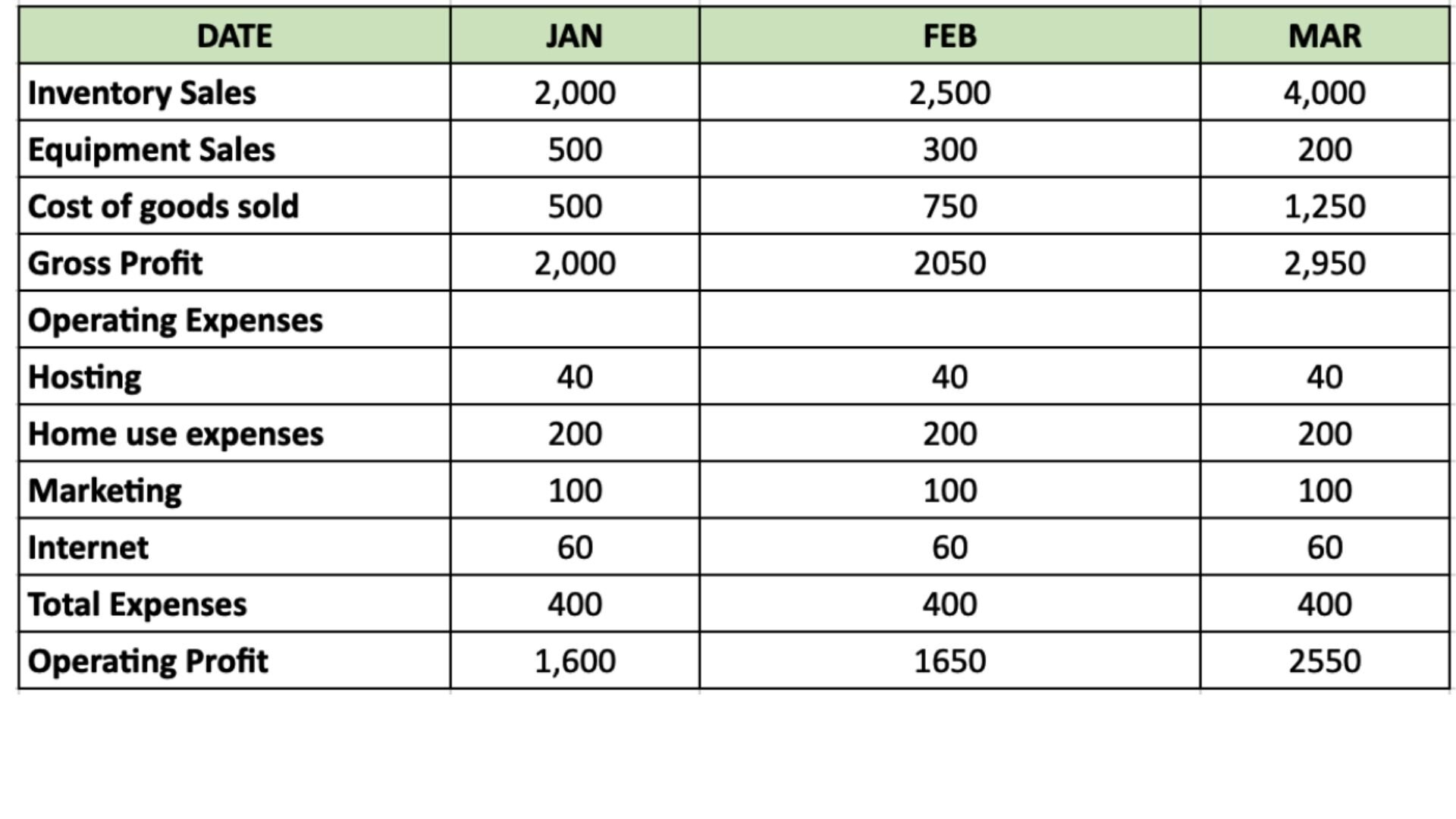
You should watch your cash flow, which is the money coming in and coming out of your business. Here is a basic example of a cash flow statement for an eCommerce business for the first quarter:

A cash flow statement is considered the most important document you can have as an eCommerce entrepreneur. When you know how much cash is flowing in and out of your online business, you can sustain a positive profit margin. On the other hand, if you experience a loss, your cash flow reflects where you need to budget or where you are overspending.

Balance Sheet

A balance sheet consists of assets and liabilities of the business. Both columns should be balanced. The purpose of a balance sheet is to measure the overall position of your business.

The balances must follow the accounting equation:

Assets = Liabilities + Owner’s Equity

(Owner’s equity is the money invested in the business by the owner.)

Income statement

The income statement includes all money brought in over a period. In the basic example above, this shows over a quarter. It shows operating and non-operating income, for example, your inventory sales, and equipment sales, therefore your primary income is your inventory sales.

VAT Threshold for E-commerce

The threshold for eCommerce businesses and selling from a physical store is the same. If you reach the turnover threshold of £85,000 per annum, you will need to register for VAT and charge tax on your goods sold to customers (20%). Therefore, you may need to increase your prices by 20% in order to maintain profit margins, but this may have the effect of customers being sensitive to the price change.

Potential E-commerce sales and delivery tax

The UK HM Treasury is considering applying a 2% sales tax for eCommerce businesses, as well as the 20% standard VAT rate. This is to level out the competition between high street businesses, who face higher operating costs, and online sales.

In addition to this, there could possibly be a delivery tax implemented in order to reduce pollution. This has the aim of influencing consumer behaviour and encouraging customers to environmentally friendly businesses.

Claimable expenses for E-commerce business

Allowable or claimable expenses are costs that are wholly and exclusively involved with the day to day running a business. This, therefore, excludes any costs incurred that are involved with your personal use.  As an eCommerce business, you can take advantage of multiple tax deductions on multiple claimable expenses.

Claimable expenses for eCommerce businesses may include:

·      Advertising and promotion - costs of promotion of your e-commerce business: Marketing (social media advertisements, sponsored advertisements, sponsored content fees by influencers, email marketing software) and Website related content (hosting, domain names, website subscriptions)

·      Banks fees

·      Cost of Goods Sold – the expense you pay as an online seller for manufacturing or selling a product: Materials, Labour (people involved in the production, not those hired for sales), Inventory (goods purchased for resale)

·      Use of home office expenses – must not include personal use, therefore you must proportion your business use and personal use of your home.

Capital Expenses

A capital expense is usually a large cost incurred in order to purchase an asset that you are expecting to have long use of life and benefit your e-commerce business. In this case, your capital expenses would be computers purchased and the website, as most websites provide customers with a system where they can purchase goods or services and contact your business. These are functions and qualify for capital allowances, as they fall into the ‘plant and machinery’ category:

·      Domain name

·      Hardware relating to the website

·      Operating software relating to the website

(You can also claim these as start-up costs for your e-commerce business)

This differs from a revenue expense as this is an amount that is expensed immediately and are used more in the day to day life of the business and is replaced more regularly, such as office stationery.

How to claim expenses for E-commerce businesses

If you are self-employed or a sole trader, employed or a partner at an e-commerce business, you can claim your allowable expenses through the HMRC Self-Assessment Tax Return. You can either file your tax return online or send a paper form, before the tax deadline.

You must have registered for the Self-Assessment Tax Return by the 5 October 2020, and pay the tax you owe by 31 January 2021

If you are filing your tax return online, you must send this by the 31 January 2021.

If you are filing a paper return, you must send this by 31 October 2020.

Contact us for support on your taxes


What Income is Subject to Tax in the UK?

What Income is Subject to Tax in the UK?

A complete overview of the types of income subject to UK Income Tax, the exemptions and allowances available, and key points to help you accurately report earnings and minimise your tax liability.

A Summary of Personal Income Subject to UK Income Tax

In the UK, Income Tax is charged on most types of income that an individual receives. The amount of tax due depends on your total taxable income, the type of income, and the allowances or reliefs available.

If your total income is below the Personal Allowance £12,570 for 2024/25, no Income Tax is due. However, once your income exceeds this threshold, different income categories, such as employment, self-employment, property, investments, pensions, and certain state benefits, may become taxable.

At the same time, there are many exemptions, allowances, and reliefs designed to reduce your tax liability, especially for small amounts of income, certain benefits, and specific investment products. These include personal allowances, marriage allowance, trading allowances, dividend allowances, and tax reliefs on pension contributions and charitable donations, among others. Taking advantage of these can help lower the overall tax payable and ensure that you are not overpaying on your earnings.

UK tax documents and income summary

Earnings from Work

Income from employment or work-related activities is subject to UK Income Tax. Below we break down the main categories and what you need to know for each.

Salaries and Wages

This includes normal pay, overtime, holiday pay, and any back pay you may receive. HMRC considers all regular remuneration from your employer as taxable income, so it’s important to report these amounts accurately on your Self Assessment if applicable.

Bonuses, Tips, and Commission

Any performance-related bonuses, tips from customers, or commission payments are considered taxable, even if paid directly by a customer rather than through payroll. For example, if you work in hospitality or sales, ensure all tips or incentive payments are included in your declared income.

Benefits in Kind

Non-cash benefits provided by your employer, such as a company car (unless fully electric with exemptions), private medical insurance, or living accommodation, are generally taxable unless explicitly exempt. The rules around these benefits can be complex — HMRC provides guidance here.

Redundancy Payments

Certain redundancy payments are taxable, but any amount under £30,000 is generally tax-free. Payments above this threshold may attract tax, so it’s important to understand the breakdown of your redundancy package.

Severance and Termination Payments

Payments in lieu of notice (PILON), holiday pay for untaken leave, and bonuses or commissions due at the point of termination can be taxable. Like redundancy payments, amounts under £30,000 may be tax-free, but amounts above this are generally subject to Income Tax. Always check your employment contract and HMRC guidance to ensure correct reporting.

UK employee payroll and benefits illustration

Certain Employed Income Types Are Exempt from Taxation

Work-Related Expenses

Expenses paid by your employer that are wholly and exclusively for your work are generally exempt from taxation. This can include business travel costs, uniforms required for your role, and professional subscriptions that are approved by HMRC. Keeping accurate records of these expenses is essential to demonstrate they are legitimate and work-related.

Trivial Benefits and Non-Cash Awards

Genuine non-cash awards of trivial value, such as staff meals or refreshments, and small seasonal gifts under £50 (excluding cash or vouchers), are usually exempt from Income Tax. These benefits are intended to reward staff without creating a significant tax liability, but they must meet HMRC’s criteria for triviality and non-cash form.

HMRC-Exempt Benefits

HMRC exempts certain work-related benefits from taxation, including free or subsidised meals in a staff canteen, one mobile phone per employee, parking at or near your workplace, work-related training, certain relocation expenses (up to £8,000), protective clothing or uniforms, and eye tests or glasses needed solely for computer screen use. These exemptions are designed to cover essential work-related costs and provide relief from unnecessary tax burdens.

employee work-related exempt expenses

Redundancy, Severance, and Compensation Payments

Statutory Redundancy and Ex-Gratia Payments

Statutory redundancy payments or ex-gratia payments under £30,000 are generally exempt from Income Tax. Payments related to injury or disability arising from employment are also usually exempt. Employer pension contributions made as part of a settlement may fall under this exemption as well.

Compensation for Loss of Office

Genuine compensation for loss of office, including approved settlement agreement sums, may be tax-free up to £30,000. This mirrors the treatment of redundancy payments and ensures employees are not unduly taxed on amounts designed to compensate for termination. PILON, holiday pay for untaken leave, and contractual bonuses can also be considered, depending on the specifics of the agreement.

redundancy and compensation documents

Self-Employment and Business Income

Profits from self-employment, including sole traders and partnerships, are subject to UK Income Tax. Any income earned from bartering — goods or services received in exchange for work — must be valued at market price and declared as income. Casual work, such as “odd jobs” or side hustles like gardening, tutoring, online sales (if trading in nature), and gig economy work such as Uber or Deliveroo, must also be reported if they meet the criteria for taxable trading income.

It is important to note that even small amounts of casual work can be taxable if they exceed the thresholds set by HMRC, so accurate record-keeping is essential. Self-employed individuals are responsible for reporting profits correctly on their Self Assessment tax return.

Income Types Exempt from Taxation

Certain types of self-employed income may be exempt from taxation under specific conditions. The exemptions help simplify small-scale or hobby activities that are not intended to generate profit. Below we break down the main categories:

Trading Allowance

If your total trading income from self-employment is under £1,000 in a tax year, you may qualify for the trading allowance. This means you do not have to pay tax or submit a Self Assessment return for these earnings, provided you are not claiming expenses. This allowance is particularly helpful for small-scale or one-off trading activity.

Bartering Exemptions

Genuine personal swaps that are not part of a business, such as exchanging furniture with a friend, are generally exempt from taxation. One-off private exchanges without any commercial or trading intent are also excluded. HMRC only requires bartering to be declared if it forms part of your trade or business income.

Casual Work Exemptions

If your casual work or side hustle generates total trading income under £1,000 in a tax year, it is covered by the trading allowance and no tax return is required. This is useful for occasional work such as tutoring, gardening, or gig economy tasks.

Hobby Income

Income from hobbies where there is no profit motive, such as occasionally selling personal items at a loss, is generally not taxable. HMRC distinguishes between hobbies and business activities, so sporadic sales of personal belongings do not fall under self-employment income.

self-employment income and bookkeeping

Property Income

Income from property includes rental income from letting out a property and certain types of furnished holiday lets. After deducting all allowable expenses, this income is subject to UK Income Tax. Properties that do not meet the criteria for furnished holiday lets are taxed as normal rental property, even if partially furnished.

It’s important to understand the conditions for furnished holiday lets (FHL), such as availability to let for at least 210 days per year and actual lettings for at least 105 days per year. Properties failing these conditions are treated as standard rental properties for tax purposes.

Income Types Exempt from Taxation

Certain property income may qualify for exemptions or reliefs under HMRC rules. These allowances can reduce the taxable amount of income, helping small-scale landlords and holiday-let owners manage their tax liability.

Property Allowance

The property allowance allows you to earn up to £1,000 per year in rental income without paying tax, provided you are not claiming any other allowable expenses. This simplifies tax reporting for small-scale lettings or part-time rental activity.

Rent-a-Room Scheme

If you let out a furnished room in your main home, you can earn up to £7,500 per year tax-free under the Rent-a-Room scheme. This allowance is designed to encourage homeowners to rent out spare rooms without the burden of complex tax calculations. You can choose to use the scheme or calculate your profits traditionally, depending on which is more beneficial.

Furnished Holiday Lets Reliefs

Furnished Holiday Lets (FHL) can access more generous tax reliefs than normal rental properties. These include capital allowances for certain furnishings and equipment, as well as potential Capital Gains Tax reliefs such as Business Asset Disposal Relief or Gift Hold-Over Relief. Meeting the FHL conditions is crucial to benefit from these tax advantages.

property rental income and tax records
investment income and savings illustration

Investment Income

Investment income covers earnings from savings, dividends, and certain types of trust income. These income types are generally subject to UK Income Tax, depending on allowances, exemptions, and the specific nature of the income source.

Savings income includes interest from banks, building societies (excluding ISAs), bonds, credit unions, peer-to-peer lending, and certain National Savings & Investments (NS&I) products unless specifically exempt. Dividends from UK or overseas companies are taxable if they exceed the annual allowance. Additionally, some discretionary or interest-in-possession trust income is taxable, often at special trust rates.

Income Types Exempt from Taxation

Certain investment income may be exempt from taxation, either through specific allowances or by HMRC rules:

  • ISA income and gains (Cash ISA, Stocks & Shares ISA, Lifetime ISA, Innovative Finance ISA).
  • Savings income below the Personal Savings Allowance or Starting Rate for Savings.
  • The first £500 per year of dividends (2024/25) is tax-free under the Dividends Allowance.
  • Dividends held inside a pension are exempt from immediate taxation.
  • Premium Bond prizes and certain NS&I products with tax-free status (e.g., NS&I Index-linked Savings Certificates, though no longer widely available).
  • Lottery or betting winnings.
  • Gains on UK government gilts (“Qualifying Corporate Bonds”).
  • Some trust distributions may carry a tax credit or be covered by allowances. Income within bare trusts is taxed as if received directly by the beneficiary, so amounts within their allowances could be tax-free.

Its always worth contacting a professional to check you are correctly defining your income as exempt or not. Not only will a professional save you money on your tax liability but they could also mitigate the chance of you making mistakes on your return. Mistakes on your tax return can result in heavy penalties.

Potential Tax Benefits

Some benefits and allowances you receive may either be partially or fully exempt from UK Income Tax. Understanding which benefits are taxable and which are exempt can help you plan your finances and ensure compliance with HMRC rules. Below we break down the main benefits and their treatment for tax purposes.

Carer’s Allowance

A benefit for people providing care to someone for at least 35 hours per week. This allowance is considered taxable income, so it must be included on your Self Assessment if you are required to file. More info can be found here.

Jobseeker’s Allowance (JSA)

Income-based JSA is exempt from taxation, while contribution-based JSA may be taxable. Note that income-based JSA is largely replaced by Universal Credit for most claimants. Guidance is available here.

Employment and Support Allowance (ESA)

The taxable part of ESA must be reported on your Self Assessment if applicable. This varies depending on the type of ESA and your circumstances. Full guidance can be found here.

Income Types Exempt from Taxation

Certain benefits are fully exempt from taxation. These exemptions ensure support reaches recipients without reducing their disposable income. The main exempt benefits include:

Disability Living Allowance (DLA)

A non-taxable benefit for people with disabilities who need help with mobility or daily living costs.

Personal Independence Payments (PIP)

A replacement for some DLA claimants, PIP is designed to help with additional costs caused by long-term health conditions or disabilities. It is not taxable.

Attendance Allowance

Paid to those over State Pension age needing care due to illness or disability. Fully exempt from Income Tax.

Industrial Injuries Disablement Benefit

Compensation for work-related injuries or occupational diseases. Non-taxable.

Universal Credit

Income-based support to help with living costs. Payments are exempt from Income Tax.

Housing Benefit & Council Tax Reduction

Benefits to help pay rent or council tax are fully exempt from taxation.

Child Benefit

Generally exempt from tax, although the High Income Child Benefit Charge may apply if you or your partner earn above £50,000.

Income-based JSA

This benefit is fully exempt, as it has largely been replaced by Universal Credit for most claimants.

UK benefit payments and paperwork

A Summary of Personal Income Subject to UK Income Tax

UK Income Tax covers a broad range of income sources, but the system includes numerous allowances and exemptions to ensure that not all income is taxed equally. Understanding which income is taxable, and which reliefs apply, is essential for accurate reporting and avoiding unnecessary tax bills.

Most earnings, pensions, property profits, and investment returns are taxable, but often reduced by allowances such as the trading allowance, savings allowance, dividend allowance, and Rent-a-Room relief.

Certain income streams are entirely exempt from taxation, particularly ISA income, state disability benefits, and Premium Bond prizes. Special rules also apply to redundancy payments, pension lump sums, and furnished holiday lets, which may attract partial exemptions or reliefs.

If you receive overseas income and are a UK resident, it may also be taxable depending on your residency and domicile status. It is important to understand these rules to prevent double taxation and ensure compliance.

Careful planning and awareness of your allowances, exemptions, and reliefs can help you reduce your overall tax liability and ensure you only pay what is required by law.

UK tax documents and income summary
A Guide to Amending Your UK Tax Return

A Guide to Amending Your UK Tax Return

If you have spotted a mistake, left out some income, or realised you could claim extra reliefs, knowing how to amend your UK personal tax return ensures your records are accurate and your tax bill is correct.

Live classical concert with a full audience

A guide to Amending Your UK Tax Return

Mistakes and oversights on tax returns are more common than you might think. Whether you’ve spotted an omitted source of income, a forgotten expense, or a figure that needs updating, HMRC allows you to make changes to your return after it’s been submitted.

Amending your return ensures that your tax position is accurate and up to date. Once a correction is made, HMRC will adjust your tax calculation accordingly, which may result in either a refund or an additional payment.

This guide explains the key deadlines, methods, and steps involved in amending a UK tax return — and what to do if you miss the standard timeframe.

Reasons You May Need to Amend a Tax Return

There are several situations where you might need to update a return you’ve already filed. Some are due to changes in your personal circumstances, while others arise from new information or updated guidance from tax authorities. Here are a few examples:

Change in overseas tax treatment

One of our clients received updated guidance from the Canada Revenue Agency (CRA) regarding how their Canadian pension should be taxed. This change meant their original UK return no longer reflected the correct tax position, so we filed an amendment to align with HMRC rules.

Missed income or benefits

A client realised they had forgotten to include bank interest from a savings account. Adding this income required us to amend the return and recalculate the tax due.

Updated expense claims

A self-employed client initially underestimated their allowable business expenses. Once the correct figures were provided, we submitted an amendment which reduced their overall tax bill.

Late-arriving documents

Sometimes, dividend vouchers or P60/P45 forms arrive after the return is filed. In one case, a client’s investment provider issued an updated dividend certificate, which meant their return needed to be corrected.

Corrections to pension contributions

A client originally reported a lower pension contribution than what was actually paid. Updating this figure increased their available tax relief and reduced their liability.

Chef cooking in a wok, looks tasty
Live classical concert with a full audience

Step-by-Step: Amending your UK tax return via HMRC Online

Amending a UK tax return through HMRC’s online system is often more straightforward than many people expect, but it’s important to approach the process carefully to make sure the information you provide is accurate. Whether you’ve noticed a mistake, forgotten to include some income, or realised you’re entitled to extra reliefs, HMRC allows you to update your submitted return within specific time limits. Correcting these issues promptly helps you avoid potential penalties and ensures you pay the right amount of tax.

Before you begin, it’s useful to know what you’ll need and how the process works. You’ll need access to your HMRC online account, the details you want to change, and any supporting records to back up your amendments. Once logged in, HMRC guides you through the amendment process in a series of steps, and you can track any changes to your tax calculation once they’ve been processed. In the sections that follow, we’ll walk through the step-by-step process to make amending your return as smooth as possible.

old couple walking in new york with the empire state building and statue of liberty in the background

Step 1

Sign in to your HMRC account.

Step 2

From ‘Your tax account’, select ‘Self Assessment account’.

Step 3

Click ‘More Self Assessment details’.

Step 4

From the left-hand menu, choose ‘At a glance’.

Step 5

Select ‘Tax return options’.

Step 6

Pick the tax year you want to amend.

Step 7

Open the return, make your corrections, and file it again.

If You Used Commercial Software

Most tax software has a built-in process for amendments. The exact steps vary by provider, but typically you’ll re-open your submitted return, make the changes, and re-submit directly through the software.

How to Amend your UK self assessment by Post

If you prefer to amend your Self Assessment tax return by post, HMRC still provides a clear process to follow. Instead of updating your details online, you’ll need to complete a paper return using the relevant forms, making sure all changes are clearly marked. This method can be useful if you’re more comfortable working with hard copies or if you don’t have reliable access to HMRC’s online services.

The process involves using the main Self Assessment form (SA100) alongside any necessary supplementary pages, clearly labelling the pages as amendments, and sending them to HMRC at the correct address. Once received, HMRC will review your changes and update your tax bill, issuing a refund if you’ve overpaid or advising you of any extra amount due. While straightforward, paper amendments can take longer to process, so it’s worth allowing extra time before your account is updated.

Step 1 : Get the forms:

Download the SA100 tax return form from HMRC, or Call HMRC to request one by post. Supplementary pages (e.g. SA102 for employment, SA105 for property income) can also be downloaded online.

Step 2: Complete the corrected pages with the updated information.

Make sure to complete the relevant pages with the updated information. It's always important to double check so you don't have to amend your return again.

Step 3: On each page, write:

A self-employed client initially underestimated their allowable business expenses. Once the correct figures were provided, we submitted an amendment which reduced their overall tax bill.

Late-arriving documents

“Amendment” clearly at the top, Your name, Your UTR (found on previous tax returns or HMRC letters)

Step 4: Send your amended pages:

to the address on your Self Assessment paperwork, or use the HMRC Self Assessment address above if unsure.

Step 5: Wait for HMRC to process your amendment.

They will send you an updated tax calculation and bill, and issue any refund directly to your bank (if bank details are provided on the return).

Always keep a copy of the amended pages you send, along with proof of posting (e.g. Post Office receipt). This helps track progress if HMRC queries your amendment.

Chef cooking in a wok, looks tasty
New York City

If You’ve Missed the Deadline to Change Your Return

If you’ve missed the 12-month deadline for amending your Self Assessment return, you can no longer make changes online or by post. Instead, you’ll need to write directly to HMRC to explain what needs correcting and why. This written approach is the only option once the amendment window has closed.

In some cases, you may still be able to reclaim overpaid tax by making a claim for overpayment relief. This can be done up to four years after the end of the relevant tax year, but your letter must include all the required information and evidence. Without the correct details, HMRC is likely to reject your claim, so it’s important to be thorough when setting out your case.

When You Need to Write to HMRC

You must contact HMRC in writing if you need to correct an old return (beyond the 12-month amendment window).

What to Include in Your Letter

For all late amendments, include:

  • The tax year you are correcting.
  • The reason for the correction (why you paid too much or too little).
  • The amount you believe is over or underpaid.
  • Restructuring or moving to a different business model.
  • Death of a director or shareholder.
  • Your signature (no one else can sign for you).

For overpayment relief claims, you must also state:

  • That you are making a claim for overpayment relief.
  • Whether you have previously appealed the same payment.
  • A signed declaration: “The details I have given are correct and complete to the best of my information and belief.”

If you’re unsure whether your situation qualifies for overpayment relief or another correction route, it’s best to seek advice before writing to HMRC — this can avoid delays or rejected claims. Download our example template

Changes in Tax Due on your Amended UK Personal Tax Return

When you amend your tax return, the change may result in either a refund or an additional tax bill. If you have overpaid, HMRC will update your Self Assessment account and issue a repayment—usually directly to your bank account if details are provided, or by cheque if not.

If the amendment means you owe more tax, HMRC will send you an updated bill with a new payment deadline and make any necessary adjustments to your payments on account. Whether you’re due a refund or need to make an extra payment, it can take a few weeks for HMRC to process the changes, especially if the amendment was made by post.

If You’re Owed Tax

If your amendment shows you’ve paid too much tax:

The HMRC will update your Self Assessment statement. Any overpayment will usually be refunded directly to your bank account (provided you’ve given HMRC your bank details). If no bank details are held, HMRC will send a cheque to your registered address.

Refunds can take longer to process after a paper amendment, so it’s a good idea to keep an eye on your Self Assessment account for updates.

Chef cooking in a wok, looks tasty

Need More Help?

If you need more help or haven't found exactly what you were looking for, feel free to Get in Touch. We have over 20 years of experience helping our clients who have missed filing deadlines.

UK–US Double Taxation Relief and NIIT Changes Explained (November 2025)

UK–US Double Taxation Relief and NIIT Changes Explained (November 2025)

A detailed and practical overview of the latest changes to double taxation relief between the UK and the US, including updates to the Net Investment Income Tax (NIIT) rules and how they affect cross-border taxpayers.

Live classical concert with a full audience

NIIT Recognised for UK Double Taxation Relief

In November 2025, HMRC updated its Double Taxation Relief Manual to confirm that the US Net Investment Income Tax (NIIT) qualifies as an admissible foreign tax for UK credit relief purposes. This clarification resolves a long-running area of uncertainty for UK taxpayers with exposure to US investment income.

Prior to this update, whether NIIT could be credited against UK tax was widely debated, leading to inconsistent treatment and, in some cases, unrelieved double taxation. HMRC’s revised guidance now confirms that NIIT can be taken into account when calculating UK double taxation relief, provided the usual conditions for credit relief are met.

For individuals and businesses subject to both UK tax and US NIIT on the same income or gains, this change can materially reduce the overall tax burden. This article explains what NIIT is, what HMRC’s guidance change means in practice, who stands to benefit, and the practical steps taxpayers should now consider.

What Is the US Net Investment Income Tax (NIIT)?

The US Net Investment Income Tax (NIIT) is a 3.8% federal surtax imposed on certain categories of US investment income. It applies in addition to standard US federal income tax once a taxpayer’s modified adjusted gross income exceeds specified statutory thresholds.

NIIT commonly applies to the following types of income:

  • Interest, dividends, and annuities
  • Rents and royalties
  • Capital gains, including gains on US securities and US real estate
  • Passive income from partnerships, LLCs, and S corporations

While NIIT primarily affects US taxpayers, non-US residents can also be subject to the charge where they are treated as US taxpayers for federal income tax purposes. This can arise through US residency tests, elections, or specific filing positions taken under US tax law.

The Historic Problem: NIIT and UK Tax Relief

Until HMRC’s November 2025 update, NIIT occupied an uncertain and often problematic position for UK tax purposes. Although it is calculated by reference to investment income, NIIT is not explicitly labelled as “income tax” under US law and is imposed under a separate chapter of the Internal Revenue Code.

HMRC had not previously provided clear confirmation that NIIT qualified as a tax on income for the purposes of UK unilateral double taxation relief. As a result, many UK taxpayers found themselves exposed to genuine double taxation.

In practice, this meant taxpayers could be required to pay:

  • UK income tax or capital gains tax, and
  • US Net Investment Income Tax on the same income or gain

While some relief claims were accepted on a case-by-case basis, others were rejected or left unresolved, creating uncertainty and inconsistent outcomes. HMRC’s updated guidance now addresses this long-standing grey area.

Chef cooking in a wok, looks tasty
Live classical concert with a full audience

The November 2025 Change: NIIT Is Now Admissible

HMRC Confirmation of NIIT Status

HMRC has now explicitly confirmed in its Double Taxation Relief Manual that the United States Net Investment Income Tax, commonly referred to as NIIT, is an admissible foreign tax for the purposes of UK foreign tax credit relief. This update, published in November 2025, brings long awaited clarity for UK taxpayers who are subject to US tax on investment income.

How NIIT Is Treated for UK Credit Relief

Under the revised guidance, NIIT is treated in the same way as other admissible US taxes, including US federal income tax and certain US federal excise taxes on insurance. At the same time, HMRC has clearly distinguished NIIT from US charges that do not qualify for UK credit relief, such as Social Security and Medicare taxes under FICA and taxes charged under the Self Employment Contributions Act.

Practical Impact for UK Taxpayers

The updated guidance removes any remaining doubt over HMRC’s position and confirms that NIIT is regarded as a tax on income for UK credit relief purposes. For UK taxpayers who suffer both UK tax and US NIIT on the same income or gains, this confirmation allows relief to be claimed and can significantly reduce true double taxation, subject to the normal rules governing foreign tax credits.

Who Benefits From the NIIT Clarification

HMRC’s confirmation that US Net Investment Income Tax is admissible for UK foreign tax credit relief is particularly important for UK resident individuals with exposure to US investment income. This includes those holding US investment portfolios, receiving US rental or passive business income, or realising gains on US taxable assets.

The change is also highly relevant for UK residents who are treated as US taxpayers for federal tax purposes, such as dual residents or individuals who meet US residency tests or have made elections under US tax law. In addition, UK shareholders in US pass through entities, including partnerships and LLCs, may now be able to obtain relief where NIIT is charged on underlying income or gains.

For many affected taxpayers, the ability to credit NIIT against UK tax can reduce the combined effective tax rate by up to 3.8 percent, significantly easing the impact of double taxation on the same income or gains.

How the Credit Works in Practice

UK foreign tax credit relief for NIIT remains subject to the standard limitations that apply to all foreign tax credits. The amount of credit available is capped at the UK tax attributable to the same income or gain, meaning excess US tax cannot generate a UK repayment.

Relief is only available where the income or gain is taxed in both jurisdictions. Where NIIT is paid on income that is also subject to UK income tax, the NIIT should now be included within the foreign tax credit calculation when completing the UK return.

In the case of capital gains, NIIT may be creditable against UK capital gains tax, provided the gain is chargeable in both the United Kingdom and the United States and the normal conditions for credit relief are satisfied.

Chef cooking in a wok, looks tasty
Map of the United States showing different state tax rates

Interaction with US State Taxes

The November 2025 NIIT clarification complements HMRC’s detailed guidance on US state taxes. While many state income taxes are already eligible for UK foreign tax credit relief, other taxes, including franchise, gross receipts, or capital-based taxes, remain inadmissible. Taxpayers must therefore continue to review state-specific tax obligations individually to determine which credits can be claimed.

The recognition of NIIT as creditable strengthens the overall coherence of UK–US double taxation relief, but it does not automatically extend to all state-level taxes. Careful planning and review remain essential for those with significant exposure to multiple US jurisdictions.

Next Steps for Taxpayers After the NIIT Guidance Update

Following HMRC’s November 2025 confirmation that the US Net Investment Income Tax (NIIT) is creditable for UK double taxation relief, taxpayers should take a series of practical steps to ensure they optimise relief and remain compliant. The actions vary depending on prior returns, investment structures, and tax planning arrangements.

Review Open and Historic Returns

Taxpayers with unresolved or disputed foreign tax credit claims involving NIIT should revisit those positions. There may be scope to amend UK tax returns, subject to statutory time limits, reopen enquiries or appeals, and submit additional claims supported by the updated HMRC guidance.

Update Tax Provisioning and Cash‑Flow Modelling

For affected clients, effective tax rates on US investment income may now be lower than previously assumed. This is particularly important for high-net-worth individuals, trusts and family offices, and cross-border investment structures that need accurate tax provisioning and forecasting.

Ensure Correct Classification of US Taxes

Care is still required to distinguish NIIT from Medicare surtaxes, self-employment taxes, and state-level levies that remain inadmissible. Incorrect categorisation can delay or jeopardise the ability to claim relief efficiently.

Chef cooking in a wok, looks tasty
Person reviewing tax documents with a calculator

Final Thoughts on NIIT and UK Double Taxation Relief

HMRC’s confirmation that US Net Investment Income Tax (NIIT) is an admissible tax for UK foreign tax credit relief represents a significant and welcome development. This guidance removes long-standing uncertainty, aligns UK treatment with economic reality, and delivers tangible relief for UK taxpayers exposed to US investment income.

Despite this clarity, the complexity of US federal and state taxes means that professional advice remains essential. November 2025 marks a turning point, reducing the risk that NIIT will be a permanent source of double taxation for UK taxpayers.

If you would like advice on how this change affects your business or personal tax position, please speak to your usual adviser or contact a specialist.

Need Specialist Advice on NIIT?

If you need further guidance on how the November 2025 NIIT changes affect your UK-US tax position, or have questions about claiming double taxation relief, please Get in Touch. Our team is ready to help you navigate these updates with confidence.

U.S. Income Tax: The Basics

U.S. Income Tax: The Basics

U.S. Income Tax can be a very daunting prospect to those who do not understand the ins and outs of the U.S. tax system. By understanding the basics you can gain peace of mind when filing your U.S. taxes

Live classical concert with a full audience

Understanding US Income Tax

The landscape of US income tax can often feel like a dense and intricate maze. From understanding who is required to pay, to deciphering the various forms and regulations, it's a system that touches nearly every individual and business operating within the United States. This article aims to be your comprehensive guide, shedding light on the most important aspects of this crucial element of the American financial system

At its core, US income tax is a levy imposed by the federal government, and in many cases by state and local governments, on the earnings of individuals, corporations, estates, and trusts. It's the primary way these governing bodies fund public services, from infrastructure and education to defense and social programs. Understanding the fundamentals of this system is not just a matter of legal compliance; it's key to effective financial planning and business management.

Student and teach talking about something cool

State Vs Income Tax

When we talk about US income tax, it's easy to think of it as one monolithic system. However, the reality is more like a two-tiered structure, with obligations arising at both the federal and, often, the state level. While both aim to tax your earnings, the way they go about it – from the tax rates they apply to what income they consider taxable and the deductions they allow – can differ significantly. Getting to grips with these distinctions is key to understanding your overall tax picture.

Think of the federal income tax as the overarching system, governed by the Internal Revenue Code (IRC). It's the tax levied by the central government and operates on a progressive model. This simply means the more taxable income you have, the higher the tax rate you'll pay on those higher portions. The federal system uses tax brackets, essentially income ranges, each with its own tax rate. For 2024, there are seven of these, ranging from 10% up to 37% for the highest earners. These brackets aren't set in stone; they're adjusted periodically to keep pace with inflation. When filing your federal taxes, you generally have a choice: take the standard deduction, a fixed amount based on your filing status, or itemize specific expenses like medical costs, state and local taxes (with some limits), and charitable donations. A significant recent change came with the 2018 Tax Cuts and Jobs Act (TCJA), which bumped up the standard deduction, influencing how many people choose to file.

One major difference between state tax and income tax is the tax rate structure. Some states opt for a flat tax, also known as a single-rate system. Here, everyone pays the same tax percentage on their entire taxable income, regardless of whether they earn a little or a lot. As of 2024, states like Arizona, Colorado, Georgia, and Illinois use this flat tax approach. Even Washington has a flat tax, though it applies specifically to the capital gains of higher earners, and Iowa is heading towards a flat tax system. On the other hand, many states mirror the federal approach with a progressive tax system. This means they also use tax brackets, taxing higher income at higher rates. While some states might base their brackets on the federal model, many create their own unique sets of income ranges and tax percentages. The frequency with which these brackets are adjusted for inflation also varies. For example, Hawaii has quite a few tax brackets, while Kansas has only a handful. Interestingly, California has the highest top tax rate in the country, hitting very high earners, while North Dakota has one of the lowest top rates, kicking in at a relatively high income level.

In essence, while both federal and state governments rely on income tax as a key revenue source, their systems differ significantly in structure, rates, and specific rules. The federal system is a nationwide progressive model, while states offer a spectrum of approaches, from flat taxes to progressive systems with varying degrees of complexity, and even the absence of a broad income tax altogether. Understanding these distinctions is fundamental to grasping the full picture of income taxation in the United States.

Understanding Who Pays Tax

US income tax isn't a selective process; it casts a wide net, touching the financial lives of a vast range of individuals and entities operating within the country. Understanding who is obligated to pay and why it's relevant to them is a foundational piece of the income tax puzzle.

Individuals

The most common group subject to US income tax is individuals. This includes:

US Citizens

Regardless of where they reside in the world, US citizens are generally subject to US income tax on their worldwide income.

Resident Aliens

Non-US citizens who meet certain residency tests (based on the number of days they are physically present in the US) are also taxed on their worldwide income.

Non-Resident Aliens

Non-US citizens who meet certain residency tests (based on the number of days they are physically present in the US) are also taxed on their worldwide income.

For these individuals, income tax is relevant because it directly impacts their net earnings and their disposable income. The amount of tax owed can significantly affect their financial planning, savings, and overall financial well-being.

Other Taxable Entitites

While individuals form the largest group of taxpayers, US income tax also applies to various business structures and legal entities:

Corporations (C-Corps)

These are legal entities separate from their owners and are subject to corporate income tax on their profits. Their shareholders are then also taxed on any dividends they receive, leading to a potential "double taxation."

Limited Liability Companies (LLCs)

The tax treatment of an LLC depends on its election. It can be treated as a sole proprietorship (if it has one member), a partnership (if it has multiple members), or even as a C-Corp or S-Corp.

Estates and Trusts

These legal entities, created to manage assets after someone's death or for the benefit of specific individuals, are also subject to income tax on any income they generate.

old couple walking in new york with the empire state building and statue of liberty in the background
Student and teach talking about something cool

Gross Income: Inclusions and Exclusions

Gross income is a foundational element in the United States federal income tax system, forming the starting point for calculating a taxpayer’s taxable income. It is defined under Section 61 of the Internal Revenue Code as “all income from whatever source derived,” unless specifically excluded by law. The broad scope of this definition ensures that nearly all economic gains received by an individual or entity are subject to taxation unless there is a clear statutory exemption.

Taxable Inclusions: What Constitutes Gross Income

The most common types of includible income are wages, salaries, tips, commissions, and bonuses received as compensation for services. In addition to earned income, taxpayers are also required to include unearned income such as interest from bank accounts, dividends from corporate stock, rental income from property, and royalties from intellectual property or mineral rights. Capital gains profits realized from the sale of stocks, real estate, or other capital assets are also taxable, though they may be subject to preferential rates depending on the holding period.

Other types of income that must be reported include unemployment compensation, gambling winnings, alimony received (for divorce or separation agreements executed before January 1, 2019), and income from canceled debts, unless an exclusion such as insolvency or bankruptcy applies. Additionally, bartered services and non-cash compensation—such as the receipt of property or services in exchange for labor—are generally considered taxable and must be valued at fair market value.

Exclusions: What Can Be Legally Omitted from Gross Income

Despite the wide reach of gross income rules, the tax code provides several exclusions that allow certain types of income to be omitted from taxation. Among the most significant are gifts and inheritances, which are not considered taxable income to the recipient, though they may be subject to gift or estate taxes on the part of the donor or decedent’s estate. Similarly, life insurance proceeds paid by reason of the insured’s death are generally excluded from the beneficiary’s gross income.

Other exclusions include interest on municipal bonds, which is exempt from federal income tax, and qualified scholarships and fellowships, provided the funds are used for tuition, fees, books, and required supplies. Employer-provided benefits can also be excluded under certain conditions. For example, premiums for group-term life insurance up to a specified limit, health insurance contributions, adoption assistance, and dependent care benefits may all be excluded if they comply with the requirements set forth in the tax code and associated regulations.

Residency and Tax Status

Determining your tax residency isn't just a technicality; it's the crucial factor that dictates which state (or states) has the authority to tax your income. This becomes particularly important if you've recently moved, are planning a relocation, or even if you split your time between different states. Each state operates under its own set of rules to establish who it considers a tax resident, and a misunderstanding can lead to unwelcome tax bills or penalties.

Think of it this way: your residence is generally where you live. Tax residency, however, is a legal designation that determines your state income tax obligations. While often the same, they can diverge, especially in situations involving interstate moves or part-year living in different states.

Most states hinge their definition of tax residency on two key concepts: domicile and statutory residency.

  • Domicile: This refers to your permanent home, the place you intend to return to after any temporary absences. It's often described as your "true home."
  • Statutory Residency: This usually involves spending a specific amount of time within a state during a tax year, often around 183 days.

Generally, if you are domiciled in a state or meet its statutory residency test, that state can treat you as a tax resident. This means it can tax your income, regardless of where that income was earned. This is where the potential for dual tax residency arises – you could meet the domicile test in one state and the statutory residency test in another, leading to the possibility of being taxed by both.

Chef cooking in a wok, looks tasty
Student and teach talking about something cool

Establishing Your Domicile

When you move to a new state, clearly establishing your new domicile as soon as possible is crucial for avoiding tax confusion. States look for concrete actions that demonstrate your intent to make a new state your permanent home. Some key ways to document this change include:

  • Registering to vote in your new state.
  • Buying or leasing a permanent residence in your state
  • Obtaining a driver's license from your new state.
  • Updating your address with important institutions like your bank, the US Postal Service (USPS), and the Internal Revenue Service (IRS).

The more evidence you have, the better protected you'll be if a state decides to audit your residency. These audits happen when a state wants to verify your residency claims, and they might be more likely if you've moved from a high-tax state to one with lower taxes. Auditors might scrutinize your financial records, travel history, and even your social connections to determine your true tax home.

Implications of Dual Tax Residency

Being considered a tax resident in more than one state can unfortunately lead to double taxation, where multiple states claim the right to tax your entire worldwide income for the same year. This often happens when you meet the domicile test in one state and the statutory residency test in another. It can also occur if you own property in multiple states, live in one but work in another, or don't properly establish domicile after a move.

While some states offer credits for taxes paid to other states, these credits can vary significantly and might not always fully offset the extra tax burden.

Understanding What is Taxable

US income tax applies to a broad range of earnings, but not all money you receive is subject to it. Understanding the difference between taxable income and non-taxable income is fundamental to accurately calculating your tax liability.

Generally Taxable Income

This category encompasses most forms of income you receive, including:

  • Wages, Salaries, and Tips: Money earned from employment.Wages, Salaries, and Tips: Money earned from employment.
  • Self-Employment Income: Profits from your own business or freelance work.
  • Interest Income: Earnings from savings accounts, bonds, and other interest-bearing investments.
  • Dividend Income: Payments received from owning stock in companies.
  • Capital Gains: Profits from selling assets like stocks, real estate, or other investments. The tax rate can vary depending on how long you held the asset.
  • Retirement Income: Distributions from traditional IRAs, 401(k)s, and pensions (though contributions may have been pre-tax).
  • Rental Income: Earnings from renting out property.
  • Alimony Received (for agreements finalized before January 1, 2019): Payments received from a former spouse under a divorce or separation agreement.
  • Unemployment Compensation: Benefits received while unemployed.
  • Social Security Benefits (potentially taxable): A portion of your Social Security benefits may be taxable depending on your other income.
  • Prizes and Awards: The value of cash and non-cash prizes and awards.

Generally Non-Taxable Income:

While the list of taxable income is extensive, certain types of income are typically exempt from federal income tax:

  • Child Support Payments: Payments received for the support of a child.
  • Alimony Received (for agreements finalized after December 31, 2018): Payments received under newer divorce or separation agreements are generally not taxable income for the recipient
  • Certain Scholarship and Grant Money: Amounts used for tuition, fees, books, supplies, and equipment required for your courses (subject to certain conditions).
  • Workers' Compensation Benefits: Payments received due to a work-related injury or illness.
  • Damages for Physical Injury or Sickness: Compensation received for physical injuries or sickness.
  • Life Insurance Proceeds: Amounts received as a beneficiary upon the death of the insured
  • Certain Social Security Benefits: If your total income is below a certain threshold, your Social Security benefits may not be taxable.
  • Municipal Bond Interest: Interest earned from bonds issued by state and local governments.
  • Qualified HSA Distributions: Distributions from a Health Savings Account (HSA) used for qualified medical expenses.

It's important to remember that tax laws can be complex, and the taxability of certain income can depend on specific circumstances and may have exceptions. Consulting official IRS resources or a tax professional is always recommended for clarification on specific income types.

How to reduce your overall tax liability

It's wise to explore ways to potentially lower your tax burden, but remember that the information below provides general overviews. Navigating the complexities of US income tax requires careful consideration of your individual circumstances, and it is crucial to consult with a qualified tax professional to ensure you are applying these strategies correctly and in full compliance with the law. They can provide personalized advice and help you avoid any unintended errors.

Here are some common avenues individuals and businesses explore to potentially reduce their income tax liability:

Deductions to Reduce Your Income Tax

Deductions lower your taxable income, the amount that's actually taxed. Think of them as subtractions from your total income.

You can take the standard deduction, a set amount that depends on your filing status or, you can itemize deductions, listing specific eligible expenses. You choose whichever is higher. Common itemized deductions include:

  • Certain medical expenses (above a specific income threshold).
  • State and local taxes (with limits).
  • Home mortgage interest.

Many normal and necessary costs to run your business can be deducted.

Credits to Reduce Income Tax

Tax credits are often more valuable because they directly lower the amount of tax you owe, dollar for dollar.

Various credits exist for individuals and businesses, often to encourage certain actions or help specific taxpayers. Examples include:

  • Child Tax Credit.
  • Earned Income Tax Credit.
  • Credits for energy-efficient home improvements.
  • Business credits for research, hiring, or renewable energy investments.

Business Expenses

For business owners, deducting normal and necessary costs to run the business lowers taxable income. Some examples include:

  • Office supplies.
  • Rent and utilities.
  • Advertising
  • Travel.
  • Professional fees.

Always consult a tax professional when before trying to reduce your income tax. Any error in this error can lead you liable to large financial penalties and potentially jail time.

Student and teach talking about something cool

Essential Documents for US Income Tax

Preparing your US income tax return can feel like assembling pieces of a puzzle. Having the right documents organized and readily available is crucial for an accurate and efficient filing process. The specific documents you'll need will depend on your individual circumstances, sources of income, and any deductions or credits you plan to claim. However, here's a breakdown of some of the most common and relevant documents you'll likely need:

For Identifying Yourself and Dependents

Social Security Numbers (SSNs) or Individual Taxpayer Identification Numbers (ITINs): You'll need your own SSN or ITIN, as well as those for your spouse (if filing jointly) and any dependents you are claiming. Ensure these are accurate to avoid processing delays.

Birth Dates: You'll need the birth dates for yourself, your spouse, and any dependents.

For Reporting Your Income

Form W-2, Wage and Tax Statement: Received from your employer(s), this form reports your annual wages, salaries, tips, and other compensation, as well as the amount of federal and state income tax withheld.

Form 1099 Series This is a series of forms used to report various types of income from sources other than an employer. Common types of 1099 forms include: 1099-NEC, 1099-DIV and 1099-INT among others

Schedule K-1 (Form 1065, 1120-S, or 1041): If you were a partner in a partnership, a shareholder in an S corporation, or a beneficiary of an estate or trust, you'll receive a Schedule K-1 detailing your share of the entity's income, deductions, credits, etc.

Records of Self-Employment Income and Expenses: If you are self-employed, you'll need detailed records of all your income and deductible business expenses (invoices, receipts, etc.).

Rental Income and Expense Records If you own rental property, you'll need records of rental income received and all associated expenses (mortgage interest, repairs, etc.).

Student and teach talking about something cool

For Claiming Deductions and Credits

Records for Itemized Deductions (if applicable):

Medical Expenses: Bills, receipts, and statements from doctors, hospitals, dentists, and insurance companies.

State and Local Taxes (SALT): Records of property taxes paid, state and local income taxes paid (e.g., W-2 showing withholdings, estimated tax payments), and sales tax records if you are deducting actual sales tax instead of state income tax.

Home Mortgage Interest: Form 1098, Mortgage Interest Statement, from your lender.

Charitable Contributions: Receipts from qualifying organizations (written acknowledgments for donations over $250), bank records, and records of non-cash donations.

Casualty and Theft Losses: Documentation of the loss and any insurance reimbursements.

Records for Adjustments to Income:

  • IRA Contributions: Statements from your IRA custodian showing contributions made.
  • Student Loan Interest Payments: Form 1098-E, Student Loan Interest Statement, from your lender.
  • Health Savings Account (HSA) Contributions: Records of your contributions.

Records for Tax Credits

Please note that the specific documentation needed will vary depending on the credit. Some common examples include:

  • Child and Dependent Care Expenses: Provider's name, address, and Taxpayer Identification Number (TIN).
  • Education Credits (e.g., Form 1098-T, Tuition Statement): Statements from educational institutions.
  • Energy Credits: Receipts for qualifying energy-efficient improvements.

Bookkeeping and Record Keeping

Accurate bookkeeping and diligent record keeping are the bedrock of a smooth and defensible tax process. Think of them as building a strong foundation for your financial reporting. Consistent and organized records not only simplify tax preparation but also empower you to understand your financial health and make informed decisions year-round. Here are some practical tips to establish effective bookkeeping and record-keeping habits:

Keep Separate financial Accounts

If you have income beyond regular employment (e.g., freelance work, investments), consider maintaining separate bank accounts and even credit cards to track these activities more clearly.

Regularly Track Income

Keep records of all income received, whether it's pay stubs, 1099 forms, or records of cash transactions. Note the date, source, and amount.

Document Deductible Expenses

Start a habit of saving receipts for potentially deductible expenses throughout the year. This might include medical bills, charitable donations, home improvement records (if relevant for future home sales), and educational expenses. Make notes on what the expense was for.

Utilize Digital Tools

Scan paper receipts and store them digitally. Many apps allow you to photograph receipts and categorize them on the go. Cloud storage ensures you won't lose your records.

Review Periodically

Don't wait until tax season. Take some time each month or quarter to review your income and expenses to ensure everything is accurate and you're not missing any deductions.

By implementing these tips, both individuals and businesses can establish robust bookkeeping and record-keeping practices that will not only simplify tax preparation but also provide valuable insights into their overall financial picture. Remember, a little effort throughout the year can save significant time and stress during tax season and beyond.

For more tips feel free to reach out, we are always here to help you and tailor our service to your situation.

Understanding the Calculation: An Overview for Individuals and Businesses

It's important to remember that the specifics of income tax calculation can be quite intricate and highly dependent on individual or business circumstances. This overview provides a general understanding of the process.

1.

Determine Gross Income

This is the total income you receive from all sources throughout the year. This includes wages, salaries, tips, interest, dividends, capital gains, retirement distributions, rental income, and other forms of earnings.

2.

Subtract Adjustments to Income

Certain deductions are taken "above the line," meaning they reduce your gross income to arrive at your Adjusted Gross Income (AGI). Common adjustments include contributions to traditional IRAs, student loan interest payments, contributions to health savings accounts (HSAs), and certain self-employment taxes.

3.

Calculate Taxable Income

This is your AGI minus either the standard deduction (a fixed amount based on your filing status – single, married filing jointly, etc.) or your total itemized deductions (if these exceed the standard deduction). Itemized deductions can include things like certain medical expenses, state and local taxes (with limitations), home mortgage interest, and charitable contributions. You'll choose whichever results in a lower taxable income.

4.

Calculate Tax Liability

Once you have your taxable income, you apply the federal income tax brackets to this amount. The US uses a progressive system, meaning different portions of your taxable income are taxed at different rates. As your income rises, the tax rate on the additional income also increases. The specific tax brackets and rates depend on your filing status and are subject to change annually.

5.

Apply Tax Credits

Tax credits directly reduce the amount of tax you owe. Various credits are available, such as the Child Tax Credit, Earned Income Tax Credit, education credits, and credits for certain energy-efficient improvements.

6.

Determine Total Tax and Payments

You then compare your total tax liability (calculated in step 4, minus any credits in step 5) with the total amount of taxes you've already paid throughout the year (through withholdings from your paycheck or estimated tax payments). This determines whether you owe additional taxes or are due a refund.

How is Income Tax Collected?

US income tax is primarily collected through two main methods: withholding and estimated tax payments. For the majority of individuals who are employees, income tax is automatically withheld from each paycheck by their employer. The amount withheld is based on the information the employee provides on their Form W-4, Employee's Withholding Certificate, which includes their filing status and any adjustments or credits they expect to claim. Employers then remit these withheld taxes to the Internal Revenue Service (IRS) on a regular basis throughout the year. This "pay-as-you-go" system ensures that tax liability is met gradually.

Individuals who are self-employed, have significant income from sources not subject to withholding (like investments or rental income), or don't have enough tax withheld from their wages are generally required to make estimated tax payments throughout the year. These payments are typically made quarterly to the IRS and, if applicable, to state and local tax authorities. Estimated tax covers not only income tax but also self-employment tax (Social Security and Medicare taxes for the self-employed). By paying estimated taxes, these individuals avoid potential penalties for underpayment of tax when they file their annual tax return.

Most states hinge their definition of tax residency on two key concepts: domicile and statutory residency.

  • Domicile: This refers to your permanent home, the place you intend to return to after any temporary absences. It's often described as your "true home."
  • Statutory Residency: This usually involves spending a specific amount of time within a state during a tax year, often around 183 days.

Understanding key tax deadlines is crucial for both individuals and businesses to avoid penalties and ensure compliance. While specific dates can shift slightly if they fall on a weekend or holiday.

Chef cooking in a wok, looks tasty

Key Deadlines for US filers

April 15th

Standard Deadline for filing form 1040

June 15th

Automatic extension for expats living abroad.

October 15th

Extended deadline for those who file Form 4868.

FBAR Deadline

Due April 15 (automatic extension to October 15 if missed).

Staying aware of these key dates and planning accordingly is a vital part of effective financial management and tax compliance in the US.

Student and teach talking about something cool

Understanding Audits and Penalties: What Happens When Things Go Wrong

Even with the best intentions, errors can occur on tax returns.The IRS, and state tax authorities, have systems in place to identify potential discrepancies, which can sometimes lead to an audit or the assessment of penalties. Understanding these possibilities is part of being a well-informed taxpayer.

Tax Audits: When the IRS Asks Questions

A tax audit is simply a review by the IRS (or a state tax agency) of your tax return to ensure that the income, expenses, and credits you reported are accurate.Audits can be triggered for various reasons, including statistical sampling (random selection), discrepancies between your return and information reported by third parties (like your employer or bank), or if certain deductions or credits on your return are unusually high compared to similar taxpayers. An audit doesn't automatically imply wrongdoing; it's a verification process.The IRS might conduct an audit by mail, or through an in-person examination. If selected for an audit, it's crucial to respond promptly, provide all requested documentation, and consider consulting with a tax professional who can represent you and help navigate the process effectively.

Penalties for Non-Compliance

The IRS imposes penalties for various types of non-compliance, designed to encourage timely filing and accurate reporting. These penalties can significantly increase your tax liability. Common penalties include:

  • Failure to File Penalty: Assessed if you don't file your tax return by the due date (including extensions).
  • Failure to Pay Penalty: Assessed if you don't pay the taxes you owe by the due date, even if you filed on time.
  • Accuracy-Related Penalties: Applied if there's a substantial understatement of tax or negligence/disregard of rules. This can be 20% of the underpayment.
  • Failure to Deposit Penalty: For businesses that don't make required payroll tax deposits on time.
  • Estimated Tax Penalties: Assessed if you don't pay enough tax throughout the year through withholding or estimated tax payments.

Penalties can accrue interest, further increasing the amount owed. While the IRS may abate (remove) certain penalties if there's a reasonable cause for the non-compliance, it's always best to avoid them by filing accurate returns on time and paying your taxes when due. If you receive a penalty notice, it's wise to understand the reason and explore any options for relief.

Need More Help?

If you need more help or haven't found exactly what you were looking for, feel free to Get in Touch. We have over 20 years of experience helping our clients save money for their retirement and big life occasions.

Who Qualifies as a US-UK Dual Filer Understanding your tax obligations
 

Who Qualifies as a US-UK Dual Filer
Understanding your tax obligations

Author: By Alistair Bambridge Bio: Alistair is a chartered accountant with over 20 years of experience dealing in U.S. and U.K. taxation. Article March 2025 10 Minute Read

What Does It Mean to Be a US-UK Dual Filer?

A US-UK dual filer is someone who has tax obligations in both the United States and the United Kingdom due to citizenship, residency, or income sources. Unlike most countries that use residency-based taxation, the US taxes its citizens and Green Card holders on their worldwide income, no matter where they live. 

The UK, however, taxes individuals based on residency, meaning if you meet the Statutory Residence Test (SRT), you are required to report worldwide income to HMRC. Even if you are not a UK resident, you may still have to file a UK tax return if you earn UK-sourced income (e.g., rental income, employment, or dividends from UK companies).

Why Some Individuals Must File in Both the US and UK

Dual tax filing is required because US and UK tax laws overlap, creating situations where individuals must comply with both systems. 

Below are the combinations of tax filing requirements that often lead our clients to become dual filers

  • Holding a US Citizenship or Green Card, leads their worldwide income to become taxable no matter where they live.

  • Living in the UK for more than 183 days during the tax year therefore the HMRC considers worldwide income taxable. 

  • Meeting tax residency requirements in both countries, making them dual tax residents.

  • Earning UK-sourced income as a US citizen, i.e. rental income, dividends from UK company 

  • Earning US-Soured income as a UK citizen, i.e. US dividends, US company wages 

It should be noted that the UK has tightened its rules on undeclared foreign income, meaning UK tax residents must fully disclose all overseas earnings, bank accounts, and investments to HMRC.

How the US-UK Tax Treaty Impacts Dual Filers

The US-UK tax treaty helps prevent double taxation and clarifies which country has the right to tax specific income. 

Methods for preventing double taxation as provisioned by the dual tax treaty include:

Work-Related Expenses

Employees can claim tax relief on certain work-related expenses that they must pay out of their own pocket, as long as these are necessary for their job and not reimbursed by their employer. Key categories include:

Residency Tie-Breaker Rules 

If you qualify as a tax resident in both countries, the treaty provides tie-breaker rules to determine your primary tax residency based on factors such as permanent home, economic ties, and time spent in each country.

Foreign Tax Credits (FTC) 

If you pay tax in one country, you can often claim a tax credit in the other country to reduce your tax liability. This prevents you from paying tax twice on the same income.

Pension & Retirement Accounts 

The treaty ensures UK pensions and US Social Security benefits are not taxed twice, defining where these payments are taxable. It should be noted US and UK pension treatment is complex under the treaty:

  • The US often taxes UK pension contributions and growth, even if they are tax-free in the UK. Withdrawals may also be taxable in both countries, requiring foreign tax credits to avoid double taxation. 
  • The UK tax rules can lead to unexpected tax liabilities on US retirement accounts (401(k), IRA, etc.), even if no withdrawals are made.

Social Security & National Insurance 

The treaty prevents double taxation on Social Security benefits, generally allowing benefits to be taxed only in the country of residence.

Reduced Withholding Taxes  

The treaty lowers or eliminates withholding taxes on dividends, interest, and royalties, preventing unnecessary taxation of cross-border investments.

Totalisation Agreement  

A separate US-UK Social Security Agreement ensures individuals do not have to pay Social Security/National Insurance contributions in both countries for the same work.

US-UK dual filers may need to file Form 8833 with the IRS to benefit from treaty provisions and ensure proper reporting on their UK Self-Assessment tax return. Given the complexities of pension taxation, it is essential to seek professional guidance to avoid unexpected tax liabilities. 

Who Is Required to File Taxes in Both the US and the UK?

US Citizens and Green Card Holders Residing in the UK

The US taxes its citizens and Green Card holders on worldwide income, regardless of where they live. This means that even if you are a full-time UK resident, you must file a US tax return (Form 1040) every year. 

Additionally, those with foreign bank accounts exceeding $10,000 at any point in the year must file an FBAR (Foreign Bank Account Report). 

UK Residents with US Tax Status

A UK resident with US tax status (such as a US citizen, Green Card holder, or visa holder with financial ties to the US) may have dual tax filing obligations. If you meet the UK Statutory Residence Test (SRT), you are considered a UK tax resident and must report worldwide income to HMRC

Dual Citizens and Their Tax Responsibilities

Holding both US and UK citizenship creates tax obligations in both countries. The US enforces citizenship-based taxation, meaning US citizens living in the UK must file US taxes annually, even if they do not earn US income. At the same time, the UK taxes residents on worldwide income, meaning dual citizens who reside in the UK must also file UK taxes. The US-UK Tax Treaty can help determine which country has the primary right to tax certain types of income, and the Foreign Tax Credit (FTC) may offset taxes paid in one country against the other.


US Expats Employed in the UK

US citizens and Green Card holders working in the UK must comply with both IRS and HMRC tax filing requirements. If you earn employment income from a UK employer, you will likely pay UK income tax under the PAYE system. However, you must still report this income on your US tax return. To reduce tax liability, US expats can claim the Foreign Earned Income Exclusion (FEIE) or the Foreign Tax Credit (FTC). 

Additionally, those with UK pension contributions may face double taxation issues, as US tax laws do not always recognize UK pension tax deferrals.

UK Nationals Working or Investing in the US

UK nationals who work in the US, own US-based investments, or receive US rental income may be required to file a US tax return. The IRS taxes US-sourced income even if the individual is a non-resident. Common tax filing triggers include:

  • Receiving wages from a US employer.

  • Owning rental property in the US.

  • Receiving US dividends, interest, or capital gains.

  • Holding shares in US-based funds (PFIC rules apply).

Non-resident UK citizens may also face US withholding taxes on certain types of US income.

Business Owners and Entrepreneurs With Interests in Both Countries

Running a business across the US and UK creates complex tax reporting obligations. US persons operating businesses in the UK must comply with both HMRC and IRS regulations, including reporting foreign business income and filing forms such as Form 5471 (for foreign corporations). Conversely, UK-based business owners earning income from US clients or operations may need to file a US tax return and comply with US withholding tax rules.

Industry-Specific Considerations for US-UK Dual Filers

New York City

Seafarers & Maritime Professionals

Seafarers working internationally often face dual tax obligations due to earning income in multiple jurisdictions. The UK has a Seafarers' Earnings Deduction (SED) that may exempt qualifying income from UK tax, but US citizens and Green Card holders must still report worldwide income to the IRS. Determining tax residency for seafarers depends on factors such as time spent in each country and employer location. If a seafarer spends more than 183 days in the UK, they may be classified as a UK tax resident and need to file with HMRC in addition to their US tax return (Form 1040).

A woman smiling

IT & Remote Workers Across Borders

With the rise of remote work and digital nomadism, IT professionals working across the US and UK must determine their tax residency status under the Statutory Residence Test (SRT) in the UK and citizenship-based taxation in the US. If a US citizen or Green Card holder resides in the UK while working remotely for a US-based company, they must report income to both HMRC and the IRS. Conversely, UK citizens working remotely for a US company while living in the UK may need to file a US tax return if they have US-sourced income.

A woman smiling

Creative Industry Professionals (Actors, Musicians, & Artists)

Actors, musicians, and creative professionals often work internationally, making them subject to dual tax reporting obligations. If a US citizen performs in the UK, their UK earnings are taxed under HMRC rules but must also be declared on a US tax return. Similarly, UK citizens earning royalties or performance fees in the US may be liable for US federal and state taxes. The US-UK Tax Treaty helps allocate taxing rights, but withholding tax rules on royalties, performance fees, and licensing income must be carefully managed to avoid overpayment.

A woman smiling

Medical Professionals & NHS Employees

US expat doctors, nurses, and medical consultants working in the UK face dual filing requirements due to the US's citizenship-based taxation system. UK-based medical professionals must file a US tax return (Form 1040) while also reporting their NHS or private practice income to HMRC. The taxation of NHS pensions and private healthcare earnings varies under the US-UK Tax Treaty, and US citizens may need to apply foreign tax credits (FTC) or exclusions to avoid double taxation. Similarly, UK citizens moving to work in the US healthcare system may face state-specific tax obligations alongside federal tax filing./p>

A woman smiling

Military & Government Employees

Military personnel and government employees stationed abroad may have special tax exemptions and unique filing rules under the US-UK Tax Treaty. Generally, income earned as a US military service member or US federal government employee abroad remains taxable by the IRS but may be exempt from UK taxation. UK nationals working in diplomatic or military roles in the US may be exempt from US taxation on official earnings but still have to file with HMRC if they remain UK tax residents. The US Foreign Earned Income Exclusion (FEIE) does not apply to government wages, requiring individuals to carefully manage their dual tax obligations.

How Tax Residency Affects Dual Filing Status

US Tax Residency Rules

The US follows a citizenship-based taxation system, meaning US citizens and Green Card holders must file a US tax return (Form 1040) regardless of where they reside. Even if a US citizen lives full-time in the UK, they remain tax residents of the US and must report worldwide income. Non-citizens may also be considered US tax residents if they meet the Substantial Presence Test (SPT), which applies to foreign nationals who spend a certain number of days in the US over three years.

UK Statutory Residence Test (SRT) and Tax Residency

The UK determines tax residency based on the Statutory Residence Test (SRT), which assesses an individual’s residency status based on days spent in the UK and other ties. If an individual spends 183 or more days in the UK within a tax year, they are automatically considered UK tax resident. Those who spend fewer days may still be considered residents if they have strong UK connections, such as a home, family, or work commitments. UK tax residents must declare worldwide income to HMRC, making it essential for dual filers to determine whether they qualify for split-year treatment or treaty benefits under the US-UK Tax Treaty.

Tax Implications of Moving Between the US and UK

A mid-year move between the US and UK can significantly impact tax obligations. US citizens moving to the UK remain subject to US worldwide taxation, but they may qualify for Foreign Earned Income Exclusion (FEIE) or Foreign Tax Credits (FTC) to offset UK tax liabilities. Conversely, UK citizens moving to the US may become US tax residents under the Substantial Presence Test (SPT), triggering US filing requirements

Partial-Year Residents & Split-Year Treatment

Individuals who move between the US and UK within a tax year may qualify for split-year treatment, which allows them to be considered residents for only part of the year in one country. The UK offers Split-Year Treatment to individuals who arrive in or leave the UK mid-year, preventing them from being taxed on worldwide income for the entire tax year. However, the US does not offer split-year treatment—US citizens and Green Card holders are taxed on worldwide income for the full year, even if they relocate.

What Are the Filing Requirements for US-UK Dual Filers?

US Tax Return Filing (Form 1040 & Related Forms)

US citizens and Green Card holders must file Form 1040 with the IRS annually, regardless of where they live. Dual filers must report worldwide income, including:

  • Foreign wages, self-employment income, and pensions.

  • Rental income, dividends, capital gains, and interest earned abroad.

  • Foreign tax credits (FTC) or Foreign Earned Income Exclusion (FEIE) may apply to reduce US tax liability.

Additional forms may be required:

  • Form 2555 – To claim the Foreign Earned Income Exclusion (FEIE).

  • Form 1116 – To claim the Foreign Tax Credit (FTC).

  • Form 8938 – To report foreign assets under FATCA (if applicable).

  • Form 5471 – If holding ownership in foreign corporations.

Form 8865 – If involved in a foreign partnership.


UK Tax Return Filing (HMRC Self-Assessment)

US-UK dual filers may need to file a UK Self-Assessment tax return if they:

  • Earned income over £100,000, which requires mandatory filing, or have untaxed income that is not collected via PAYE.

  • Are self-employed or receive rental income in the UK.

  • Have dividends or investment income exceeding UK thresholds.

  • Are claiming tax reliefs that require a return (e.g., Foreign Tax Credit for US taxes paid).

UK tax returns must be filed online by January 31st following the tax year-end (April 5th).

FATCA & FBAR Reporting for Dual Filers

US citizens and Green Card holders must disclose foreign bank accounts and financial assets if they exceed reporting thresholds:

  • FBAR (Foreign Bank Account Report – FinCEN Form 114) must be filed if foreign accounts exceed $10,000 at any point in the year.

  • FATCA (Form 8938) is required if foreign assets exceed $200,000 (for single filers abroad) or $400,000 for joint filers abroad).

FBAR penalties can reach $10,000 per violation, making compliance essential. FATCA reporting extends to foreign pensions, trusts, and certain investments, meaning UK pensions may need to be reported.

Determining If You Need to File in Both Countries

Dual filers must determine their US and UK tax residency status to assess their filing obligations. 

US Citizens & Green Card Holders

Must always file a US tax return (Form 1040), regardless of residency.

UK Residents

Must file with HMRC if they meet the Statutory Residence Test (SRT) or earn UK income.

Income Sources 

Those earning in both countries must declare worldwide income and claim treaty benefits where applicable.

Foreign Account Balances 

If assets exceed FATCA or FBAR thresholds, additional reporting is required.


How to Stay Compliant as a US-UK Dual Filer

Managing dual tax obligations effectively requires careful tracking of deadlines, residency status, and expert guidance.

Keeping Track of Filing Deadlines in the US & UK

US-UK dual filers must meet tax deadlines in both countries to avoid penalties:

US Deadlines

April 15th

Standard Deadline for filing form 1040

June 15th

Automatic extension for expats living abroad.

October 15th

Extended deadline for those who file Form 4868.

FBAR Deadline

Due April 15 (automatic extension to October 15 if missed).

UK Deadlines

April 5th

End of the UK Tax year

October 31st

Paper Self-Assessment deadline..

January 31st

Online Self-Assessment filing deadline.

July 31st

Second payment on account (if applicable).

Failing to file on time can result in penalties and interest charges.

Managing Tax Residency & Avoiding Issues

Understanding and documenting tax residency status helps prevent errors in dual tax filings:

US Residency Rules

  • Citizenship-Based Taxation -US citizens and Green Card holders must file taxes regardless of where they live.

  • Substantial Presence Test (SPT) – Foreign nationals may become US tax residents if they meet the 183-day rule over a three-year period.

UK Residency Rules

  • Statutory Residence Test (SRT) – Determines UK residency based on days spent in the UK and significant ties (home, work, family).

  • Split-Year Treatment – May apply if moving to or from the UK mid-year.

Avoiding Residency Mistake

  • Track days spent in each country to prevent unintentional tax residency.

  • Maintain proper documentation of work contracts, travel records, and homeownership.

  • Use the US-UK Tax Treaty to determine primary residency status and prevent double taxation.


Receive Expert Dual-Tax Filer Tax Advice and Preparation Support 

Our team of experienced tax professionals specializes in dual-tax filing, residency planning, and compliance, ensuring you meet all requirements while optimizing your tax position.

Connect with us today for tailored advice and seamless tax preparation support.

 
Understanding US and UK Tax Penalties

Understanding US and UK Tax Penalties

What are the Penalties for not filing?
Our founder alistair bambridge
Author: Alistair Bambridge CTA, AAT, EA, CPA Bio: Alistair is a chartered accountant with over 20 years of experience dealing in US & UK Taxation
 

US Tax Filing Penalties – What Happens If You Don’t File?

Failing to file or pay US taxes on time can lead to substantial penalties, interest charges, and even legal consequences. The IRS enforces strict rules for late filings, unpaid taxes, and unreported foreign assets, making compliance essential.

Failure to File vs. Failure to Pay – Understanding the Difference

The IRS imposes different penalties for failing to file a tax return versus failing to pay taxes owed

The failure-to-file penalty is much higher than the failure-to-pay penalty, making it crucial to file on time, even if full payment isn’t possible.

Late Filing Penalties – How Much Can You Owe?

If you miss the April 15 filing deadline (or June 15 for expats) without an extension, the IRS imposes:

  • 5% of unpaid taxes per month, up to a maximum of 25%.

  • A minimum penalty of $485 (for returns over 60 days late) or 100% of unpaid taxes, whichever is less.

Filing an extension can prevent these penalties, but interest still applies to unpaid balances.

Late Payment Penalties and Interest Charges

The IRS charges interest on unpaid taxes, accumulating until the full balance is paid.

The failure-to-pay penalty is 0.5% per month on the unpaid balance, up to 25% total.

Interest accrues daily at the federal short-term rate plus 3%, increasing the amount owed over time.

If taxes remain unpaid after 10 days of receiving a final IRS notice, penalties can increase to 1% per month.

Taxpayers can avoid escalating penalties by setting up an IRS payment plan or requesting penalty relief.

IRS Failure-to-File Penalty for FBAR & FATCA Non-Compliance

US citizens and Green Card holders with foreign financial accounts must comply with FBAR (FinCEN Form 114) and FATCA (Form 8938) requirements. Failure to report foreign accounts can result in severe penalties:

FBAR penalties:

Non-willful failure to file – Up to $10,000 per violation.

Willful failure to file – The greater of $100,000 or 50% of the account balance per violation.

FATCA penalties:

Up to $50,000 for failing to file IRS Form 8938.

The IRS aggressively enforces foreign asset reporting, and penalties can accumulate quickly.

Can the IRS Seize Assets or Revoke Passports for Non-Filing?

If tax debts remain unpaid, the IRS has enforcement powers that can include:

Tax liens and levies – The IRS can place a lien on bank accounts, real estate, and other assets

  • Passport revocation – Taxpayers with unpaid debts over $59,000 (adjusted for inflation) may have their US passport denied or revoked.

  • Legal action – In extreme cases, failure to file for multiple years can result in criminal prosecution.

To avoid these consequences, taxpayers should file on time, report foreign accounts, and explore payment options for unpaid taxes.


UK Tax Filing Penalties – What Happens If You Don’t File?

Failing to file a UK Self-Assessment tax return or pay taxes on time can result in automatic fines, interest charges, and enforcement actions by HMRC. Understanding these penalties can help taxpayers avoid costly mistakes and stay compliant.

Late Self-Assessment Filing Penalties

Missing the January 31 online filing deadline for Self-Assessment tax returns leads to immediate penalties:

  • £100 fixed penalty if the return is up to 3 months late, even if no tax is owed.
  • £10 per day fines (up to £900) if the return is over 3 months late.
  • £300 or 5% of the tax due (whichever is higher) if the return is over 6 months late.

Further penalties of £300 or 5% of the tax due for returns over 12 months late.

Even if a taxpayer misses the deadline but does not owe tax, these fines still apply, making timely filing essential.

Late Payment Interest and Additional Penalties

MIn addition to late filing fines, HMRC charges interest and penalties on unpaid tax bills:

  • Interest on unpaid tax accrues daily from the deadline until full payment is made.
  • 5% penalty on any unpaid tax after 30 days.
  • Another 5% penalty at 6 months and again at 12 months for unpaid amounts.

Additional enforcement actions if tax remains outstanding for an extended period.

Setting up a Time to Pay arrangement with HMRC can help prevent escalating penalties for those struggling to meet payment deadlines.

HMRC Investigations and Tax Compliance Crackdowns

If HMRC suspects tax evasion, under reported income, or hidden foreign assets, they may launch a tax investigation, which can lead to:

  • In-depth tax audits, requiring full financial disclosure.
  • Increased penalties of up to 100% of unpaid tax for deliberate under-reporting.
  • Criminal prosecution for serious cases of tax evasion.

Those with unreported offshore income can use HMRC’s Worldwide Disclosure Facility (WDF) to report and minimize penalties voluntarily.

Can HMRC Take Legal Action for Non-Payment?

If taxes remain unpaid, HMRC has the authority to enforce collection through:

  • Court orders – Legal action to recover unpaid amounts.
  • Asset seizures – Freezing of bank accounts or repossession of property.
  • Debt collection agencies – HMRC can assign unpaid debts to enforcement agents.

For severe cases of tax avoidance or fraud, HMRC may also issue criminal penalties, imprisonment, or director disqualification for business owners.

old couple walking in new york with the empire state building and statue of liberty in the background

How to Avoid Tax Filing Penalties in the US and UK

Avoiding tax penalties requires proactive planning, timely filing, and utilizing available relief options. Whether facing late filings, unpaid tax bills, or unreported foreign income, there are ways to minimize penalties and stay compliant with both IRS and HMRC regulations.

When to Request a Filing Extension or Payment Plan?

For taxpayers who cannot file or pay taxes on time, requesting an extension or setting up a payment plan can help reduce penalties.

US Filing Extensions and Payment Plans:

Filing Extension: Taxpayers can file IRS Form 4868 for an automatic six-month extension (until October 15), but taxes owed must still be paid by April 15 to avoid interest.

Payment plans: The IRS offers short-term (up to 180 days) and long-term (monthly installments) payment plans to help taxpayers pay off tax debts over time.

UK Filing Extensions and Payment Plans:

Filing Extension: HMRC does not grant general extensions, but taxpayers experiencing hardship may request an exemption from penalties if they have a valid reason for missing the deadline.

Time to Pay Arrangement: Taxpayers struggling to pay their bills can set up an HMRC payment plan online to spread tax payments over an agreed period.

Requesting an extension or arranging payments early can prevent unnecessary penalties and interest charges.

Voluntary Disclosure Programs – Fixing Past Non-Compliance

Taxpayers who missed previous filings or have undeclared foreign income can minimize penalties by using IRS and HMRC voluntary disclosure programs:

IRS Streamlined Filing Compliance Procedures – Allows expats and non-willful taxpayers to correct missed filings without penalties.

Offshore Voluntary Disclosure Program (OVDP) – Available for those with serious compliance issues, but may include fines.

Delinquent FBAR & FATCA Filing Program – Reduces penalties for taxpayers who failed to report foreign accounts on time.

UK Voluntary Disclosure Programs:

Worldwide Disclosure Facility (WDF) – HMRC’s program for reporting previously undeclared foreign income and assets.

Contractual Disclosure Facility (CDF) – Used for cases where HMRC suspects deliberate tax fraud, providing a way to settle tax debts and avoid prosecution.


How to Avoid Tax Filing Penalties in the US and UK

Avoiding tax penalties requires proactive planning, timely filing, and utilizing available relief options. Whether facing late filings, unpaid tax bills, or unreported foreign income, there are ways to minimize penalties and stay compliant with both IRS and HMRC regulations.

When to Request a Filing Extension or Payment Plan

For taxpayers who cannot file or pay taxes on time, requesting an extension or setting up a payment plan can help reduce penalties.

US Filing Extensions and Payment Plans:

Filing Extension: Taxpayers can file IRS Form 4868 for an automatic six-month extension (until October 15), but taxes owed must still be paid by April 15 to avoid interest.

Payment Plans: The IRS offers short-term (up to 180 days) and long-term (monthly installments) payment plans to help taxpayers pay off tax debts over time.

UK Filing Extensions and Payment Plans:

Filing Extension: HMRC does not grant general extensions, but taxpayers experiencing hardship may request an exemption from penalties if they have a valid reason for missing the deadline.

Time to Pay Arrangement: Taxpayers struggling to pay their bills can set up an HMRC payment plan online to spread tax payments over an agreed period.

Requesting an extension or arranging payments early can prevent unnecessary penalties and interest charges.

Voluntary Disclosure Programs – Fixing Past Non-Compliance

Taxpayers who missed previous filings or have undeclared foreign income can minimize penalties by using IRS and HMRC voluntary disclosure programs:

IRS Streamlined Filing Compliance Procedures – Allows expats and non-willful taxpayers to correct missed filings without penalties.

Offshore Voluntary Disclosure Program (OVDP) – Available for those with serious compliance issues, but may include fines.

Delinquent FBAR & FATCA Filing Program – Reduces penalties for taxpayers who failed to report foreign accounts on time.

UK Voluntary Disclosure Programs:

Worldwide Disclosure Facility (WDF) – HMRC’s program for reporting previously undeclared foreign income and assets.

Contractual Disclosure Facility (CDF) – Used for cases where HMRC suspects deliberate tax fraud, providing a way to settle tax debts and avoid prosecution.

Taking advantage of these disclosure programs can help resolve past tax issues and minimize potential fines and legal consequences.

Need Help Catching Up on Your Taxes?

Falling behind on tax filings can be stressful, but you don’t have to navigate it alone. Whether you need to file overdue US or UK tax returns, report foreign income, or correct past non-compliance, our expert tax team can help you get back on track while minimizing penalties.

Contact us today for professional support and a clear path to compliance.

 
IRS Form 4868: How to File an Extension for Your Tax Return
 

IRS Form 4868: How to File an Extension for Your Tax Return

Filing your tax return on time is crucial to avoid penalties, but sometimes you need extra time. IRS Form 4868 allows taxpayers to request an automatic 6-month extension for filing their federal tax return. This guide explains who should file for an extension, how to complete Form 4868, and what to keep in mind during the process.

What Is IRS Form 4868?

IRS Form 4868 is used to request additional time to file your federal tax return, extending the deadline by six months. While the extension gives you until 15th October to file your return, it does not extend the payment deadline for any taxes owed. You must pay your estimated taxes by the original due date, typically 15th April, to avoid interest and penalties.

Who Should File an Extension?

You might consider filing Form 4868 if:

• You are waiting for additional documentation, such as investment or income forms.

• You need extra time to organise complex financial information.

• Unforeseen personal or financial circumstances prevent you from filing on time.


How to File IRS Form 4868: A Step-by-Step Guide

1. Determine If You Need an Extension

Assess whether you can complete your return by the original filing deadline or if additional time is required.

2. Estimate Your Tax Liability

Calculate your total tax obligation for the year and subtract payments already made to avoid underpayment penalties.

3. Complete Form 4868

  • Include your name, address, Social Security Number (or Taxpayer Identification Number), and estimated tax liability.

  • Indicate the amount paid with the extension, if applicable.

4. Submit Form 4868

  • File electronically through IRS e-file providers or tax software.

  • Alternatively, mail the completed form to the IRS using the correct address listed for your state.

5. Pay Any Estimated Taxes Due

Payments can be made online via IRS Direct Pay, debit/credit card, or by check. Ensure payment is made by 15th April to avoid penalties.

Deadlines and Key Dates

  • Original Filing Deadline: 15th April (or the next business day if it falls on a weekend/holiday).

  • Extension Deadline: 15th October.

  • Special Circumstances: Taxpayers abroad or in federally declared disaster areas may qualify for additional time.

What Happens After Filing Form 4868?

Once submitted, Form 4868 is automatically approved if correctly completed and filed on time. You will not receive confirmation but can assume approval unless the IRS contacts you. During the extension period, ensure you prepare your return thoroughly and pay any remaining taxes by the new deadline.

Common Mistakes to Avoid

  • Assuming the extension delays tax payments—it only extends the filing deadline.

  • Filing Form 4868 with incorrect or incomplete information.

  • Missing the extension filing deadline entirely.

Benefits of Filing an Extension

  • Filing Form 4868 helps you:

  • Avoid late filing penalties, which are higher than late payment penalties.

  • Gain additional time to organise your records and avoid errors.

  • Ensure you claim all eligible deductions and credits.

When to Seek Professional Assistance

Filing an extension is straightforward for most taxpayers, but you may want professional help if:

  • You have multiple income sources or international tax obligations.

  • Estimating your tax liability is challenging.

  • You are unsure of the requirements or deadlines.


Conclusion

Filing IRS Form 4868 is a practical way to extend your federal tax filing deadline while staying compliant with IRS regulations. By paying any taxes owed by the original deadline and carefully completing the form, you can avoid penalties and prepare your return accurately.

Need help with your extension or tax preparation? Consult a qualified tax professional to ensure everything is handled smoothly.

 
A Guide through U.S. Tax Returns for Non-Residents

A Guide through U.S. Tax Returns for Non-Residents

Filing your U.S. tax return as a non-us citizen can be complex. We aim to help you through the process by giving you some insight into what to expect.

The Ultimate Guide to Non-Resident Tax Returns: What You Need to Know to Stay Compliant

Filing taxes as a non-resident can seem complex, but understanding your obligations is key. A non-resident for tax purposes is typically someone who doesn’t meet the Substantial Presence or Green Card tests. This includes individuals living abroad but earning U.S.-sourced income, such as rental income or gains from property. This guide covers the key aspects of non-resident tax returns to help you navigate the process and stay compliant.

Who Needs to File a Non-Resident Tax Return?

Residency status affects your filing obligations and entitlements. Treat this area with caution to avoid errors. Below are the tests for determining residency status, its impact on taxable income, and relevant tax forms.

this

Residency for tax purposes is determined through specific criteria like the Substantial Presence Test and the Green Card Test, which directly affect filing obligations.

Substantial Presence Test: To be classified as a U.S. tax resident under this test, you must have spent 183 days in the U.S. over a three-year period. This includes all days in the current year, 1/3 of the days from the previous year, and 1/6 from two years prior.

Green Card Test: Lawful permanent residents are considered U.S. tax residents for the entire year, regardless of time spent in the country, until their Green Card is officially revoked or surrendered

old couple walking in new york with the empire state building and statue of liberty in the background

Exceptions and Exemptions

Certain exemptions apply, such as for visa holders (e.g., F, J, M, or Q visas) or individuals eligible for treaty benefits. These allow some taxpayers to maintain non-resident status even if physical presence criteria are met.

Key Tax Considerations for Non-Residents

Tax Treaties: Income tied to a U.S. trade or business, taxed at graduated rates.

FDAP Income: Passive income like dividends or interest, taxed at a flat 30% unless reduced by a tax treaty.

Withholding Taxes: A flat 30% withholding rate applies to FDAP income unless treaty benefits lower it. Proper documentation is critical to avoid excess withholding or claim refunds.

Deductions and Credits

Non-residents have limited access to deductions, restricted to expenses tied directly to U.S.-sourced income, such as business expenses or state taxes. Non-residents cannot claim the standard deduction (except Indian students under specific treaty provisions) but may qualify for credits like the Foreign Tax Credit for taxes paid on U.S.-sourced income.

Common Filing Errors To Avoid

1. Using the Wrong Form: Filing Form 1040 instead of Form 1040-NR leads to incorrect tax treatment.

2. Misreporting Income: Omitting U.S.-sourced income or misunderstanding what qualifies can result in errors.

3. Overlooking Tax Treaties: Failing to claim treaty benefits can lead to unnecessary tax payments.

Filing a Non-Resident Tax Return

Filing a non-resident tax return involves:

1. Determining Residency Status: Understand whether you qualify as a resident or non-resident based on IRS criteria.

2. Gathering Documentation: Collect relevant forms such as W-2s, 1099s, income statements, and proof of treaty eligibility (e.g., Form W-8BEN).

3. Completing Form 1040-NR: Report only U.S.-sourced income, applying deductions and credits where eligible.

4. Meeting Deadlines: Submit your return by 15th June if living abroad, or 15th April if within the U.S. Extensions may be available.

5. Ensuring Compliance: Verify accuracy to avoid penalties and file electronically or by mail based on IRS requirements.

A woman smiling

When to Seek Professional Help

Complex situations, such as dual-status returns or multiple-country income, can be challenging to navigate. Tax treaties and deductions require detailed understanding to apply correctly. Consulting a specialist ensures your return is accurate and fully optimised while taking advantage of all available benefits.

Final Thoughts

Filing a non-resident tax return requires careful attention to detail, particularly with income classifications, deductions, and treaty benefits. Understanding your obligations and avoiding common errors will help you stay compliant and avoid unnecessary liabilities. For additional support, working with a tax professional can simplify the process and provide peace of mind.

Schedule a consultation with a U.S. tax expert to ensure your return is accurate and compliant.

UK Tax Update for Expats and Non-Doms

UK Tax Update for Expats and Non-Doms

The recent UK Budget has introduced several significant tax policy changes affecting expats, non-domiciled individuals, and those with overseas assets.

A Brief Overview

The recent UK Budget has introduced several significant tax policy changes affecting expats, non-domiciled individuals, and those with overseas assets. These updates are crucial for tax planning, as they will impact capital gains, inheritance tax, benefits reporting, and more. This article provides an in-depth review of these changes to help you navigate the shifting tax landscape. For further assistance or tailored advice, consider reaching out to discuss your unique circumstances.

Capital Gains Tax (CGT) Increases

The Chancellor has increased capital gains tax rates, which may affect many expat investors:

Basic Rate Taxpayers

Capital gains tax on assets (excluding residential property and carried interest) has increased from 10% to 18%.

Higher Rate Taxpayers

The rate for higher earners has risen from 20% to 24%.

Trustees and Personal Representatives

Trustees and representatives managing estates will also see a rise to 24% for disposals made after 30 October 2024

These rates apply across the board for gains exceeding the annual CGT exemption threshold, which currently stands at £6,000 for individuals and £3,000 for most trusts.

Changes to Business Asset Disposal Relief (BADR)

Previously known as Entrepreneurs’ Relief, BADR offers a reduced CGT rate on gains from the sale of qualifying business assets:

Increased Rates: From 6 April 2025, the relief rate will rise from 10% to 14% and then to 18% in 2026.

Qualifying Threshold: The first £1 million in gains will qualify for the reduced rate, while gains beyond this will be taxed at the new 24% rate.

For business owners and entrepreneurs considering the sale of assets, the timing of disposals is more critical than ever to maximise tax savings.

old couple walking in new york with the empire state building and statue of liberty in the background

Major Reforms to Non-Domiciled Tax Status

As of 6 April 2025, the UK government will abolish non-dom status, which previously allowed UK residents with a foreign domicile to exclude foreign income from UK taxes if it remained offshore. Under the new regime:

  • Residence-Based Taxation: All UK residents will now be taxed on global income and gains, regardless of their domicile.
  • Impact on Trusts: Foreign income from trusts benefiting non-doms will also be taxed unless the individual qualifies for a new relief period (discussed below)  .

New Temporary Repatriation Facility

The government has introduced a transitional measure to ease the impact on former non-doms:

  • Reduced Tax Rates: Former non-doms can remit previously untaxed foreign income and gains accrued before 5 April 2025 at reduced rates of 12% for the first two years (2025–2027) and 15% for the final year (2028).
  • Eligibility: This facility also applies to foreign income held within trusts, offering a tax-efficient way to bring assets into the UK

Four-Year Foreign Income and Gains Relief for New UK Residents

The new regime offers a four-year grace period for those newly arriving in the UK, provided they were not UK residents in the 10 years before arrival. This measure:

  • 100% Relief on Foreign Income and Gains: For new UK residents, foreign income and gains will be exempt from UK tax for the first four years of residence.
  • Eligibility Requirements: New residents must apply for this relief each tax year, making it critical to maintain accurate residency records .

These measures reflect the government’s shift toward a residence-based tax system while offering temporary relief to ease the transition for those impacted.

old couple walking in new york with the empire state building and statue of liberty in the background

Inheritance Tax (IHT) Changes for Overseas Residents

Starting from 6 April 2025, the UK’s inheritance tax regime will expand to include worldwide assets of expats under specific conditions

Worldwide Assets in Scope

If an individual has been a UK resident for at least 10 of the previous 20 years, the UK can now apply inheritance tax to all global assets, even if they leave the UK. This measure closes a previously available route for avoiding IHT by moving abroad.

Relief for Recently Departed Residents

After leaving the UK, expats remain within IHT scope based on their residency duration, ranging from 3 to 10 years. The inclusion of overseas assets may significantly increase IHT liability, especially given the UK’s 40% rate, one of the highest globally

For those holding substantial overseas assets, it may be wise to revisit estate plans, especially in light of the relatively low IHT threshold in the UK (£325,000 for individuals and £500,000 with a UK property).

Mandatory Real-Time Reporting of Benefits in Kind (BiK)

From April 2026, the UK government will require real-time reporting of most benefits in kind (BiK) through payroll software, a significant shift for employers and employees alike:

Real-Time PAYE Reporting: Employers must report income tax and Class 1A National Insurance Contributions (NICs) for BiKs via Full Payment Submission (FPS).

Impact on Cash Flow and Admin: For employees, this means taxes will be paid on BiKs as they are provided, rather than in arrears, improving accuracy and simplifying tax administration. However, employers may face an increase in administrative burden to meet real-time reporting requirements

This change aims to reduce end-of-year discrepancies and enhance the clarity of tax liabilities, ultimately leading to a smoother tax experience for all parties.

Stamp Duty Land Tax (SDLT) on Additional Properties

The UK Budget has also introduced changes to Stamp Duty Land Tax (SDLT) rates for second homes and properties purchased by non-natural persons (e.g., companies):

  • Increased Rates for Additional Properties: SDLT on additional residential properties has increased by 2%, taking rates for second homes to 3% on properties valued up to £250,000, 8% on properties valued between £250,001 and £925,000, 13% up to £1.5 million, and 15% beyond this amount.
  • Higher Rates for Corporate Purchases: Non-natural persons buying residential properties worth over £500,000 now face an SDLT rate of 17%, up from the previous 15%

These changes are aimed at deterring the purchase of multiple residential properties and increasing the availability of housing for primary residents.

Planning Considerations

These wide-reaching tax changes underscore the importance of proactive tax planning, particularly for expats, business owners, and those holding overseas assets. Here are some key planning points:

1.

Review Capital Gains Timing

With CGT rates increasing, planning the timing of asset sales could help optimise tax liability.

2.

Consider Repatriating Foreign Assets

For former non-doms, the Temporary Repatriation Facility provides a unique opportunity to bring foreign income into the UK at reduced rates.

3.

Evaluate Estate Planning

Expats may need to revisit their estate plans to account for the expanded inheritance tax scope, especially given the UK’s high IHT rate.

4.

Prepare for Real-Time BiK Reporting

Employers should work with payroll providers to ensure systems are updated for real-time BiK reporting.

For personalised advice, consider scheduling a consultation. These updates bring both new challenges and opportunities, and expert guidance can help ensure you’re optimally positioned under the new rules.

UK Tax Obligations as a US Citizen

UK Tax Obligations as a US Citizen

Reporting UK taxes as a US citizen comes with specific tax filing requirements, deductions, and US expat tax forms. This guide offers straightforward advice on how to navigate your UK tax obligations as a US citizen.

UK Resident vs Non-Resident Stats in UK Tax System

The UK uses the Statutory Residence Test (SRT) to establish whether you are a resident for tax purposes. This test considers factors like the number of days spent in the UK, your ties to the country, and employment status. If you are classified as a non-resident, you are generally only taxed on income earned within the UK, while residents are subject to tax on their global income.

How Residency Status Impacts Filing Obligations

Residency status affects your filing obligations and entitlements. Treat this area with caution to avoid errors. Below are the tests for determining residency status, its impact on taxable income, and relevant tax forms.

this

The Non-Resident

Taxable Income: Only taxed on UK-sourced income, not on global income.

Exemptions: Income earned outside the UK is not subject to UK taxes.

Reporting: Must report UK-sourced income but do not need to declare worldwide income.

Capital Gains: Generally not subject to UK Capital Gains Tax unless on UK property.

Work Income: Only income earned from UK employment or business activities is taxed in the UK.

Time Limits: Spending fewer than 16 days (or 46 if previously non-resident) helps maintain non-resident status.

this

The UK Resident

Taxable Income: Subject to UK tax on worldwide income, including income from investments, employment, and pensions.

Personal Allowance: Eligible for the UK Personal Allowance, which reduces the taxable income.

Capital Gains: Liable to UK Capital Gains Tax on worldwide assets, including property and investments.

Reporting: Must declare all global income and gains on a UK Self-Assessment tax return.

Double Taxation: May need to use the US-UK tax treaty and foreign tax credits to avoid double taxation on worldwide income.

Sufficient Ties: Various personal and economic connections to the UK increase the likelihood of being classified as a resident.

old couple walking in new york with the empire state building and statue of liberty in the background

Split-Year Treatment for Part-Year UK Residency

Split-year treatment allows your tax year to be divided into a UK resident and a non-resident period if you move to or leave the UK within the tax year.

Eligibility for Split-Year Treatment

You may be eligible for split-year treatment if your UK residency status changes during the tax year. Below are common instances the apply to our clients claiming split year treatment:

Started working halfway through the tax year.

The individual was employed in the UK, earning less than £100K, and began working midway through the tax year.

Stopped working abroad

The individual's overseas job ends, and they become a UK resident partway through the year.

Getting a home in the UK

The individual relocates to the UK and establishes it as their primary residence for the remainder of the year, or they cease using their previous home.

Leaving the UK

The individual moves abroad part way through the year and the UK home no longer acts as main residence.

UK Tax Year and Filing Deadlines for UK Residents and Non-Residents

The UK Tax Year Period runs from 6 April to 5 April of the following year. Follow our fee UK tax year calendar and never miss a date.

5th
October

Both residents and non-residents who need to file a tax return for the first time, must register by the 5th October.

31st
October

Residents and non-residents choosing to file a paper tax return must ensure HMRC receives it by 31st October. However, online filing is recommended for quicker processing.

31st
January

All online tax returns must be submitted and tax paid by midnight on 31st January following the end of the tax year. Amendments to previous year returns must also be made by this deadline.

What is Regarded as Taxable Income in the UK?

In the UK, taxable income includes various sources of income, both from within the UK and, for residents, worldwide. Here's a detailed breakdown of what is considered taxable income:

1.

Employment Income

  • Salaries and Wages: Any income from employment, including bonuses, overtime pay, and commissions.
  • Benefits in Kind: Non-cash benefits provided by an employer, such as a company car, private medical insurance, and housing. These are usually valued and taxed as part of your income.
  • Expense Reimbursements: Any expenses paid by your employer that are not exclusively for business purposes may be taxable.
2.

Self-Employment and Business Income

  • Profits from Self-Employment: Income from freelance work, sole proprietorships, and business activities after allowable expenses are deducted.
  • Partnership Income: Non-cash benefits provided by an employer, such as a company car, private medical insurance, and housing. These are usually valued and taxed as part of your income.
  • Expense Reimbursements: Profits from a partnership are shared among partners and taxed as personal income
3.

Investment Income

  • Interest: Interest earned on savings accounts, fixed deposits, bonds, and other financial instruments.
  • Dividends: Income from shares and other equity investments. The first £1,000 of dividend income (as of 2023/24) is tax-free, with the remainder taxed at specific rates depending on your income level.
  • Rental Income: Income from renting out property, minus allowable expenses (e.g., maintenance, letting fees, mortgage interest for some properties).
  • Income from Trusts: Payments or distributions received from trusts can also be taxable.
4.

Pension Income

  • State Pension: Payments from the UK state pension are taxable as income.
  • Private and Occupational Pensions: Withdrawals from private, workplace, or personal pension schemes are taxable.
  • Overseas Pensions: Income from foreign pension schemes is also taxable if you are a UK resident.
5.

Capital Gains

  • While not strictly “income,” capital gains from the sale of assets (e.g., property, shares) are subject to Capital Gains Tax. The gain is calculated as the difference between the sale price and the original cost, minus any allowable deductions.
  • Annual Exemption: The first £6,000 (as of 2023/24) of gains is exempt from tax. Gains above this amount are taxed at specific rates depending on the asset type and your income level.
6.

Other Forms of Income

  • Foreign Income: If you are a UK resident, your global income, including foreign salaries, investments, and pensions, is taxable.
  • Social Security Benefits: Some UK benefits, such as Jobseeker’s Allowance, are taxable.
  • Benefits from Employment: Company benefits like accommodation, loans, and healthcare may be taxed based on their market value.
  • Income from Trusts and Estates: Distributions from trusts and inheritance income (if not covered by inheritance tax) can be taxable.
7.

Miscellaneous Income

  • Gambling Winnings: Normally, gambling winnings are not taxed. However, other forms of prize money (e.g., from competitions) can be taxable.
  • Income from Selling Goods or Services: If you regularly sell goods or services (e.g., through an online marketplace), this income could be regarded as taxable trading income.

What is Not Taxable?

Some forms of income are typically not subject to tax, such as:

1. Certain State Benefits

Child Benefit, Disability Living Allowance, and Personal Independence Payments.

2. Lottery Winnings:

These are usually exempt from tax.

3. Gifts and Inheritances

Inheritance may be subject to Inheritance Tax, but gifts are generally not taxable unless they generate income.

How to Determine your Income Tax Rate and Band in the UK

The UK uses a progressive income tax system with different rates and bands. Your income tax rate depends on your total taxable income for the tax year (6 April to 5 April). Here's how to determine your tax rate and band:

Here is a step-by-step breakdown of the process:

1.

Calculate your Total Taxable Income

This means your overall income for the year from all income streams including: employed, self-employed etc.

2.

Apply your personal allowance

Deduct any expenditure and approved allowances from your total taxable income

3.

Determine your tax band

Determine you tax band for the relevant tax year by finding where your income falls in the HMRCs income tax band list

4.

Take into account extra considerations

For example, your national insurance contributions and student loan payments

5.

Calculate your taxable income

Given this information you should be able to gain a general calculation of what tax you may owe for the given tax year.

A woman smiling

Personal Allowance and Restrictions for High Earners

In the UK, the standard Personal Allowance for the 2023/24 tax year is £12,570. However, if your income exceeds £100,000, your allowance is reduced by £1 for every £2 earned over this threshold. Once your income reaches £125,140, the Personal Allowance is fully eliminated

Navigating National Insurance Contributions (NICs) for US Citizens in the UK

NICs are mandatory contributions for individuals working in the UK. They go towards funding state benefits, including the National Health Service (NHS) and the State Pension. The amount you pay varies depending on your income and whether you are employed or self-employed.

US citizens with UK financial ties should be aware that while NICs are not considered a foreign tax for US purposes. While NICs do not qualify for the US Foreign Tax Credit, they can influence the Foreign Earned Income Exclusion (FEIE) and other tax considerations.

Under the UK-US Totalization Agreement, those in the UK for less than 52 weeks and contributing to US Social Security may be exempt from UK NICs.

NICs for Employed vs. Self-Employed Individuals

Employed

US citizens employed in the UK pay Class 1 NICs through the Pay-As-You-Earn (PAYE) system:
12% on weekly earnings between £242 and £967.
2% on earnings above £967 per week.

Married Filing Jointly

If self-employed, US citizens are liable for:
Class 2 NICs: A flat rate of £3.45 per week if annual profits exceed £12,570.
Class 4 NICs: 9% on annual profits between £12,570 and £50,270, and 2% on profits over £50,270.

old couple walking in new york with the empire state building and statue of liberty in the background

UK Capital Gains Tax (CGT) for US Citizens

US citizens, whether living in the UK or holding UK investments and property from abroad, are subject to UK CGT on certain asset sales.

Taxable Capital GAins

Property: CGT is due on gains from selling a second home, rental property, or land. Main residences are typically exempt.

Investments/Shares: Applies to gains from selling shares, bonds, or investments not in tax-advantaged accounts.

Other Assets: Personal items worth over £6,000 (excluding cars) may also be taxable.

Getting a home in the UK

The individual relocates to the UK and establishes it as their primary residence for the remainder of the year, or they cease using their previous home.

Annual Exempt Amount

The UK offers an annual CGT allowance of £6,000 for the 2023/24 tax year, meaning only gains above this are taxable. However, the US does not have a similar exemption, so all gains must be reported to the IRS.

Reporting and Paying CGT

In the UK: Report gains within 60 days of selling UK property or through the Self Assessment tax return for other assets. CGT rates are 18% or 28% for residential property and 10% or 20% for other assets, depending on your taxable income.

In the US: Report all gains to the IRS. Use the Foreign Tax Credit to offset some double taxation, though differences in rules require careful planning.

Inheritance Tax (IHT) for US Citizens with UK Ties

For US citizens with assets in the UK, whether you are a UK resident or have UK-based property, IHT can affect how your estate is taxed upon your death.

Inheritance Tax Rates and Thresholds

Each filing status has a different income threshold. For example, single filers usually have a lower threshold than those filing as a Head of Household or Married filing jointly.

How will age influence your threshold?

In the UK, IHT is charged at a rate of 40% on the value of an estate exceeding the £325,000 threshold (the "nil-rate band"). If your estate is passed to a spouse or charity, it is typically exempt from IHT. Additionally, the threshold can increase if the estate includes a family home left to children or grandchildren

Treatment of Worldwide Assets for UK-Domiciled Individuals

If you are considered UK-domiciled, the UK will tax your worldwide assets, not just those located in the UK. Domicile is based on various factors, such as where you intend to reside long-term. For US citizens who have become UK-domiciled or are considered "deemed domiciled" (after living in the UK for at least 15 of the last 20 years), this can mean that all global assets may be subject to UK IHT.

Example: Self-employment incomuk-obligationse has a low threshold. If you earned $1,000 in 2023, you must file if $400 or more came from self-employment.

Implications for US Citizens with Assets in the UK

For US citizens with UK property or financial assets, IHT can apply regardless of their residency status. The UK and the US have a double taxation treaty that includes provisions for estate taxes, helping prevent double taxation. However, there are differences in how each country treats assets and exemptions.

Value Added Tax (VAT) For US Citizens in the UK

Value Added Tax (VAT) is a consumption tax applied to most goods and services in the UK. US citizens living in the UK, especially those running businesses or involved in cross-border transactions, need to understand VAT rules and obligations.

A woman smiling

VAT Basics and Applicable Rates

VAT is charged on the sale of goods and services, with the standard rate in the UK being 20%. There are also reduced rates of 5% for specific goods like home energy and a 0% rate for essentials like most food, books, and children's clothing. Some services and goods are exempt from VAT, such as health services and insurance.

VAT Registration for Businesses

If you operate a business in the UK and your VAT-taxable turnover exceeds the £85,000 threshold in a 12-month period, you must register for VAT.

A woman smiling

Cross-Border Transactions and VAT

For businesses dealing with international transactions, VAT treatment varies:

Goods Exported Outside the UK: Generally, exports to non-UK countries are zero-rated, meaning you charge 0% VAT on sales.

Goods Imported to the UK: You usually pay import VAT, which can be reclaimed if you’re VAT-registered.

Services: VAT on cross-border services depends on the nature of the service and whether the customer is a business or a consumer.

A woman smiling

Triangular VAT

Triangular VAT applies to transactions between three businesses in three different countries. For example, if a US citizen living in the UK operates a business that buys goods from an EU supplier and sells them to an EU customer, but the goods are shipped directly from the supplier to the customer, triangular VAT rules can simplify the VAT accounting process.

Under the triangular VAT rules

  • The intermediary (the UK-based business in this case) does not need to register for VAT in the customer's country.
  • Instead, the VAT responsibility is shifted to the final customer, using a “reverse charge” mechanism.
A woman smiling

When is it Relevant

Triangular VAT is relevant if:

  • Your business if VAT-registered in the UK
  • You are involved in cross-border trade between different EU countries.
  • You act as an intermediary between an EU supplier and an EU customer.

While this situation has become less common for UK businesses post-Brexit, it is still important for US citizens in the UK engaged in EU trade to understand these rules to ensure VAT compliance and avoid unnecessary registrations in multiple countries.